

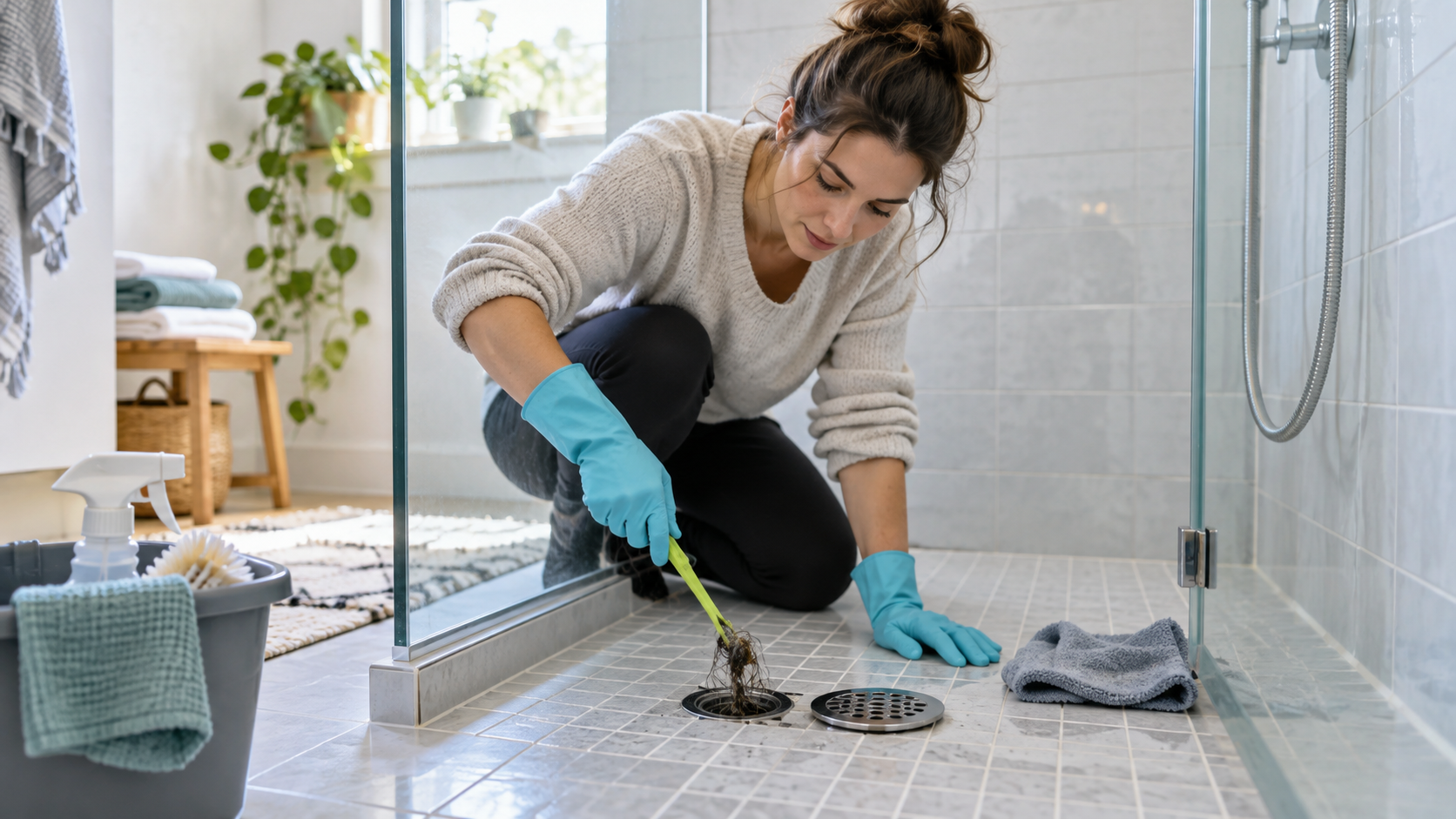
You step into the shower, turn on the water, and a few minutes later you notice it: water is gathering around your feet instead of disappearing down the drain.
Not exactly the relaxing shower you had in mind.
A slow shower drain is one of those household problems that usually starts small. The water takes an extra few seconds to disappear. Then a few weeks later it takes a minute. Eventually, you are standing in a shallow puddle and wondering whether something unpleasant is growing beneath the drain cover.
Most shower clogs are not mysterious. Hair is the usual suspect. Soap residue, skin oils, mineral deposits, conditioner, shaving products, and general bathroom grime can join the party and turn a loose bundle of hair into a surprisingly stubborn plug.
The good news is that many shower drains can be cleaned without harsh chemicals or complicated plumbing work.
The trick is starting with the simplest method and moving gradually to more involved options. Pull out what you can reach first. Flush the drain. Use a small drain tool if necessary. Save stronger methods for clogs that actually need them.
That approach is easier on the plumbing, easier on you, and usually less messy.
Why shower drains clog so easily
Think about everything that goes down a shower drain during an average week.
Loose hair is obvious. But shampoo, conditioner, body oils, dead skin cells, shaving cream, soap, dirt, and tiny fibers also enter the drain.
Individually, most of those materials flow away without much trouble.
The problem starts when hair catches on the drain opening or the inside surface of the pipe. Sticky residue begins coating it. More hair arrives. Then more soap residue.
Before long, you have something that looks less like a plumbing problem and more like a small creature that has been quietly living under the shower.
In homes with hard water, mineral buildup can make the situation worse by narrowing surfaces and giving debris more places to collect.
Signs your shower drain needs cleaning
You do not have to wait until the shower is completely blocked.
A drain often gives plenty of warning first.
- Water drains more slowly than it used to
- A shallow puddle forms while the shower is running
- You can see hair collected beneath the drain cover
- The drain makes gurgling sounds
- An unpleasant odor comes from the drain
- Water briefly backs up before draining
- You need to clean standing water from the shower floor after use
- The drain repeatedly slows down after temporary fixes
The sooner you deal with a slow drain, the easier the job usually is.
A thin layer of hair near the opening can be removed in minutes. A dense clog farther down the line may need a snake or professional cleaning.
What you need before you start
You probably already have several useful tools at home.
You do not need every item for every job. Start with basic supplies and add tools only if the clog refuses to move.
- Rubber or disposable gloves
- Flashlight
- Screwdriver that fits the drain cover
- Needle-nose pliers
- Plastic barbed drain-cleaning tool
- Small bucket or trash bag
- Old paper towels or rags
- Plunger suitable for flat drains
- Hand-operated drain snake
- Hot tap water
- Dish soap for greasy or product-heavy residue
And yes, gloves are worth it.
The material that comes out of a shower drain is rarely the kind of thing you want wrapped around your fingers.
Start by removing the drain cover
Some shower drain covers lift out. Others twist. Many are held in place with one or more screws.
Look carefully before forcing anything.
If screws are present, remove them and place them somewhere safe. Shower screws have a strange talent for disappearing at exactly the wrong moment.
Lift the cover and shine a flashlight into the drain.
If you see a wad of hair close to the top, you may have already found most of the problem.
The easiest method: remove visible hair by hand or tool
For many slow shower drains, physical removal is the most effective first step.
Use needle-nose pliers or a small plastic drain-cleaning strip to grab visible hair.
Pull slowly.
If the clog has built up over time, one small piece may turn into a surprisingly long strand of hair and soap residue.
Keep pulling until the tool comes back mostly clean.
Place everything directly into a trash bag or on disposable paper towels. Do not put the removed hair into the toilet. You just worked hard to get it out of one drain; there is no reason to send it into another plumbing fixture.
How to use a plastic drain-cleaning tool
Those inexpensive flexible plastic strips with small barbs along the sides are useful for shower drains because they grab hair without requiring much plumbing experience.
Insert the tool gently into the drain.
Move it slightly up and down, then pull it back out.
Expect resistance if hair is wrapped around the tool.
Clean the tool and repeat several times.
Do not force a flimsy plastic strip deeply into a drain if it feels stuck. Breaking the tool inside the pipe gives you a second problem, which is not the goal here.
Flush the drain after removing the hair
Once the visible material is gone, run hot tap water through the drain.
Hot water can help move softened soap residue and loose debris farther through the system.
There is usually no need to pour a kettle of aggressively boiling water into the drain.
Very hot water can be unnecessary, and plumbing systems contain different pipe materials, joints, finishes, and seals. Hot water from the tap is a gentler choice for routine cleaning.
Run the shower for a minute or two and watch how quickly the water disappears.
If drainage is back to normal, you may be finished.
Can dish soap help clean a shower drain?
Sometimes.
Dish soap will not dissolve a large hair clog. But it can help loosen greasy body-product residue and soap buildup surrounding debris.
Add a small amount of dish soap, let it move into the drain, then flush with hot tap water.
This works better as a maintenance step or after the main hair clog has already been physically removed.
Think of it as cleanup, not heavy-duty clog removal.
What about baking soda and vinegar?
This is probably the most famous homemade drain-cleaning trick on the internet.
You pour baking soda into the drain, follow it with vinegar, watch the dramatic foam, and feel like chemistry is doing something important.
But there is a nuance.
Baking soda is alkaline. Vinegar is acidic. When mixed, they react and largely neutralize one another while producing carbon dioxide bubbles.
The bubbling action may loosen some light debris near the drain opening, and the method can be useful for mild odor or surface cleaning. But it is not a powerful solution for a thick hair clog.
If you can physically remove the hair, that is usually much more effective.
So baking soda and vinegar are fine as a gentle maintenance option, but do not expect the foam to eat through a dense plug of hair.
How to use a plunger on a shower drain
If the clog is deeper and you cannot reach it with a small plastic tool, a plunger may help.
Remove the drain cover if necessary.
Add enough water to cover the lip of the plunger so it can form a seal.
Place the plunger directly over the drain and make several firm, controlled plunges.
The idea is not simply to push the clog farther down.
The changing pressure can loosen material and move it enough for water to pass.
After plunging, run water and see whether drainage improves.
Using a hand drain snake for a stubborn clog
A hand-operated drain snake reaches farther than a plastic hair tool.
It is useful when the clog sits deeper inside the branch drain.
Feed the cable slowly into the drain while turning the handle.
You may feel resistance when the cable reaches a bend. That does not automatically mean you found the clog.
Continue carefully.
When you feel a different kind of resistance, rotate the cable and work it through the obstruction.
Then slowly pull the cable back.
You may bring hair and debris with it.
Clean the cable as you go and avoid letting dirty material scrape across finished shower surfaces.
Which shower drain cleaning method should you try?
| Problem | Best first step | Why it works |
|---|---|---|
| Hair visible near opening | Pliers or plastic drain tool | Removes the blockage directly |
| Slow drain with light residue | Physical cleaning plus hot tap water | Clears debris and flushes loose buildup |
| Mild odor | Clean visible debris and flush the drain | Removes material that can trap odors |
| Clog slightly deeper in pipe | Plunger | Pressure changes may loosen the blockage |
| Deep hair clog | Hand drain snake | Reaches farther into the branch line |
| Drain still blocked after mechanical cleaning | Professional drain service | Problem may be farther down or more complicated |
Should you use chemical drain cleaner?
Chemical drain cleaners are available everywhere in the United States, and the labels make the process look simple.
Pour it in. Wait. Problem gone.
Sometimes it works.
But chemical drain cleaner is not the best first step for a shower clog.
Many shower blockages are made mainly of hair. If you can physically remove the hair, you solve the problem directly without leaving caustic chemicals inside the drain.
Strong drain products can also create a hazard for anyone who later opens the drain or uses a snake.
If a plumber works on a drain after chemical cleaner has been added, tell them exactly what was poured into it.
That information matters.
Never mix different drain-cleaning chemicals
This part is important.
Do not mix drain cleaner with bleach, ammonia, acids, vinegar, another brand of drain cleaner, or random household cleaning products.
Different chemicals can react and create dangerous heat, splashing, or toxic gases.
If you already poured a chemical product into a blocked drain, do not start adding other substances because the first one did not work quickly enough.
Follow the product label and keep the bathroom ventilated as directed.
What if there is standing water in the shower?
If the drain is fully blocked, you may have several inches of standing water.
Remove enough water with a cup or small container to access the drain.
Then begin with mechanical removal.
If no chemicals have been added, you can safely inspect the opening and use a hair tool or plunger.
If someone has already poured chemical drain cleaner into the standing water, avoid reaching into it.
Wear appropriate protection and follow the product’s safety instructions.
How to clean a shower drain that smells bad
A shower drain odor does not automatically mean there is a clog, though the two often happen together.
Hair, soap residue, skin oils, and other organic material can collect inside the drain and develop an unpleasant smell.
Start by removing the drain cover and cleaning visible debris.
Wash the drain cover separately.
Then flush the drain with hot tap water.
If the shower is rarely used, another possibility is that water in the trap has evaporated.
A plumbing trap normally holds water, creating a barrier between the bathroom and sewer gases.
Running water for a short time may refill a dry trap.
If a strong sewer odor continues despite regular use and a clean drain, the issue deserves further investigation.
Hair clogs versus soap buildup
Hair and soap residue behave differently.
Hair creates a physical web inside the drain.
Soap and body-product residue can make that web sticky and dense.
This is why simply pouring hot water down a severely clogged shower usually does not solve much.
The hair itself is still there.
Remove the physical obstruction first. Then flush away residue.
It is the same idea as cleaning a hairbrush. You pull the hair out before washing the brush.
How often should you clean a shower drain?
There is no fixed schedule that fits every home.
A household with four people with long hair may need drain maintenance far more often than a one-person home.
Watch the drainage speed.
If you notice water taking longer to disappear, clean the drain before it becomes fully blocked.
For many households, checking for visible hair every few weeks is enough to prevent major buildup.
How to prevent shower drain clogs
Prevention is much easier than pulling a large, wet hair clog out of a pipe.
A simple hair catcher can make a surprisingly big difference.
- Install a removable hair catcher over or inside the drain
- Clean the hair catcher regularly
- Remove visible hair after showering
- Do not rinse large amounts of shaved hair directly into the drain
- Flush the drain with hot tap water periodically
- Clean the drain cover before residue becomes thick
- Deal with slow drainage early instead of waiting for a full blockage
- Keep excessive oils and heavy products out of the drain when practical
A hair catcher may not be beautiful, but neither is standing ankle-deep in yesterday’s shower water.
Does the type of shower drain matter?
Yes.
Traditional round shower drains, linear drains, tile-in drains, and tub-shower combination drains can have different covers and access methods.
Linear drains often have removable channels or strainers that need regular cleaning.
Some modern drains collect a surprising amount of hair beneath a decorative cover even when the drain appears clean from above.
If you have a specialty drain, check how the cover is intended to be removed before prying on it.
How to clean a linear shower drain
Linear drains are popular in modern walk-in showers.
They look sleek, but they still collect hair.
Lift the removable cover according to the drain design.
Many have a small basket or hair strainer underneath.
Remove the strainer, empty the debris into the trash, wash the removable parts, and clean residue from the drain channel.
Then reinstall everything in the correct position.
Regular cleaning matters because the long channel can collect soap film even when the actual outlet remains open.
Can hard water clog a shower drain?
Hard water alone is usually not responsible for a sudden hair clog.
But mineral deposits can build up on fixtures and pipe surfaces over time.
That rough buildup can contribute to slower flow and give soap residue more places to stick.
If mineral scale is severe throughout the bathroom, the issue may extend beyond a simple drain cleaning.
Why the clog keeps coming back
You clean the drain.
Everything works beautifully for a week.
Then the water starts pooling again.
That usually means one of two things.
Either only part of the clog was removed, or new hair is quickly catching on debris that remains farther down the line.
A drain snake may be needed to clear more of the obstruction.
Repeated clogs can also point to poor drainage slope, pipe damage, heavy buildup, or another plumbing issue beyond the immediate shower drain.
When the problem is not actually in the shower drain
If multiple fixtures drain slowly at the same time, the shower itself may not be the main problem.
Suppose the shower is slow, the toilet gurgles, and the bathroom sink also drains badly.
That pattern can suggest a blockage farther downstream where several fixtures share piping.
A local shower hair clog normally affects the shower.
A larger drain-line problem can affect several fixtures.
That distinction is useful before you spend an afternoon repeatedly cleaning the same drain opening.
What gurgling can tell you
An occasional small sound is not always meaningful.
Persistent gurgling, especially when another fixture is used, can indicate air movement caused by a drainage or venting issue.
If your shower gurgles when the toilet flushes or the washing machine drains, pay attention.
The problem may be farther into the drainage system than a simple hair clog.
What if water backs up into the shower?
This deserves more attention than a normal slow shower drain.
If water or wastewater comes into the shower when a toilet flushes, washing machine empties, or another fixture drains, stop treating it as a simple shower-cleaning job.
The shower is often one of the lowest drain openings in a home, so a larger blockage can show up there first.
A plumber or drain-cleaning professional may need to inspect the shared drain line.
Shower drain cleaning methods compared
| Method | Best for | Main limitation | Skill level |
|---|---|---|---|
| Manual hair removal | Visible shallow clogs | Cannot reach deep obstructions | Easy |
| Plastic drain tool | Hair just below the opening | Limited reach | Easy |
| Hot tap water | Loose soap residue | Does not remove dense hair clogs | Easy |
| Plunger | Moderate localized clogs | May not reach stubborn deep blockages | Easy |
| Hand drain snake | Deeper hair clogs | Requires careful handling | Moderate |
| Chemical drain cleaner | Specific clogs when label permits | Chemical hazards and limited value for some hair clogs | Easy but requires caution |
| Professional drain cleaning | Recurring, deep, or shared-line blockages | Higher cost | Professional |
Can you damage a drain with a snake?
Yes, especially if the tool is used aggressively.
A small hand snake is generally manageable for a homeowner, but forcing it into resistance can damage fittings, scratch surfaces, or cause the cable to become stuck.
Older plumbing deserves extra care.
If the cable refuses to advance, do not treat the handle like gym equipment.
Back it out and reassess.
What if the drain snake will not go farther?
You may be hitting a bend or fitting rather than the clog.
Pull the snake back slightly, rotate it, and try advancing again gently.
If it repeatedly stops in the same place and you cannot move forward without significant force, stop.
A professional has longer equipment and more experience navigating different drain layouts.
Should you use a wet/dry vacuum?
A wet/dry vacuum can sometimes pull loose material from a shower drain if you can create a decent seal around the opening.
Use only a vacuum designed for wet pickup.
Never use a standard household vacuum on standing water.
This technique is optional rather than essential. For most shower hair clogs, a plastic tool or hand snake is simpler.
What not to put down a shower drain
A shower drain is designed for wastewater, not general household disposal.
Avoid intentionally washing down large quantities of hair, waxy products, heavy oils, paint, construction debris, grout residue, plaster, or other materials that can settle or harden inside plumbing.
Renovation debris is especially problematic.
Rinsing tile adhesive or grout tools in the shower may seem convenient for about thirty seconds. The plumbing consequences can last much longer.
What about drain-cleaning enzymes?
Some maintenance products contain enzymes or bacteria intended to break down organic material over time.
They are generally intended for maintenance rather than immediate removal of a severe clog.
Read the label and make sure the product is intended for your plumbing system.
If the shower is already holding several inches of water, mechanical removal is usually the more direct place to start.
Cleaning the drain cover matters too
The cover itself can become coated with conditioner, soap residue, mineral deposits, and hair.
Remove it and wash it separately when possible.
Use a small brush to clean openings and edges.
A clean cover improves water flow into the drain and makes it easier to see when new hair begins accumulating.
How long should a clean shower take to drain?
There is no universal number because drain size, shower design, water flow, and plumbing layout differ.
But water should not steadily build around your feet during normal use.
After the shower is turned off, the remaining surface water should disappear without leaving a persistent pool over the drain.
If the shower consistently cannot keep up with the showerhead’s flow, the drain deserves attention.
When to stop DIY cleaning and call a plumber
Basic shower drain cleaning is a reasonable homeowner task.
There is also a point where continuing to poke at the drain becomes less useful.
Consider professional help when the drain remains blocked after hair removal and basic snaking, when several fixtures are slow, when sewage backs up, when the clog returns repeatedly, or when you suspect damaged plumbing.
A professional may use longer cables, powered drain machines, inspection cameras, or other equipment depending on the problem.
Could the shower drain pipe be damaged?
It is possible, though ordinary hair clogs are far more common.
Older pipes can corrode. Connections can shift. Poorly installed lines can have drainage problems. Renovation work can introduce debris or damage.
If a drain becomes slow again almost immediately after thorough professional cleaning, the plumbing layout or pipe condition may need evaluation.
FAQ about how to clean a shower drain
What is the easiest way to clean a shower drain?
Remove the drain cover and pull out visible hair with gloves, pliers, or a plastic barbed drain tool. Then flush the drain with hot tap water. Hair removal solves many common shower clogs without stronger products.
What dissolves hair in a shower drain?
Some commercial drain cleaners are formulated to break down organic material such as hair, but mechanical removal is often faster and avoids leaving strong chemicals in the drain. Never mix different drain-cleaning products.
Does baking soda and vinegar unclog a shower drain?
The mixture creates bubbling that may loosen light residue, but baking soda and vinegar largely neutralize each other. It is not usually strong enough to remove a dense hair clog. Physical hair removal is more reliable.
Can I pour boiling water down a shower drain?
For routine cleaning, hot tap water is usually enough. Extremely hot or boiling water is not necessary and may not be suitable for every pipe, joint, seal, or shower material.
Why does my shower drain keep clogging?
Hair may be collecting farther down the pipe, or only part of the original clog may have been removed. Recurring problems can also come from heavy buildup, drainage design issues, or a blockage in a shared line.
How often should I remove hair from the shower drain?
Check it whenever drainage begins slowing. Homes where several people have long hair may benefit from cleaning the drain or hair catcher every few weeks before a larger clog develops.
When should I call a plumber for a shower clog?
Call a professional if several fixtures are draining slowly, wastewater backs up into the shower, a hand snake cannot clear the blockage, the clog returns quickly, or you suspect a deeper drain-line problem.
Conclusion: Start With the Hair, Not the Chemicals
When a shower drain slows down, the temptation is to reach immediately for the strongest-looking bottle in the cleaning aisle.
Usually, there is a simpler place to begin.
Take off the drain cover.
Look inside.
And remove the hair.
It is not glamorous work. Nobody is going to post a beautiful before-and-after photo of the thing you pull out of the pipe.
But for ordinary shower clogs, physical removal is often the most direct solution.
A small plastic drain tool can pull out material that hot water, vinegar, bubbles, and wishful thinking will never move.
After that, flush the drain and clean the cover.
If water starts disappearing quickly again, you are done.
If it remains slow, move one step deeper.
Try a plunger.
Use a hand snake carefully.
Watch what happens when other fixtures drain.
The pattern tells you something.
A shower that drains slowly by itself probably has a local issue.
A shower that fills with water when the washing machine empties is telling a very different story.
That is when it makes sense to stop treating the problem as a little bundle of hair beneath the drain cover.
Safety matters as well.
If you use a chemical drain product, read the label and treat it like the strong chemical it is.
Do not mix it with bleach.
Do not follow it with vinegar.
Do not pour another drain cleaner on top because the first product did not work in five minutes.
And if a plumber later works on the line, tell them what has already been poured into it.
That small piece of information can protect the person working on your drain.
For routine maintenance, you usually do not need much chemistry at all.
A hair catcher does more useful work than most people expect.
Clean it regularly.
Pull loose hair from the shower instead of rinsing it into the drain.
If the water begins slowing, deal with it early.
A two-minute cleaning today can prevent a completely blocked shower next month.
And pay attention to odors.
A dirty drain can smell because organic residue is collecting inside it.
Cleaning the cover and removing hair may solve the issue.
But a strong sewer odor that continues in a regularly used shower deserves a different kind of attention.
The water trap and drainage system are meant to keep sewer gases out of the bathroom.
Persistent odor can signal a problem beyond ordinary drain cleaning.
The same goes for repeated clogs.
If you thoroughly clean the drain and it blocks again almost immediately, the solution is not necessarily to clean it harder.
The obstruction may be farther down.
There may be buildup along the pipe.
Several fixtures may share a blocked branch.
Or the plumbing itself may have a problem.
Knowing when to stop is part of good DIY work.
You do not have to personally defeat every pipe in the house.
There is also no prize for forcing a drain snake until it gets stuck somewhere under the bathroom floor.
If the tool will not move, pull it back.
If sewage appears, stop.
If several drains are affected, look at the bigger picture.
If the shower works perfectly after a handful of hair comes out, celebrate the easy win.
The best drain-cleaning routine is boring.
Catch the hair.
Clean the cover.
Flush away light residue.
Respond when drainage starts slowing.
That is pretty much it.
And there is something satisfying about turning on the shower afterward and watching the water disappear instantly instead of slowly rising around your ankles.
No dramatic chemicals.
No emergency plumber.
No mysterious puddle.
Just a clean drain doing the one job you expect it to do.

Leave a Reply