

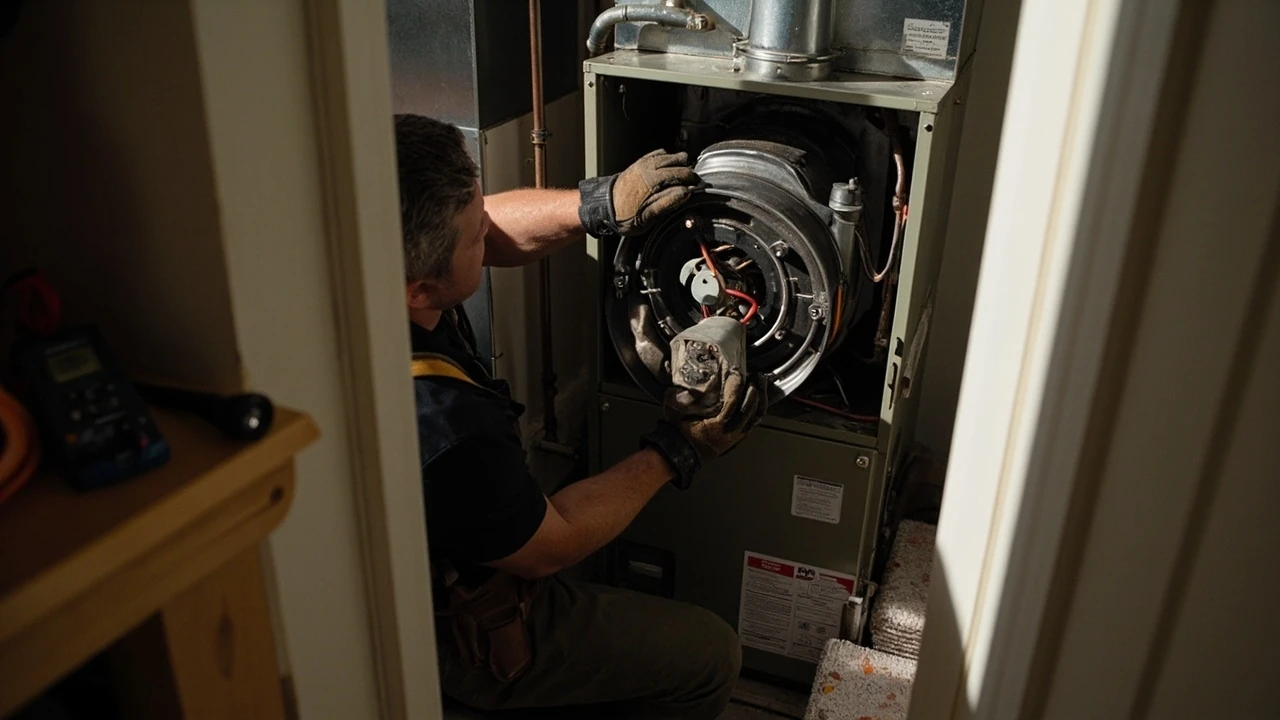
Blower motor replacement cost: what U.S. homeowners actually pay
A homeowner in Ohio opens the closet door, hears the furnace fire up, then notices something wrong: weak airflow from the vents, a burning smell, or no air moving at all even though the burner is running. The blower assembly is the part that pushes heated or cooled air through the ductwork, and when it fails, the rest of the system cannot do its job. Most full-service quotes for a blower motor replacement cost land somewhere between $300 and $900 for parts and labor, but the real number depends on motor type, accessibility, and whether related parts also need attention.
This guide walks through what typically drives the price, how PSC and ECM motors differ, what a technician actually does during the job, and where homeowners can save without cutting corners. The goal is to help you read a quote with confidence and avoid paying for the wrong repair.
How much does blower motor replacement cost on average?
Most U.S. homeowners see a complete blower motor replacement fall into a fairly predictable range, but the spread inside that range is wide. The part alone varies from roughly $50 for a basic single-speed motor to $450 or more for a variable-speed ECM motor, and labor often matches or exceeds the part cost on a straightforward swap.
Industry pricing summaries put the typical total somewhere between $300 and $900 for a standard residential furnace. Simpler jobs in easy-to-access locations trend to the lower end, while ECM replacements in attics, tight closets, or packed mechanical rooms push to the upper end. Emergency or after-hours calls add a premium that can double labor on some quotes.
When you receive a written estimate, it should break the job into parts, labor hours, and any add-on items such as a new capacitor, control module, or mounting hardware. A quote that lumps everything into a single number is harder to evaluate and harder to compare across contractors.
What the blower motor actually does in your system
The blower motor sits inside the air handler or furnace cabinet and drives a fan wheel that pulls air across the heat exchanger in heating mode or across the evaporator coil in cooling mode. Without it, the heat exchanger gets hot but the air never moves, which is why a failing blower can leave some rooms warm while others stay cold, even with the thermostat calling for heat.
Because the motor runs on almost every heating and cooling cycle, it tends to log more operating hours than the compressor or the inducer motor. That constant duty, combined with dust, vibration, and heat, is why it is one of the more common components to wear out in a residential HVAC system.
Modern systems often pair the blower with a control board that ramps speed up and down based on demand. On those systems, a motor failure can be triggered by the board, the motor itself, or the wiring between them, which is why good diagnostics matter before any part is replaced.
Common symptoms that point to the blower motor
Weak airflow is the most common early sign. Rooms far from the air handler feel cooler in winter or warmer in summer than rooms nearby, and the supply registers feel anemic even when the fan is set to “on.”
Unusual sounds are another giveaway. A failing motor often produces a hum that does not turn into airflow, a high-pitched squeal as the bearings wear, or a repeated clicking as the control board tries to start a motor that will not spin. Any smell of hot plastic or ozone is a red flag that deserves an immediate shutoff and a service call.
Other clues include a furnace that fires the burners but never delivers warm air, a system that short-cycles, or a blower that runs only on the highest setting. None of these by themselves confirm a motor failure, because a weak capacitor, a bad relay on the control board, or a stuck relay can mimic the same symptoms, which is one reason a real diagnostic matters.
What drives the final price: PSC vs ECM, access, and add-on parts
Most blower motor replacement pricing comes down to a few predictable buckets. Understanding each one makes it easier to read a quote and push back on items that look padded.
- Motor type (PSC vs ECM). PSC motors are the simpler, lower-cost option and have been used for decades. ECM motors are electronically commutated, more efficient, and common in newer variable-speed systems, but they cost more to replace, especially when the control module is integrated with the motor.
- Brand and part matching. Some manufacturers only warranty the system when an OEM motor or a specific replacement kit is used. Universal aftermarket motors exist, but they are not always a safe choice on systems with proprietary controls.
- Accessibility. A blower that lives behind a removable panel in a basement utility room is a one-hour job. The same motor in an attic, a tight closet, or a packed mechanical room can stretch to three or four hours, and that labor shows up in the quote.
- Add-on parts. PSC systems often pair the motor with a run capacitor that ages alongside it. ECM systems may need a new control module or a programmed motor assembly. Mounting hardware, vibration grommets, and wiring repairs are smaller items that can add up.
- Related damage. A clogged filter, a caked-on blower wheel, or overheated wiring all add labor. A technician who discovers a blower wheel packed with dust will usually recommend cleaning it during the same visit, and the time for that ends up on the invoice.
When a quote looks high, it is usually labor time, motor type, or extra parts driving it, not the price of the motor itself. Asking the technician to separate those three buckets on the estimate is a fast way to see where the money is going.
PSC motors versus ECM motors at a glance
The two motor families you will see on most replacement quotes behave differently, and that difference is the single biggest reason a quote for one home can be hundreds of dollars higher than a quote for a similar home across the street.
| Factor | PSC motor | ECM motor |
|---|---|---|
| Typical part cost | $50 to $250 | $200 to $450 or more |
| Speed control | Fixed speeds set by relay taps | Variable speed controlled by a module |
| Efficiency | Standard | Generally higher, especially at part load |
| Common in | Older and entry-level systems | Newer, higher-efficiency systems |
| Pair parts to watch | Run capacitor, relays | Control module, programmed motor assembly |
| Diagnostic notes | A weak capacitor can mimic motor failure | Board faults can mimic motor failure |
As a general rule, many older or single-stage furnaces use PSC motors, while newer variable-speed systems often use ECM motors. A technician can confirm what your system uses before any parts are ordered, and that confirmation is worth getting in writing on the estimate.
What a professional replacement actually includes
A real blower motor replacement is more than a parts swap. The technician’s job is to confirm the diagnosis, install the correct motor, verify the system is safe, and leave the airflow where it should be.
- Confirming the motor is the problem by testing the capacitor, checking the control board for fault codes, and reading voltage at the motor leads.
- Shutting down power at the disconnect and the breaker, then verifying zero voltage with a meter before opening the cabinet.
- Removing the blower assembly, labeling wires, and pulling the motor out of the housing without damaging the blower wheel or the heat exchanger.
- Installing the new motor, making sure the motor is properly seated in its mounting bracket, and reinstalling the blower wheel on the shaft with the correct alignment.
- Reconnecting the wiring, reinstalling the door, restoring power, and running the system through a full heating or cooling cycle to confirm airflow and temperature rise.
- Cleaning the blower wheel and the housing if access allows, since a clean wheel reduces strain on the new motor.
A good installer charges for correct diagnosis and safe, tested operation, not just the part swap. That difference is what separates a $300 visit from a $900 visit, and it is usually worth the price when the system is a complex variable-speed model.
Warranty coverage and what homeowners often misunderstand
Warranties for blower motor replacement tend to follow a familiar structure, but the details catch many homeowners off guard. Knowing the difference between parts coverage and labor coverage is the fastest way to avoid an unexpected bill.
| Coverage type | What it usually pays for | What it usually does not pay for |
|---|---|---|
| Manufacturer parts warranty | Cost of the failed motor or module if it is a covered defect | Labor, diagnostic fees, related parts |
| Installer labor warranty | Labor on the workmanship for a set period, often one year | Replacement parts, Acts of God, lack of maintenance |
| Extended labor plan (optional) | Labor on covered repairs beyond the standard warranty | Parts, maintenance visits, pre-existing conditions |
| Home warranty (separate product) | Varies; many cover the motor as a mechanical component | Pre-existing conditions, code upgrades, permit fees |
The most common surprise is that even when the motor itself is covered, labor is commonly out of pocket unless the homeowner has labor coverage from the installer, an extended plan, or a home warranty. Always ask, in writing, whether the quote includes both parts and labor, and whether the part is being supplied through a manufacturer channel that preserves the parts warranty.
Cost factors that push a quote higher or lower
Two homes with the same furnace model can see very different quotes because the surrounding conditions change the job. The list below captures the variables that show up on real estimates.
- Location in the home. Attics, crawl spaces, and second-floor closets are slower and riskier than basement or garage installs.
- Time of year and time of day. Winter and summer peaks push demand for service, and after-hours or weekend calls add premium rates.
- System age and code compliance. Older systems may need updated disconnects, whip kits, or condensate handling to meet current code when an HVAC company opens the cabinet.
- Filter and blower wheel condition. A heavily clogged filter or a caked blower wheel adds cleaning time and may signal a recurring problem the technician will flag.
- Duct condition. Significant leaks or crushed runs reduce delivered airflow and can shorten motor life, which is why some quotes include duct sealing as a recommendation.
DIY versus hiring a professional
Handy homeowners can purchase a motor for $50 to $250 and save on labor, but the savings come with real risks. The motor has to be an exact match for the voltage, horsepower, rotation, and shaft length, and on ECM systems the new motor or module often needs to be programmed to the specific furnace. Incorrect installation can void the manufacturer warranty, leave the system unsafe, or push the motor out of alignment and shorten its life.
A professional replacement brings diagnostic tools, the ability to test the system under load, and a paper trail that protects the warranty. For most homeowners, the labor savings on a PSC replacement may be worth the risk if the cabinet is easy to open, the filter has been kept clean, and the failure is clearly mechanical. For ECM systems, attic installs, or any job that involves a control board, a licensed HVAC technician is the safer bet.
Ways to reduce blower motor replacement cost without cutting corners
The cheapest way to pay for a blower motor replacement is to avoid needing one. The next cheapest is to keep the failure mode simple. A few habits move the odds in your favor.
- Confirm the diagnosis. Ask the technician what test results point to the motor rather than the capacitor, control board, or thermostat. A weak capacitor on a PSC system can mimic motor failure.
- Replace the capacitor when appropriate. If the system uses a PSC motor and the run capacitor is weak or near end of life, replacing it during the same visit can prevent early motor stress.
- Fix the root cause. Restricted airflow from a clogged filter or a dirty blower wheel is a common contributor to motor overheating. Cleaning the wheel and the housing during the same service visit reduces the chance of a repeat failure.
- Keep filter changes consistent. A clean filter maintains airflow and reduces strain on the blower. MERV 8, MERV 11, and MERV 13 ratings all protect the motor as long as the filter is changed on schedule.
- Avoid emergency rates when you can. If the system is safe to leave off overnight and outdoor temperatures are not extreme, scheduled service during regular business hours is usually cheaper than a same-day emergency call.
- Ask about repair versus replace. If the furnace is near the end of its expected life and has multiple major issues, putting money toward a full system plan can make more sense than a single component repair.
The best savings usually come from correct diagnosis and preventing the next failure, not from choosing the cheapest motor on the shelf.
How to read a written estimate
A good estimate answers four questions before you sign it. If any of these are missing, ask the contractor to add them.
- What is being replaced? The line item should name the motor type, part number if available, and whether the capacitor, control module, or wheel is included.
- What is the labor scope? Hours or a flat rate, plus what the technician is expected to do during the visit, such as diagnostics, cleaning, and post-install testing.
- What does the warranty cover? Parts coverage from the manufacturer, labor coverage from the installer, and any extended plan options.
- What conditions could change the price? Code upgrades, duct repairs, electrical work, or additional parts discovered during the job.
Estimates that spell out these four areas are easier to compare across two or three contractors, and they reduce the chance of mid-job surprise charges.
Questions to ask before approving the work
Homeowners who ask the same set of questions on every quote tend to get more consistent results. The list below covers the practical questions a service manager should be able to answer without hesitation.
- How did you confirm the motor is the failed component and not the capacitor, board, or thermostat?
- Is the replacement motor OEM, and will using it keep the manufacturer warranty intact?
- Does the quote include the capacitor, module, mounting hardware, and any required programming?
- How long is the labor warranty, and what does it cover?
- Will you clean the blower wheel and verify the temperature rise across the heat exchanger before leaving?
- If the system is in an attic or tight closet, what is the additional labor for safe access?
- Is there a less expensive repair that would restore safe operation, and why is a full replacement recommended instead?
After the install: protecting the new motor
Once the motor is replaced, a few habits help protect the investment and keep the next replacement further out. None of these are expensive, and most are already part of a reasonable HVAC maintenance plan.
- Replace the filter on the schedule that matches the filter type and the home’s dust load, usually every one to three months.
- Keep return air grilles clear of furniture, rugs, and drapes so the system is not pulling air through a restriction.
- Schedule a yearly HVAC tune-up so a technician can spot a worn capacitor, a loose mounting, or a dirty wheel before it kills a motor.
- Listen for changes. A new hum, a rattle, or a squeal that was not there a month ago is worth a service call before it turns into another motor failure.
- Watch the thermostat. Short cycling or long run times with poor temperature rise are signs of airflow problems that the new motor will not fix on its own.
When blower motor replacement cost is not the right question
There are situations where spending money on a blower motor is the wrong call. If the furnace is past 15 years old, the heat exchanger is cracked, the control board is also failing, and the system uses R-22 refrigerant on the cooling side, a full system replacement often costs less over the next decade than a series of component repairs. A good contractor will tell you when that is the case, even if it means turning down a service call.
The reverse is also true. On a system that is otherwise sound, a blower motor replacement is usually far cheaper than a new furnace, and it can extend the life of the existing equipment by several years. The decision is about the total cost of ownership, not just the line item on the quote.
Putting the numbers together
The simplest way to think about the price is in three layers: the part, the labor, and the add-ons. A typical PSC replacement in a basement utility room might break out as a $150 motor, two hours of labor, and a $40 capacitor, while an ECM replacement in an attic could break out as a $400 motor assembly, four hours of labor, and a $150 module. Both are normal, but they are not the same job, and a single number on a quote hides that detail.
For most homeowners, the blower motor replacement cost lands in the $300 to $900 range when parts and labor are bundled, with simpler jobs on the low end and complex ECM or hard-to-access jobs on the high end. The right next step is a written estimate that names the motor, the labor, the warranty, and the conditions that could change the price.
Frequently asked questions
What is the average blower motor replacement cost for a furnace?
Most full-service quotes fall between $300 and $900 for parts and labor on a residential furnace. Simpler PSC jobs in easy-to-access locations trend to the low end, while ECM replacements or jobs in attics, tight closets, or packed mechanical rooms push to the high end. Emergency or after-hours calls add a premium that can increase labor significantly.
Why does an ECM blower motor cost more than a PSC motor?
ECM motors are electronically commutated and use a control module to vary speed based on demand, which makes them more efficient but more complex to manufacture and replace. PSC motors use a fixed-speed design with a simple run capacitor, and they have been produced in high volumes for decades, so the parts are cheaper and more widely available.
Can a dirty air filter really cause a blower motor to fail?
It can contribute. A clogged filter restricts airflow, which makes the blower work harder and run hotter. That extra heat and strain can shorten motor life, especially on systems that already have marginal airflow. Regular filter changes are one of the cheapest ways to protect the motor, and a clean filter also helps the rest of the system run closer to its rated efficiency.
How do I know the motor is the problem and not the capacitor or control board?
Ask the technician what test results point to the motor. On PSC systems, a weak capacitor can mimic motor failure, and on ECM systems, a board fault can look the same. A good diagnostic includes a capacitor test, a voltage check at the motor leads, and a review of any fault codes stored on the control board before any parts are ordered.
Will my manufacturer warranty cover the blower motor replacement cost?
Often, but only partially. Many manufacturer warranties cover the cost of the failed part if it is a covered defect, but they do not cover labor. Labor coverage usually comes from the installer’s labor warranty, an extended service plan, or a separate home warranty. Always ask, in writing, whether the quote includes both parts and labor.
Is it worth replacing the capacitor at the same time as the motor?
Often, yes, especially on PSC systems where the capacitor is paired with the motor. A capacitor that is weak or near the end of its life can stress the new motor and shorten its service life. Replacing both at the same visit is a small added cost that reduces the risk of an early repeat failure.
How long should a blower motor last after replacement?
A properly installed motor in a well-maintained system often lasts 10 to 20 years, with PSC motors at the longer end and ECM motors at the shorter end of that range. Filter changes, annual tune-ups, and clean blower wheels are the biggest factors in pushing the replacement date further out.
Can I replace the blower motor myself to save on labor?
It is possible on simple PSC systems in easy-to-access locations, but the savings come with real risks. The motor has to match the voltage, horsepower, rotation, and shaft length, and ECM systems often need programming that requires specialized tools. Incorrect installation can void the manufacturer warranty and create safety issues, so most homeowners are better off hiring a licensed HVAC technician for this job.
What questions should I ask the technician before approving the work?
Ask how the motor failure was confirmed, whether the replacement part is OEM, what the parts and labor warranty covers, whether related parts like a capacitor or module are included, and what conditions could change the price on the final invoice. A contractor who answers those questions clearly on the estimate is usually a contractor who will do the same on the job.
When does it make more sense to replace the whole system instead of the blower motor?
If the furnace is past 15 years old, the heat exchanger is cracked, the control board is also failing, and the cooling side uses outdated refrigerant, a full system replacement often makes more financial sense than a single component repair. A good contractor will walk through the numbers, including expected future repairs, before recommending either path.

Leave a Reply