

Bat removal: what U.S. homeowners actually need to know
A scratching sound above the ceiling at dusk, a faint ammonia smell in the attic, or a single bat swooping through the living room at sundown is often the first real sign that a colony has moved in. In much of the United States, bats are the most common long-term wildlife tenants in attics, wall voids, and barns, and they tend to stay year after year once they find a safe roost. The good news is that bats are protected wildlife in nearly every state, so the answer is almost never poison or a trap. The practical answer is a careful, legal process called exclusion, paired with sealing the entry points and cleaning up any guano left behind.
This guide walks through how bat removal actually works for a U.S. homeowner, from the first signs of an infestation to the final cleanup, with a focus on what you can legally do yourself, what you should leave to a licensed wildlife control specialist, and how to keep the colony from coming back next season. Because bat laws vary by state and sometimes by county, the goal here is to give you a reliable framework you can adapt to your local rules, not to replace a phone call to your state wildlife agency or a local professional.
Why bats end up in homes in the first place
Bats are not trying to be pests. They are looking for the same things homeowners want: warmth, shelter, and a safe place to raise their young. A colonial maternity roost in an attic can hold dozens to several hundred female bats, all packed into a space the size of a few ceiling joists. Once a colony establishes a roost, the same animals tend to return to it year after year, which is why a one-time eviction without sealing the entry points rarely solves the problem.
Most U.S. bat species are insectivores, and a small colony can eat a startling number of mosquitoes, moths, and beetles in a single summer night. That ecological role is exactly why they are protected. Killing bats, poisoning them, or using terminal traps is illegal in most jurisdictions and can also leave behind sick animals and a much worse cleanup problem than the original colony.
Common entry points on a typical home
Bats do not chew their way in the way rodents do. They squeeze through gaps as small as three-eighths of an inch, which is roughly the diameter of a pencil. On a typical house, the most common bat entry points include:
- Loose or missing trim boards along the roofline and fascia
- Unscreened gable vents and ridge vents
- Cracks around plumbing stacks, chimney flashing, and attic fans
- Warped or missing soffit panels
- Openings where siding meets the roof or where dormers meet the wall
- Loose utility penetrations for wires, pipes, or satellite mounts
- Damaged or missing chimney caps on older masonry chimneys
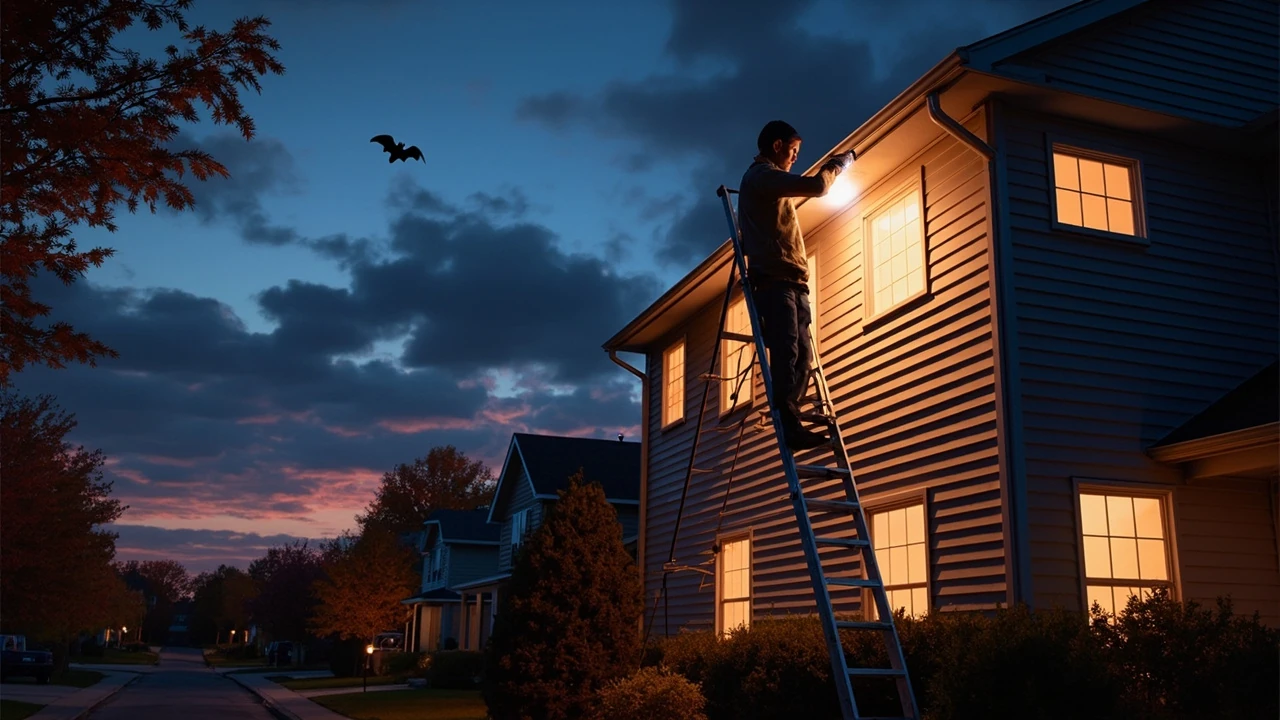
If you watch the home at dusk on a warm summer evening, you can often see bats streaming out of a single small gap. That “emergence” is the single most useful diagnostic tool a homeowner has, because it tells you exactly where to focus the eventual exclusion work.
Signs that bats have moved in
Bats are quiet, fast, and mostly active after dark, so most infestations are first noticed by smell, sound, or visible droppings rather than by seeing the animals themselves. A few signs tend to show up before the homeowner ever sees a bat indoors.
Sounds and smells in the attic or walls
Light scratching, chirping, or high-pitched squeaking above the ceiling, especially in the half hour after sunset, is a strong signal. Bats also produce a distinct musky, ammonia-like odor from urine and guano that builds up over a season. In a confined attic, that smell can work its way down into living spaces, particularly on hot days when the attic heats up.
Visible droppings and staining
Bat guano looks different from mouse droppings. It tends to be more crumbly, often contains shiny insect parts, and accumulates in piles below roosting spots rather than scattered randomly. You may also see brown or blackish staining around a gap where bats repeatedly squeeze in and out, caused by body oils rubbing off on the surface over time.
Live bat sightings inside the living space
A single bat flying through a room at dusk is often a young bat that has gotten lost and slipped out of the wall cavity through a gap around a light fixture or a return air grille. One stray bat does not mean you have a colony, but it does mean there is a gap somewhere in the building envelope worth investigating.
| Sign | What it usually means | Where to look |
|---|---|---|
| Dusk emergence of small flying mammals | Active bat colony roosting in the structure | Roofline, gable vents, soffit, chimney |
| Scratching or chirping at night | Bats moving in and out of a roost | Attic, wall voids above living space |
| Crumbly droppings with insect parts | Bat guano accumulating under a roost | Attic floor, insulation, window sills below entry |
| Ammonia or musky smell in the attic | Long-term roost with urine buildup | Attic, around dormers, above ceilings |
| Brown staining around a gap | Repeated bat entry over many weeks | Roof edges, vent covers, utility penetrations |
| Single bat indoors at dusk | Stray bat lost from a wall cavity | Around light fixtures, ceiling fans, return air grilles |
Legal protection and why it matters for your plan
In the United States, bats are protected at multiple levels. Many common species are listed under state endangered species acts, and several are also protected under federal law. The exact rules differ by state, but the practical effect is the same: you generally cannot kill bats, cannot use poisons, and cannot use exclusion methods that will trap flightless young inside the building.
That last point drives most of the calendar for bat removal. In much of the country, female bats give birth in late spring, and the young are flightless for several weeks. If you seal the entry points while flightless pups are still inside, the parents are locked out, the pups die in the walls or attic, and you are left with an odor and sanitation problem that is much harder to solve than the original colony. State wildlife agencies and most professional wildlife control operators will tell you to plan exclusion for late summer through early fall, when the young are flying and the colony is preparing to leave or hibernate.
Before starting any work, it is worth a short call to your state fish and wildlife agency, or to a licensed local wildlife control operator, to confirm which species are protected in your area, what seasons are off-limits, and whether any permits are needed for exclusion work on a structure. A few minutes of paperwork can prevent a fine and a much more serious problem.
Health and safety considerations before any work begins
Bats are wildlife, and any direct contact carries some risk. The two health concerns that come up most often are rabies and a fungal infection called histoplasmosis, which is associated with accumulated bat guano.
Rabies is the concern most people ask about. The actual percentage of bats that carry rabies is small; public health experts typically estimate it at well under one percent of the wild population, and rabid bats tend to become sluggish rather than aggressive. The risk comes from handling a bat without protection, because a bite can be small enough to miss. For that reason, any bat that can be caught, especially one found on the ground, on a curtain, or in a room with a pet or a sleeping person, should be treated as a potential rabies exposure. The standard advice from public health authorities is to call animal control or a wildlife professional, avoid bare-handed contact, and make sure the bat is available for rabies testing if there was any possible exposure.
Histoplasmosis is a lung infection caused by a fungus that can grow in accumulated bird or bat droppings. The risk is highest in confined spaces with years of guano, like a barn or an attic that has been ignored for a long time. Disturbing dry guano without protection can release spores into the air. Cleanup of significant guano accumulations is the one part of bat removal that is genuinely hazardous, and it is the part most worth leaving to a trained specialist with proper respiratory protection and disposal methods.
Step-by-step: how professional bat removal actually works
The standard professional process is sometimes called “eviction and exclusion.” The idea is to let the bats leave on their own, prevent them from coming back, and then clean up what they left behind. A homeowner with a small, accessible infestation and a good understanding of local rules can do some of this work, but the cleanup step is usually the part that benefits most from professional help.
Step 1: Inspection and identification
A proper inspection starts at dusk, watching the home from a safe distance to count where bats are emerging and roughly how many. Daytime work focuses on the attic and exterior: looking for droppings, staining, and gaps. The goal is to identify every gap larger than about a quarter inch that a bat could use, not just the one you can already see.
Step 2: One-way exclusion devices
Once the active season has reached the point where flightless pups are no longer present, exclusion begins. The standard tool is a one-way valve or net installed over each primary entry point. For additional context, These devices let bats push their way out to feed at night but block re-entry. They are left in place long enough that every bat that left has had a chance to try to come back, which usually means at least several nights of good weather.
Step 3: Sealing entry points
After the exclusion period, every gap is sealed with appropriate materials: metal flashing, hardware cloth with a small mesh, caulk, or expanding foam for small gaps. This is the step that determines whether you actually solve the problem or just delay it. Bats are extremely faithful to a roost site, and any unsealed gap is an invitation to return next year.
Step 4: Cleanup of guano and contaminated insulation
With the animals gone and the gaps sealed, attention turns to what they left behind. Depending on the size of the colony and how long it has been there, this can mean a few buckets of droppings or a full attic insulation replacement. Professionals use respiratory protection, seal off the work area, and dispose of contaminated material as a waste material rather than as ordinary household trash.
Step 5: Monitoring and follow-up
A good wildlife control operator will return to the home during the next emergence season to confirm that no bats are getting out of the new roofline, and to add additional sealing if any backup entry points show up. Homeowners who do the work themselves can do the same with a few evenings of observation at dusk.
| Step | What happens | Typical timing | DIY or pro |
|---|---|---|---|
| Inspection and counting | Identify entry points and estimate colony size | One evening at dusk plus attic visit | DIY with caution |
| One-way exclusion devices | Install valves or netting over active exits | Late summer to early fall in most regions | Often professional |
| Seal all gaps | Close every opening larger than a quarter inch | After exclusion period ends | DIY with guidance |
| Guano cleanup | Remove droppings and contaminated insulation | After sealing, before winter | Strongly recommended professional |
| Follow-up monitoring | Watch for new emergences next season | Next spring and summer | DIY observation |
DIY bat removal versus hiring a wildlife control specialist
There is a real spectrum of work a homeowner can reasonably do, and a real spectrum of work that is genuinely dangerous or legally restricted. Knowing where the line sits in your case matters as much as knowing how to install a one-way valve.
For a small colony in a single-story home with an accessible attic, a homeowner who is comfortable on a ladder, understands the local timing rules, and can watch emergences at dusk can often handle the inspection, the exclusion devices, and the sealing work. The wildlife control operator’s value in that case is the initial assessment, the legal timing, and a quick check that nothing has been missed.
For a large colony, a multi-story home, a roost that has been active for years with significant guano buildup, or a case where bats are entering a wall cavity shared with living space, the case for hiring a professional is much stronger. The work involves heights, confined-space hazards, potential rabies exposure, and a guano cleanup that can release fungal spores. A qualified wildlife control operator will have respirators, HEPA equipment, and disposal arrangements, and will know the local rules well enough to keep the project on the right side of the law.
When interviewing a wildlife control operator, the questions that matter most are whether they are licensed in your state, whether they carry liability insurance, whether they exclude bats humanely rather than trapping or poisoning, and whether they offer a written exclusion plan with a clear warranty period. If a contractor suggests poisons, snap traps, or “fumigation,” that is not a bat removal plan; it is a sign to call someone else.
Costs of bat removal in the United States
Bat removal costs vary widely by region, home size, infestation size, and how much cleanup is needed. The numbers below reflect typical ranges reported by wildlife control operators across the U.S. and are intended as a planning reference rather than a quote. Local pricing will differ, and a written estimate from a licensed operator in your area is the only reliable way to budget for a specific job.
| Service component | Typical U.S. range | What drives the cost |
|---|---|---|
| Initial inspection and estimate | Often free; sometimes a flat fee | Travel distance, home size, attic access |
| Exclusion work (one-way devices and sealing) | Several hundred to a few thousand dollars | Number of entry points, roof height, materials |
| Full attic bat-proofing of a typical home | Often a package price after inspection | Linear feet of roofline, complexity, region |
| Guano cleanup and minor decontamination | Several hundred to over a thousand dollars | Square footage, depth of contamination, disposal |
| Attic insulation replacement after cleanup | Depends on insulation type and area | Square footage, type of insulation, removal |
| Warranty or follow-up visits | Often included for one to several seasons | Contractor policy, level of exclusion work |
For a typical single-family home with a moderate colony, a complete exclusion and cleanup project usually falls somewhere in the low to mid four figures nationally, with regional variation above and below that range. Repeatedly ignoring the problem tends to make the eventual bill higher, not lower, because guano accumulation, odor issues, and structural staining all grow with time.
Preventing bats from coming back
Exclusion without prevention is a temporary fix, because bats are extremely faithful to a successful roost site. The prevention work overlaps heavily with the exclusion work, but a few details are worth thinking about on their own.
- Install or repair chimney caps and vent covers so they are tight and properly screened.
- Replace any missing or damaged soffit panels and roof trim as soon as you notice them, rather than waiting for bat season.
- Use mesh with a small enough opening to block bats on any large gable or ridge vent, not standard window screen.
- Seal utility penetrations with caulk, foam, or metal flashing once the original wiring or piping is in place.
- Keep attic access points tight, and consider adding a light layer of weatherstripping around attic hatches.
- Maintain a reasonable gap between landscaping and the home so branches do not create a launch pad onto the roof.
For homes in bat-heavy regions, a yearly walk-around at the roofline during daylight savings time change is a low-cost habit that catches small problems before they turn into next year’s colony.
Special situations: historic homes, cabins, and barns
Some structures need a more cautious approach. Historic homes, log cabins, and old barns often have construction details that make exclusion more complex: open rafters, hand-split shakes, stone foundations, and rooflines that cannot be tightly sealed without changing the look of the building. In these cases, the work often shifts toward tolerant coexistence where it is safe and legal, paired with targeted exclusion at the points where bats are entering living or work spaces.
If you own a property like this, the practical move is to talk with a wildlife control operator who has experience with older buildings, and to ask your state historic preservation office whether any of the exclusion work needs review. It is also worth thinking about timing: a barn with a long-standing bat population may be more valuable as habitat than as a sealed storage building, and a careful balance is often better than a complete eviction.
What to do if you find a single bat indoors
A lone bat in the living room is one of the most common calls a wildlife control operator gets, and it is also one of the situations where a homeowner can act sensibly without much equipment. The priority is to avoid panic, isolate the bat in one room by closing doors, and give the animal a chance to leave on its own by opening a window to the outside and dimming the lights. In many cases the bat will find its own way out within a few minutes.
If the bat does not leave, or if there was any possible contact with a person or a pet while it was in the room, the safer move is to call animal control or a wildlife professional rather than to handle the bat yourself. They can capture the animal safely and arrange for rabies testing if there was an exposure. Trying to catch a bat with a towel or a box is how most human rabies exposures actually happen, and it is one of the clearer cases where a small professional fee buys real safety.
How to choose a wildlife control specialist
Not every pest control company handles bats, and not every company that handles bats does the work to the same standard. A short list of questions will sort serious operators from less careful ones.
- Are you licensed by the state to perform wildlife removal, including bats specifically?
- Will you perform exclusion rather than trapping or poisoning?
- Can you describe the timing you plan to use, and how you will avoid trapping flightless young?
- What is included in the cleanup, and do you handle guano as a regulated waste?
- Do you carry liability insurance, and can you provide a written exclusion plan?
- What warranty or follow-up do you offer if bats return within the next season or two?
A good operator will answer these questions directly. A vague answer, an aggressive price, or a suggestion to use poisons is a strong reason to get a second opinion.
Frequently asked questions
When is the best time of year to do bat removal?
In most of the United States, late summer through early fall is the safest window. By that point, the pups from the spring maternity roost are flying, and the colony is preparing to leave or hibernate. Sealing entry points earlier in the year risks trapping flightless young inside, which leads to odor and sanitation problems. State wildlife agencies publish regional guidance, and a quick check with your state agency or a local wildlife control operator will confirm the timing for your area.
Is it legal to remove bats myself?
The rules depend on your state and on the species involved, but in most of the country, homeowners are allowed to exclude bats from their own property as long as they do not kill the animals, do not use poisons, and avoid excluding bats during the pup season. The cleanup of significant guano may fall under hazardous-waste rules in some jurisdictions. Calling your state fish and wildlife agency before starting work is the simplest way to stay on the right side of the law.
How much does bat removal cost on average?
For a typical single-family home with a moderate colony, a complete job that includes inspection, exclusion, sealing, and cleanup commonly falls in the low to mid four figures nationally, with significant regional variation. Light infestations on simple homes can cost less, and large colonies with years of guano buildup can cost more. A written estimate from a licensed wildlife control operator in your area is the only reliable number to plan around.
Will bats leave on their own if I just leave them alone?
Not in any practical sense. Bats that find a safe, warm roost will return to it year after year, and a colony that survives one season will grow the next. The seasonal migration and hibernation cycles mean the colony may leave for a few months, but it almost always comes back to the same roost. A planned exclusion combined with sealing is the only reliable long-term solution.
How do I know whether the bats in my attic are protected?
In most U.S. states, common bat species such as little brown bats, big brown bats, and Mexican free-tailed bats are protected by state law, and some are also protected under the federal Endangered Species Act. The practical effect is that you cannot kill them, poison them, or trap them permanently. The fastest way to confirm is to ask your state fish and wildlife agency or a licensed local wildlife control operator, who can usually identify the species and tell you which rules apply.
Can one bat in the house mean a full colony in the attic?
It can, but it does not have to. A single bat indoors is often a young animal that slipped out of a wall cavity through a gap around a light fixture, a return air grille, or a ceiling fan. It is worth doing a careful check of the attic for droppings, staining, and smell, and watching the home at dusk for a few evenings. If you see other signs of a colony, an inspection is the next step.
Is bat guano dangerous to clean up myself?
Small amounts of fresh guano on a hard surface in a well-ventilated space are manageable with a mask, gloves, and a wet-cleaning approach. Large accumulations in a confined attic are a different matter because of the risk of histoplasmosis, a fungal infection that can cause serious lung problems. For significant cleanup, hiring a wildlife control operator with proper respiratory protection and disposal methods is well worth the cost.
What is the difference between bat removal and bat exclusion?
Bat removal is the broad term for the whole process of getting bats out of a structure and keeping them out. Bat exclusion is the specific technique of installing one-way devices over entry points so bats can leave but cannot come back, followed by sealing every gap. In professional practice, the two terms describe the same end goal, but exclusion is the humane, legal method that defines a responsible bat removal plan.
Do bat houses help with bat removal?
Bat houses do not solve an active infestation. Installing a bat house near a home with a colony in the attic may give the colony an alternative roost, but the colony will not leave the attic on its own just because a bat house is present. A bat house is best thought of as a long-term habitat supplement to install after exclusion is complete, especially in areas where bat populations are declining.
How long does a full bat removal project take?
The exclusion itself usually takes a few days of active work, with the one-way devices left in place for at least a week to make sure every bat has had a chance to leave. Cleanup can add days for guano removal and insulation replacement, and follow-up monitoring the next season is part of a complete plan. From first inspection to a fully sealed home, a typical project runs from a couple of weeks to a few months depending on the size of the colony and the weather.
Bat removal is one of those projects where patience, timing, and a clear plan matter more than any single tool. The animals are protected, the legal calendar is real, and the cleanup deserves real respect. If you start with a careful dusk watch, confirm the timing with your state wildlife agency, and seal the home properly once the colony has left, a bat problem becomes a one-season project rather than a recurring one. If you would rather not handle the heights, the legal calendar, or the guano yourself, a licensed wildlife control operator can take the whole job from inspection to warranty, and the only lasting reminder of the colony will be a quieter attic at dusk.

Leave a Reply