

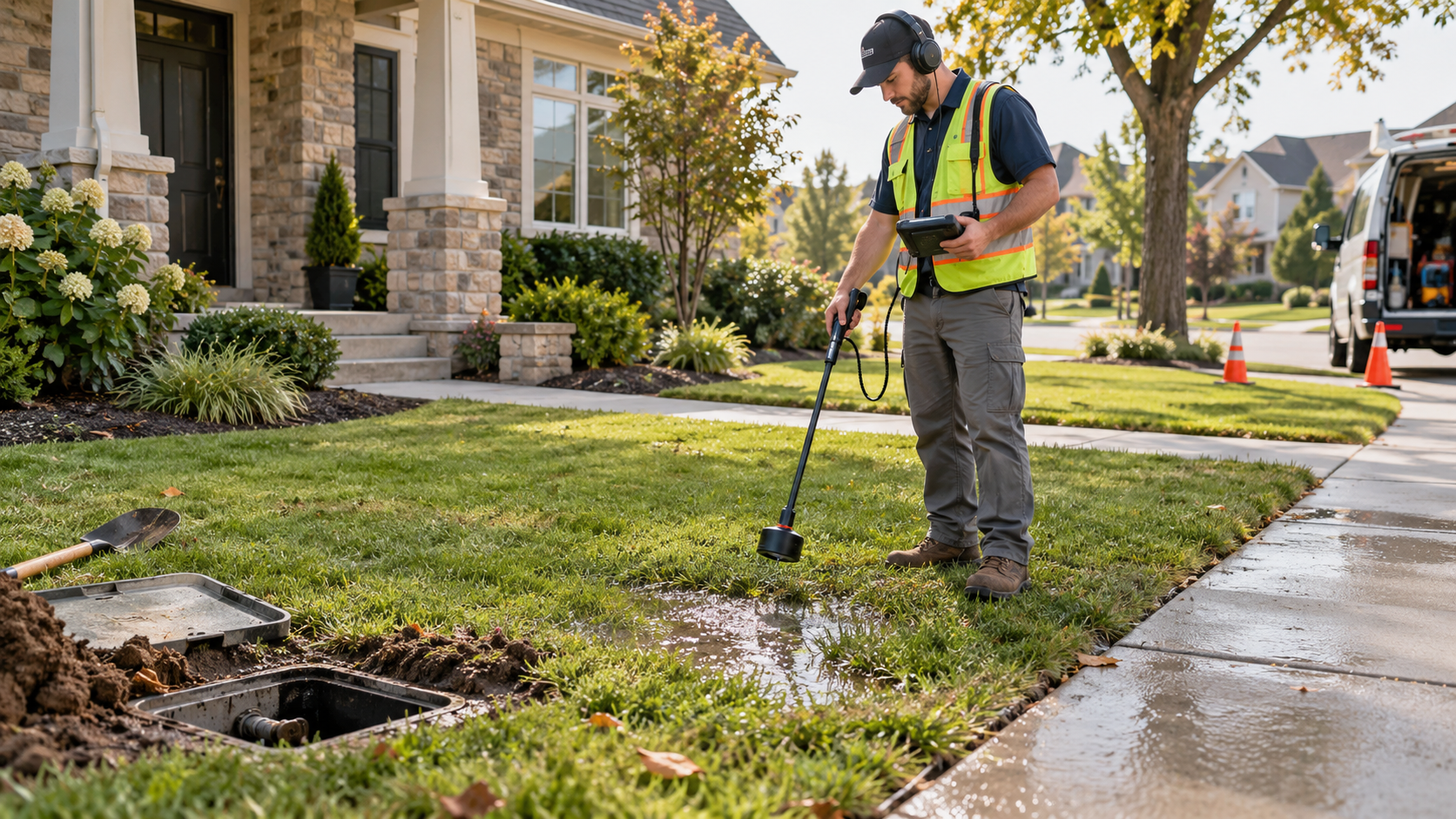
A water main problem can start with something surprisingly small. Maybe the water pressure feels a little weaker than usual. Maybe one patch of the front yard stays wet even though it has not rained. Or perhaps the water bill jumps for no obvious reason.
Then comes the less subtle version: water begins bubbling through the lawn, the meter keeps moving when every faucet is off, or the house suddenly has little to no water pressure.
At that point, water main repair goes from “something to check later” to a pretty urgent home project.
The tricky part is that homeowners often use the phrase “water main” for several different pipes. There is usually a public water main running beneath the street, plus a smaller service line that carries water from that public system to an individual property. Who owns which section depends on the local utility and jurisdiction.
That distinction matters because it can determine who arranges the repair and who gets the bill.
It also explains why two seemingly similar leaks can lead to very different projects. One property may need a small repair near the meter. Another may need its entire underground service line replaced from the street to the house.
So before anyone starts digging up the yard, the first job is figuring out exactly where the leak is and who is responsible for that section of pipe.
What is a water main?
The large public pipe supplying a neighborhood is generally considered the municipal water main. Individual homes connect to that system through service lines.
Inside everyday conversation, though, homeowners and even contractors may casually call the private service pipe a “water main line.”
That can get confusing fast.
If a contractor tells you that you have a broken water main, ask which pipe they mean.
Is the leak on the public utility side? Is it between the meter and the home? Is it close to the foundation? Is the problem actually inside the house?
Those are different repairs.
Who is responsible for a broken water line?
Responsibility varies across the United States.
In many areas, the local utility maintains the public water main while the homeowner is responsible for at least part of the service line serving the property. But the exact boundary can be at the meter, curb stop, property line, or another designated point.
Do not assume.
If a leak appears near the street or water meter, call the local water utility and ask where private responsibility begins.
A short phone call can save a lot of unnecessary digging and confusion.
Common signs that a water main or service line may be leaking
Underground leaks are annoying because you cannot simply open a cabinet and look at the pipe.
You usually notice the effects first.
- An unexplained increase in the water bill
- Low water pressure throughout the house
- A meter that continues moving when all water fixtures are off
- Wet, muddy, or unusually soft areas in the yard
- Water pooling near the driveway, sidewalk, or foundation
- Grass growing noticeably greener in one isolated area
- Sounds of running water when no fixtures are operating
- Discolored water after a line failure or repair
- Sudden loss of water service
- Water surfacing through cracks in pavement or landscaping
One clue does not always prove an underground line has failed.
Low pressure could come from a pressure regulator, clogged plumbing, a utility issue, or another problem inside the home.
A wet lawn might come from irrigation.
But several clues appearing together deserve attention.
How can you check for a hidden leak?
A simple meter check can sometimes tell you whether water is leaving the system when it should not be.
Turn off faucets, washing machines, dishwashers, irrigation, ice makers, and other known water-using devices.
Then look at the water meter.
If the meter still indicates flow after you are reasonably sure no fixture is using water, there may be a leak somewhere in the private system.
That does not tell you where the leak is. It simply tells you more water may be moving than expected.
Some modern meters or utility accounts provide detailed consumption information, which can also help reveal continuous usage patterns.
Why underground water lines fail
There is rarely one universal cause.
Age is an obvious factor, but soil movement, corrosion, installation quality, freezing conditions, tree roots, pressure changes, and the original pipe material can all play a role.
A pipe may also be physically damaged by excavation.
Anyone who has ever watched a contractor accidentally discover a utility with an excavator knows that underground infrastructure has very little sense of humor.
Corrosion
Metal piping can deteriorate over time depending on the material, soil conditions, water chemistry, and installation environment.
Corrosion may gradually weaken the pipe wall until a pinhole leak or larger break develops.
Ground movement
Soil expands, contracts, settles, freezes, thaws, and shifts.
Pipes have to live through all of it.
Movement can stress joints or rigid pipe sections, particularly when the line is already old or poorly supported.
Freezing
Water lines installed too shallow for local conditions can be vulnerable in cold regions.
Freezing water expands. That pressure can damage pipes and fittings.
Tree roots
Roots do not usually punch through a perfectly intact modern pressure pipe simply because a tree feels ambitious.
But they can contribute to movement, interact with older joints, or complicate excavation around an existing line.
High pressure
Excessive water pressure can put unnecessary stress on plumbing components.
If repeated failures occur, a contractor may recommend checking pressure rather than replacing damaged pipe and ignoring the larger issue.
What materials are used for residential water service lines?
The material depends on the age of the property, local practices, local code, soil, climate, and utility requirements.
Copper has a long history in residential water service work. Modern plastic piping such as polyethylene and PEX may also be used where approved for buried service applications.
Older properties can contain materials that are no longer preferred or may be subject to local replacement programs and rules.
| Pipe material | Common characteristics | Things to consider |
|---|---|---|
| Copper | Long-established plumbing material with good pressure performance | Material cost, soil conditions, corrosion potential, and joining methods matter |
| Polyethylene | Flexible plastic piping often supplied in long lengths | Must be approved for potable water and local buried service use |
| PEX | Flexible and resistant to many corrosion issues | Local codes and approved underground installation methods vary |
| Galvanized steel | Common in some older properties | Can corrode internally and may have reduced flow after decades of service |
| Older legacy materials | May exist in older neighborhoods | Identification and replacement requirements should be checked locally |
The best replacement material is not simply whichever pipe costs less at the hardware store.
A contractor should consider local code, utility requirements, soil conditions, pressure, installation method, and the existing connections at both ends.
Repair or replace the whole water line?
This is usually the biggest decision.
If a relatively new line has one isolated area of accidental damage, repairing that section may make perfect sense.
If an old line has failed because the pipe itself is deteriorating, patching one spot can be different.
You may repair today’s leak only to dig up another section next year.
That does not mean every leak requires full replacement. It means the condition of the entire line matters.
Ask why the pipe failed.
That question is more useful than asking only where it failed.
When a spot repair can make sense
A localized repair may be reasonable when the rest of the service line is known to be in good condition.
Examples include recent construction damage, a failed fitting, or an isolated defect in otherwise sound pipe.
The benefit is obvious: less excavation, less material, and usually a smaller bill.
But the savings disappear quickly if several future repairs follow.
When full replacement becomes more attractive
Replacement deserves stronger consideration when the existing line is old, corroded, undersized, made from a problematic legacy material, or has already experienced multiple leaks.
It can also make sense when the yard is already being excavated for another major project.
If the line is accessible now and clearly nearing the end of its useful life, replacing it before landscaping is restored may save another round of excavation later.
Traditional excavation for water main repair
The most familiar repair method is open excavation.
A contractor digs down to the damaged water line, exposes the affected section, completes the repair or replacement, tests the system, and then backfills the trench.
This method is direct.
It also gives clear physical access to the pipe.
The downside is disruption.
Lawns, landscaping, sidewalks, patios, or driveways may sit directly above the pipe route.
Replacing those surfaces can become a meaningful part of the overall project cost.
What is trenchless water line replacement?
Trenchless methods aim to reduce the amount of continuous open trench needed across the property.
Depending on site conditions, pipe material, local rules, and contractor equipment, a replacement pipe may be pulled or bored through the ground using smaller access areas.
This can preserve more of the lawn or hardscape.
But trenchless does not mean zero digging.
Access pits may still be required near connection points.
Underground utilities, rocks, unusual soil, pipe route, line depth, and structural obstacles can also limit whether the method is practical.
Traditional excavation vs. trenchless replacement
| Factor | Traditional excavation | Trenchless approach |
|---|---|---|
| Surface disruption | Usually greater | Often reduced |
| Access to old pipe | Direct and visible | More limited depending on method |
| Landscaping impact | Can be significant | Often smaller |
| Site requirements | Needs excavation access | Depends heavily on soil, route, utilities, and equipment |
| Cost | Varies with excavation and restoration | May cost more or less depending on site and restoration avoided |
| Best fit | Many straightforward repairs and replacements | Properties where minimizing surface damage has value |
There is no automatic winner.
If the line crosses an expensive driveway or mature landscaping, reducing excavation can have real value.
If the pipe runs through an open yard with easy access, traditional excavation may be perfectly practical.
How much does water main repair cost?
There is no reliable single nationwide price.
A small repair near an accessible meter is completely different from replacing a long service line beneath a driveway.
Labor rates vary significantly across the country. So do permit fees, restoration costs, pipe depth, soil conditions, and local utility requirements.
That is why quotes should describe the whole project rather than just saying “water line repair.”
The biggest cost factors commonly include:
- Length of pipe being repaired or replaced
- Depth of the water line
- Pipe material and diameter
- Traditional excavation versus trenchless work
- Location of the leak
- Soil, rock, or groundwater conditions
- Driveways, sidewalks, patios, retaining walls, or landscaping above the line
- Permit and inspection requirements
- Traffic control or street work when required
- Restoration after excavation
- Emergency or after-hours scheduling
- Changes needed at the meter or building connection
Two houses next door to each other can still receive very different estimates.
One line might run through open grass.
The other may pass under a concrete driveway and a carefully landscaped front yard.
Same neighborhood. Very different job.
How long does a water main repair take?
A straightforward accessible repair may be completed relatively quickly.
A full replacement can take longer, especially when excavation, permitting, inspections, utility coordination, or surface restoration are involved.
Some projects also require waiting for underground utility markings before digging.
The plumbing work itself may only be one part of the schedule.
If concrete, asphalt, landscaping, or masonry needs restoration, the property may not look completely finished the same day water service returns.
Will the water be shut off during repair?
Usually, at least for part of the work.
The damaged line cannot normally be cut and reconnected while remaining fully pressurized.
Ask the contractor when the shutdown is expected and how long it may last.
For planned work, homeowners can fill drinking-water containers and handle showers, laundry, and dishwashing in advance.
A few hours without water feels much longer when nobody remembered to make coffee first.
Can you keep using water when the main line is leaking?
That depends on the severity and location of the leak.
A small hidden leak may allow normal household use for a time, while a major break can reduce pressure or rapidly release large amounts of water underground.
Continuing to run water through a serious leak can waste water, increase property damage, wash away soil, and increase the bill.
If water is surfacing rapidly or threatening the foundation, electrical equipment, neighboring property, or public areas, treat the situation as urgent.
Why soil erosion around a broken line matters
Water moving underground does more than make the yard wet.
It can carry soil with it.
Over time, that can create voids or soft areas around paving, sidewalks, slabs, or other structures.
A serious leak next to a foundation deserves prompt attention for this reason.
The plumbing repair solves the water loss. The surrounding soil or structural effects may need separate evaluation if significant washout has occurred.
What should you do if water is entering the basement?
First determine whether the water is truly coming from a pressurized service line.
Basement water can also come from rain, groundwater, drainage failures, sewer problems, or interior plumbing.
If the suspected service line can be safely shut off and the water stops, that provides useful information.
But do not enter flooded areas where electrical hazards may be present.
Water and electricity remain a terrible combination.
Call before anyone digs
Residential properties can have gas lines, electrical cables, communication lines, irrigation, sewer pipes, and other utilities below ground.
Excavation should not begin blindly.
In the United States, underground utility locating procedures are a normal part of safe excavation planning.
Private lines on the property may require additional locating because not every privately installed utility is necessarily covered by standard public utility marking.
A contractor should understand what needs to be located before work starts.
Does water main repair require a permit?
Often it can, but rules vary by city, county, utility, and project scope.
A private service line replacement may require plumbing permits, inspection, utility coordination, or approval for work near a meter or public right-of-way.
Work extending into a sidewalk or street can trigger additional requirements.
Ask who obtains the permit and whether its cost is included in the quote.
Do not assume “the contractor handles everything” unless the written proposal actually says so.
Why pipe size matters
A service line does more than avoid leaks. It must also deliver enough water for the house.
An undersized line can contribute to weak performance when several fixtures run at the same time.
If an older line is being fully replaced, it is worth checking whether the existing size is still appropriate.
Home additions, extra bathrooms, larger irrigation systems, and other changes can increase demand over the years.
Bigger is not automatically better, but replacing a line is a logical moment to confirm that the design still fits the property.
Why water pressure should be checked
After a new line is installed, homeowners often expect dramatically stronger pressure.
Sometimes they get it.
But pipe replacement does not fix every pressure problem.
Pressure can also be affected by municipal supply, elevation, pressure regulators, interior piping, valves, filters, water treatment equipment, and fixture restrictions.
If pressure was one of the original complaints, ask the plumber to measure it rather than judging only by how the shower feels.
What happens after a water line is repaired?
After the repair or replacement, the system is returned to service and checked for leaks.
You may initially notice air in the pipes or temporary discoloration after water service has been interrupted.
Follow the contractor’s or utility’s instructions for flushing the system.
Do not assume that cloudy water is automatically contamination. Tiny air bubbles can make water look milky after plumbing work and then clear as the air escapes.
Persistent unusual color, odor, or taste should be investigated rather than ignored.
What should be included in a contractor’s quote?
A useful estimate should make clear what work is actually being performed.
You should know the approximate pipe route, material, size, repair or replacement method, excavation assumptions, and restoration responsibilities.
Ask whether the quote includes:
- Leak location or diagnostic work
- Excavation or trenchless installation
- New pipe, fittings, valves, and connection materials
- Permit and inspection fees
- Coordination with the water utility
- Backfilling and soil compaction
- Removal of old pipe where applicable
- Concrete, asphalt, lawn, or landscaping restoration
- Cleanup and debris removal
- Pressure or leak testing
- Workmanship warranty
- Any exclusions that could create additional charges
That last point matters.
If the estimate says landscaping restoration is excluded, you need to know what the yard may look like afterward and who will fix it.
Should you get more than one estimate?
For a planned full replacement, comparing a few detailed proposals can be useful.
Do not compare only the bottom-line price.
One company may quote open trenching with basic backfill.
Another may quote a trenchless method and include driveway restoration.
A third may include upgraded pipe size or additional valve work.
Those are not the same project.
Compare materials, scope, restoration, permits, warranty, and installation method.
Emergency repair changes the decision
Shopping around becomes harder when a service line is releasing water rapidly.
In an emergency, controlling the water and preventing damage come first.
If the line can be shut off safely, do it.
Then contact the water utility or an appropriate plumbing contractor depending on the suspected location of the failure.
Document visible damage with photos before excavation when practical. That can be useful for records, contractors, and insurance discussions.
Does homeowners insurance cover water main repair?
Coverage depends on the policy, the cause of the loss, the damaged property, and any optional endorsements.
A standard policy may treat damage caused by escaping water differently from the cost of repairing the failed underground service pipe itself.
Some insurers offer separate service-line coverage.
Do not assume the pipe is covered simply because water damage elsewhere in the house might be.
Check the actual policy or speak with the insurer.
What about utility service-line protection plans?
Some utilities, insurers, or third-party companies offer programs intended to cover certain private service-line repairs.
Terms differ widely.
Look at coverage limits, exclusions, waiting periods, pipe eligibility, contractor requirements, and whether excavation or surface restoration is included.
A plan that pays for pipe repair but excludes a costly driveway restoration may cover less than the homeowner expects.
Can a homeowner repair a water main line?
Replacing an underground pressurized water service is very different from changing a faucet.
Excavation safety, utility locating, pipe sizing, approved materials, pressure testing, municipal connections, permits, trench depth, fittings, backfill, and inspection can all be part of the job.
In many places, rules also limit who may perform or connect certain plumbing work.
For a major buried service repair, professional help is usually the practical route.
How can future water main problems be reduced?
You cannot guarantee an underground pipe will never fail.
But good installation makes a big difference.
That means correct pipe material, proper depth, suitable bedding, approved fittings, appropriate pressure, careful backfilling, and protection from physical damage.
Keep records of where the replacement line runs.
Photos taken before the trench is closed can be surprisingly helpful years later.
If landscaping is added afterward, think before planting large trees directly over or immediately beside important underground utilities.
FAQ about water main repair
How do I know if my underground water line is broken?
Common signs include unexplained water use, low pressure, a meter that keeps moving with fixtures off, wet areas in the yard, pooling water, or the sound of running water. A leak-detection professional or plumber can help confirm the location.
Who pays for water main repair?
It depends on where the failure occurs and local ownership rules. The utility generally maintains public infrastructure, while homeowners are often responsible for some or all of the private service line. Confirm the boundary with the local utility.
Can a leaking water main be repaired without digging up the whole yard?
Sometimes. Trenchless techniques can reduce surface excavation for suitable properties. Whether they work depends on the route, soil, existing pipe, underground utilities, access, and local installation requirements.
How long does a water main repair take?
A simple accessible repair may be completed relatively quickly, while full replacement can take longer because of excavation, permits, utility coordination, inspections, or surface restoration.
Should I repair one leak or replace the whole line?
An isolated failure in otherwise sound pipe may justify a spot repair. Multiple leaks, severe corrosion, old pipe, or a deteriorating material can make full replacement more practical over the long term.
Can a broken water line damage the foundation?
A major underground leak can saturate or wash away surrounding soil. If the leak is close to a foundation and significant soil movement or erosion occurs, additional inspection may be appropriate even after the plumbing problem is fixed.
Does homeowners insurance pay for underground water line replacement?
Not always. Coverage depends on the policy and cause of damage. Some policies or endorsements include service-line coverage, while others may cover resulting property damage but not the failed pipe itself. Check your specific policy.
Conclusion: Fix the Cause, Not Just the Wet Spot
Water main repair feels simple when described in one sentence: find the leaking pipe and fix it.
The real project has more layers.
First you need to know which pipe is leaking.
Then you need to know who owns it.
Then comes the bigger question: why did it fail?
That answer can determine whether a small repair makes sense or whether the entire service line is approaching the end of its useful life.
A recent pipe damaged during excavation is one thing.
A decades-old corroded line that has already leaked twice is another.
Treating those situations the same can cost more in the long run.
The installation method deserves thought too.
Traditional excavation is straightforward and gives direct access to the pipe. If the route crosses an open lawn, that may be the most sensible approach.
But if the line runs beneath decorative concrete, mature landscaping, or other expensive surfaces, reducing excavation may have real value.
That is where trenchless options become interesting.
Not glamorous. Interesting.
Home improvement sometimes works like that.
The best solution is often the one that avoids destroying something else while fixing the original problem.
Still, do not decide based on the word “trenchless” alone.
The method has to fit the property.
Soil matters.
Pipe route matters.
Existing utilities matter.
Depth matters.
Access matters.
The connections at both ends matter.
A contractor who has actually looked at the site can give a much more useful answer than an online chart comparing methods in theory.
Cost works the same way.
There is no meaningful national price that tells every homeowner what water main repair should cost.
A ten-foot accessible repair in soft soil and an eighty-foot replacement beneath hardscape are barely the same category of project.
Instead of chasing one magic number, compare the full scope.
How much excavation is included?
Who repairs the lawn?
Who replaces the concrete?
What pipe is being installed?
What size?
Are permits included?
Is utility coordination included?
What happens if rock is discovered?
What happens if the old pipe runs somewhere nobody expected?
Those questions are not picky. They are how you keep a quote from turning into a completely different number halfway through the project.
Another point worth remembering is that a new water service line should solve more than leakage.
If the old line was undersized or heavily restricted internally, replacement may improve flow.
But do not expect a new line to cure every pressure complaint.
Pressure regulators, utility pressure, interior pipes, filters, valves, fixtures, and elevation can all affect what happens at the faucet.
If pressure was a concern before the repair, have it measured and diagnosed properly.
There is also the yard.
People focus so much on the pipe that they forget the property has to be put back together afterward.
A technically perfect pipe replacement can still feel frustrating if the homeowner discovers that “backfill included” means a rough strip of soil running across what used to be a finished lawn.
Ask how restoration works before the first shovel touches the ground.
If concrete is involved, clarify whether replacement is included.
If landscaping matters, photograph it before work begins.
If irrigation crosses the trench, mention it.
If there are invisible dog-fence wires, landscape lighting, or private utilities, mention those too.
The contractor cannot protect what nobody knows is there.
After the work, keep records.
Save the invoice.
Save permit documents.
Write down the pipe material and size.
Keep photos showing the route before the trench is closed.
Record where shutoff valves are located.
Ten years from now, someone may need that information, and memory has a funny habit of turning “three feet from the maple tree” into “somewhere over there.”
And if the original leak caused significant washout near a driveway, sidewalk, retaining wall, or foundation, do not assume the problem ends when the pipe stops leaking.
The water may be gone, but displaced soil does not magically return to its original position.
Large voids, settling, or structural movement can deserve separate attention.
The main lesson is fairly simple.
Do not focus only on stopping the water.
Find out where it is coming from.
Find out why the pipe failed.
Understand who owns the damaged section.
Compare repair with replacement.
Check what happens to the yard afterward.
And make sure the proposed line is appropriate for the property, local requirements, and household demand.
A water main repair is one of those projects nobody really wants to spend money on because the finished result is mostly invisible.
You do not get a beautiful new kitchen.
You do not get a spa-like bathroom.
You get a pipe underground.
But when that pipe is installed correctly, water reaches the house without flooding the lawn, the meter stops recording mystery usage, and everyone can take a shower without thinking about underground infrastructure.
That is a pretty good result.

Leave a Reply