
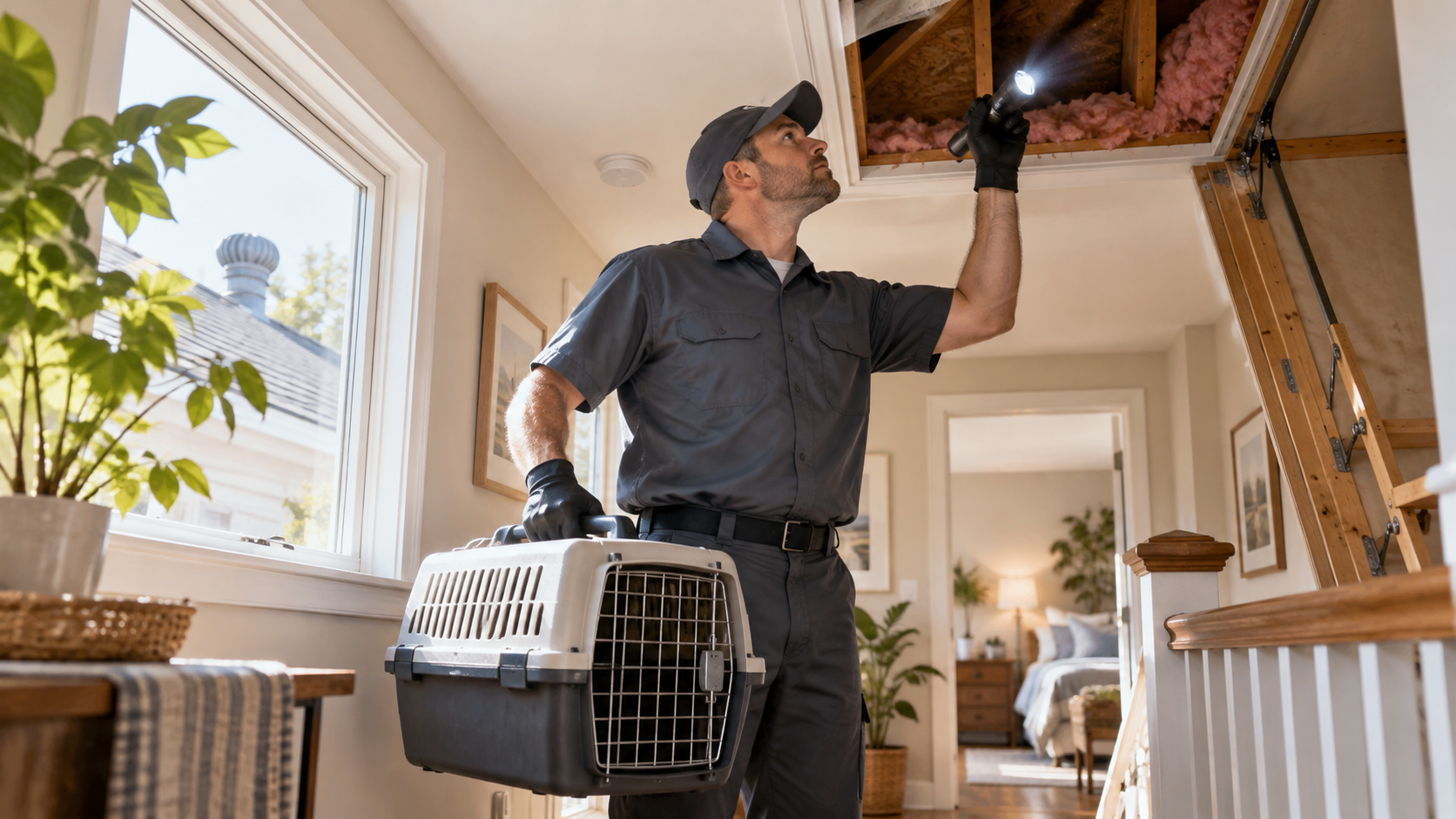
You hear scratching above the ceiling at 2 a.m. Maybe something is running across the attic. Maybe there is a strange smell near a wall. Or perhaps you actually saw a raccoon disappear under the deck and now you are wondering whether it moved in.
That is usually how the search for complete animal removal begins.
And the phrase sounds simple enough. Animal inside house. Remove animal. Problem solved.
Except that wildlife problems rarely work that neatly.
A squirrel can leave through the same opening it used to enter. A raccoon may have babies hidden in an attic. A bat can squeeze through an opening that looks almost impossibly small. Rodents may leave droppings, nesting material, chewed insulation, and damaged wiring behind them.
So real animal removal is not just about taking an animal away.
It is about figuring out what entered the property, where it entered, whether more animals are present, what damage occurred, how the opening should be closed, and whether contaminated material needs to be removed.
That is the difference between temporarily solving a wildlife problem and actually ending it.
What Does Complete Animal Removal Include?
Complete animal removal usually refers to a full wildlife-control process rather than a one-time capture.
The exact work depends on the species and the property, but a thorough service may involve inspection, removal or exclusion, entry-point repair, cleanup, and preventive work.
In other words, the goal is not simply to make tonight quieter.
The goal is to keep the same problem from coming back next week.
- Inspection of the attic, crawl space, roofline, vents, foundation, chimney, or other suspected areas
- Identification of the animal or signs it has left behind
- Humane removal or exclusion methods appropriate for the species
- Checking for young animals or nests before exclusion work begins
- Locating primary and secondary entry points
- Repairing or sealing vulnerable openings where appropriate
- Removing contaminated nesting material when necessary
- Cleaning or sanitizing affected areas when the situation calls for it
- Checking insulation, wiring, ductwork, vents, and other nearby materials for damage
- Providing recommendations to reduce the chance of another wildlife problem
Not every property needs every step.
If one bird accidentally flies into a garage through an open door, that is very different from a family of raccoons living above a bedroom.
The service should match the actual situation.
Why Animals Enter Homes in the First Place
Wild animals usually are not trying to create a homeowner nightmare.
They are looking for the same basic things animals have always looked for: food, water, shelter, warmth, and a safe place to raise young.
A house can provide all of those surprisingly well.
Attics stay protected from rain and predators. Crawl spaces are dark and quiet. Chimneys resemble hollow trees. Decks create sheltered spaces. Roof gaps can lead into warm cavities.
Then there is food.
Trash cans, pet food, bird feeders, fallen fruit, compost, outdoor feeding bowls, and poorly sealed garbage can all make a property more attractive.
Sometimes the house itself practically sends an invitation.
A damaged soffit, loose vent screen, uncapped chimney, rotten fascia board, or gap around a roofline may be all an animal needs.
Common Animals Found Around U.S. Homes
The species involved varies enormously by region.
A homeowner in Florida can face different wildlife problems from someone in Minnesota, Arizona, or New England.
Still, a few animals appear regularly in residential removal calls across large parts of the United States.
| Animal | Common Location | Typical Signs | Main Concern |
|---|---|---|---|
| Squirrels | Attics, soffits, roof cavities | Daytime scratching, chewing, nesting material | Property damage and repeated entry |
| Raccoons | Attics, chimneys, crawl spaces, decks | Heavy footsteps, disturbed insulation, strong odor | Damage, contamination, young animals |
| Bats | Attics, roof gaps, wall cavities | Small droppings, evening activity near roofline | Health concerns and species-specific legal rules |
| Opossums | Under decks, sheds, crawl spaces | Noise at night, disturbed trash, nesting | Odor and access to sheltered areas |
| Skunks | Under decks, porches, sheds | Strong odor, digging, nighttime activity | Spraying and denning |
| Birds | Vents, chimneys, roof cavities | Chirping, nesting material, feathers | Blocked vents and nesting restrictions |
| Rodents | Walls, attics, crawl spaces, kitchens | Droppings, gnawing, scratching, food damage | Contamination and building damage |
| Snakes | Garages, crawl spaces, sheds | Direct sighting, shed skin | Species identification and safe handling |
The important part is identifying the animal correctly before deciding what to do.
A sound in the attic at night could be a raccoon. The same sound during the day might point more toward squirrels. Droppings can offer clues, but guessing from droppings alone is not always reliable.
And guessing wrong can lead to the wrong removal method.
Inspection Comes Before Removal
A good wildlife inspection is basically detective work.
The technician is looking for tracks, droppings, nesting material, damage, entry points, rub marks, chewing, odor, and other signs that explain what has been happening.
The exterior of the property matters just as much as the interior.
Rooflines are especially important. Animals can exploit loose vents, gaps under eaves, broken soffits, uncapped chimneys, deteriorated wood, or openings around construction joints.
An attic inspection may reveal where the animal is spending time.
But the exterior usually reveals how it got there.
That second part is critical.
You can remove an animal successfully and still have another one move in if the entry opening remains untouched.
Removal and Exclusion Are Not the Same Thing
These terms get mixed together, but they describe different parts of the job.
Removal means getting an animal out of a building or controlled area.
Exclusion means preventing it from getting back in.
Exclusion can involve repairing holes, reinforcing vulnerable areas, installing appropriate vent protection, securing gaps, or using one-way devices in situations where they are suitable and legally allowed.
In many cases, exclusion is actually the part that determines whether the solution lasts.
A captured squirrel does not matter much if the same attic opening remains available to every other squirrel in the neighborhood.
Why Baby Animals Change the Plan
This is one of the easiest things to overlook.
An adult animal inside an attic may not be alone.
Raccoons, squirrels, bats, and other wildlife can use buildings as nesting or maternity sites.
If an adult is excluded while dependent young remain trapped inside, the situation can get much worse.
You may hear persistent noises. The mother may damage the building trying to regain access. Trapped young can die inside a wall or attic.
That is why timing and species identification matter.
A proper inspection should consider whether young animals may be present before entry points are sealed.
Wildlife Laws Matter Too
Wildlife control is not simply a construction project.
Federal, state, and local laws can affect how certain species are handled.
Some birds are protected. Bats can be subject to seasonal restrictions or state-specific rules. Trapping and relocation laws vary by location and species.
That means a method that is allowed for one animal in one state may not be appropriate somewhere else.
A wildlife-control professional should understand the rules that apply locally.
This becomes especially important when dealing with active nests, maternity colonies, protected species, or animals that may carry disease.
What Happens After the Animal Is Gone?
This is where the word “complete” in complete animal removal really matters.
Removing the animal can be only half the job.
Wildlife may leave droppings, urine, hair, nesting material, food remains, insects, damaged insulation, torn ductwork, or chewed building materials behind.
The extent can range from almost nothing to a major attic cleanup.
A single squirrel that entered briefly is different from animals that occupied the same attic for months.
The cleanup should reflect the actual level of contamination and damage rather than automatically turning every wildlife visit into a huge restoration project.
Attic Cleanup After Wildlife
Attics are one of the most common places where cleanup becomes necessary.
Animals may crush or move insulation while creating nesting areas.
Droppings can become scattered through the space. Urine can soak into porous materials. Nesting material may accumulate in corners, soffits, or near access points.
Cleanup can involve removing localized contaminated material or, in severe cases, more extensive insulation work.
It depends on how long the animals were present and how much of the attic was affected.
There is no reason to remove an entire attic full of clean insulation because one small corner was disturbed.
On the other hand, heavily contaminated insulation should not simply be covered with new material and forgotten.
Wildlife Droppings Need Careful Handling
Animal waste is not just unpleasant.
Some wildlife droppings and contaminated materials can carry pathogens or parasites.
The exact risk depends on the animal and the situation.
For example, raccoon feces can present specific health concerns. Bat droppings can accumulate in roosting areas. Rodent contamination may require careful cleanup practices.
Avoid stirring dry contaminated material into the air unnecessarily.
Heavy infestations, large accumulations, or waste from animals associated with particular health risks are good reasons to consider professional cleanup.
What About Dead Animal Removal?
Sometimes homeowners never see a live animal at all.
They notice the smell first.
A dead animal may be located in an attic, crawl space, chimney, wall cavity, under a deck, or beneath another inaccessible part of the house.
The smell can be intense, especially during warm weather.
Finding the source is often the hardest part.
If the carcass is accessible, removal is usually straightforward. If it is deep inside a wall cavity, reaching it may require opening part of the structure.
That decision should be practical.
Tearing apart half a finished room to chase a small carcass may create more damage than the original problem.
But if the location is clear and accessible with limited work, removal can dramatically reduce the odor source.
Can You Remove Wildlife Yourself?
Sometimes, yes.
An animal that wandered into an open garage and can leave through the same door may require nothing more than quiet space and an open exit.
Other situations are very different.
Do not corner, grab, or handle wild mammals with bare hands. Do not reach into dark spaces where you cannot see the animal. And do not attempt close contact with wildlife behaving strangely or aggressively.
Professional help becomes more sensible when:
- The animal is inside an attic, wall, chimney, or crawl space
- You suspect babies are present
- A bat is found inside an occupied living area
- The animal appears sick, disoriented, aggressive, or unusually tame
- You cannot identify the species
- The property has multiple entry points
- You see substantial droppings or contamination
- You suspect damage to wiring, insulation, ductwork, or roofing
- The same animal problem keeps returning
- Local wildlife rules may affect what can legally be done
The bigger the uncertainty, the less attractive DIY becomes.
What If You Find a Bat Indoors?
Bats deserve special caution.
Most bats want nothing to do with people, and many species are ecologically valuable because they eat insects.
But direct exposure matters because bats can carry rabies.
If a bat is discovered in a room where someone was sleeping, or where a child or another person may not reliably know whether contact occurred, do not automatically release it without getting appropriate public-health guidance.
Contact local health authorities or animal-control resources for advice based on the circumstances.
It is not about panicking.
It is about handling a potentially important exposure correctly.
Why Poison Is Usually a Bad Wildlife Strategy
Trying to poison an animal inside a structure can create a much larger problem.
You may lose control of where the animal dies.
That could be inside a wall, beneath insulation, or in another inaccessible cavity.
Then you have odor, flies, cleanup, and possibly property damage on top of the original wildlife issue.
Poisoning can also create risks for pets and non-target wildlife.
For larger wildlife problems, removal and exclusion are generally much more controlled approaches.
How Entry Points Are Repaired
Once the animals are confirmed out, repair work can begin.
The repair needs to match the opening.
A loose vent may need a durable protective screen or vent repair. A damaged soffit may require carpentry. A chimney may need an appropriate cap. Gaps around roof edges may need reinforcement.
The material matters too.
Weak foam stuffed into an opening that an animal chewed through is not much of a defense.
The repair should be durable enough for the species involved and compatible with the building.
Common Entry Areas Around a House
| Area | Why It Attracts Animals | What to Check |
|---|---|---|
| Roof vents | Warm air and easy roof access | Loose covers, damaged screens, chewing |
| Soffits | Protected space leading toward attic | Rot, gaps, loose panels |
| Chimneys | Similar to natural hollow structures | Missing or damaged caps |
| Roof intersections | Small construction gaps | Openings near fascia and eaves |
| Crawl-space vents | Dark, sheltered access | Torn screens and broken covers |
| Under decks | Dry denning area | Digging, tracks, nesting |
| Garage doors | Easy ground-level entry | Damaged weather seals and gaps |
| Foundation openings | Access to crawl spaces and walls | Cracks, utility gaps, missing covers |
How Much Does Complete Animal Removal Cost?
There is no useful single national price.
A one-animal removal from an accessible location is not the same job as removing wildlife from a three-story attic, repairing several roof openings, and cleaning contaminated insulation.
Cost can depend on the species, location, difficulty of access, number of animals, time required, repairs, cleanup, and whether repeat visits are needed.
Emergency work can cost more.
Large restoration projects cost more.
A simple exclusion may cost much less.
So when comparing estimates, make sure you are comparing the same scope of work.
One quote might include only trapping.
Another may include inspection, exclusion, sealing, return visits, and cleanup.
The cheaper number is not automatically the cheaper solution if it leaves the hole wide open.
Questions to Ask Before Hiring an Animal Removal Company
A good estimate should explain what the company believes is happening and what it plans to do about it.
You do not need to become a wildlife expert before hiring someone.
But you should understand the basic plan.
- What animal do you believe is present?
- What signs support that identification?
- Where is the main entry point?
- Are there likely to be young animals?
- What removal or exclusion method will you use?
- How do you confirm the animals are out before sealing openings?
- What repairs are included in the price?
- Does the quote include follow-up visits?
- Is cleanup included or priced separately?
- Are there signs of insulation, wiring, or duct damage?
- Does the company follow local wildlife rules?
- What warranty, if any, applies to the exclusion repairs?
A clear answer is more useful than a dramatic sales pitch.
Watch Out for Overly Broad Cleanup Recommendations
Wildlife contamination can be real, and some attics absolutely need substantial cleanup.
But not every animal visit requires stripping every inch of insulation from a house.
Ask to see the affected area when practical.
Request photos if the location is hard to reach.
Ask which materials are actually contaminated and why they need removal.
The scope should match the evidence.
This is especially important because insulation removal and replacement can become one of the most expensive parts of a wildlife-control project.
Why Wiring Damage Matters
Squirrels and rodents chew.
Unfortunately, electrical wiring can be one of the materials they encounter.
If a wildlife inspection reveals clearly chewed wiring, it is worth having the damage evaluated by an appropriate electrical professional.
Do not assume an animal-removal technician is automatically qualified to perform electrical repairs.
Wildlife control and electrical work are different trades.
The same principle applies to major roofing, HVAC, structural, or plumbing damage.
Use the right professional for the right repair.
How to Make Your Property Less Attractive to Wildlife
No house can be made completely invisible to animals.
Still, basic maintenance can reduce the odds of repeat visitors.
Secure trash.
Do not leave pet food outside overnight.
Pick up fallen fruit.
Trim branches where appropriate when they give easy access to vulnerable roof areas.
Inspect roof vents and soffits periodically.
Repair obvious openings before an animal discovers them.
And if you use bird feeders, understand that spilled seed can attract animals besides birds.
Do Ultrasonic Wildlife Repellents Work?
This is a popular question because ultrasonic devices are easy to buy and easier to install than repairing a roof.
Unfortunately, they should not be treated as a substitute for physical exclusion.
An animal already living in a warm attic with a secure nesting site has a strong reason to remain there.
Even if a sound or odor bothers it temporarily, the underlying access problem still exists.
Physical repairs are much more important for long-term prevention.
What About Bright Lights, Radios, or Strong Smells?
Homeowners sometimes try lights, radios, vinegar, ammonia, mothballs, or other strong odors to push animals out.
These methods are unpredictable and may create unnecessary exposure to chemicals without solving the entry problem.
Some animals simply move to another part of the structure.
Others tolerate the disturbance.
And even if the animal leaves, the opening remains.
Again, the house itself has to be addressed.
How Long Does Animal Removal Take?
Some situations are resolved quickly.
Others require several visits.
Timing depends on the species, season, building design, location of the animals, and removal method.
An animal trapped in a fireplace may be handled quickly.
A bat colony in an attic may require carefully timed exclusion work.
A raccoon with young may require a completely different plan from a single adult passing through a crawl space.
Be suspicious of anyone promising the exact same timeline for every wildlife problem.
How Do You Know the Animals Are Really Gone?
Silence is encouraging, but one quiet night is not always proof.
Wildlife activity varies.
Some animals leave the structure for long periods to feed and return later.
A professional may look for fresh tracks, movement, noises, disturbed entry points, or other recent signs before completing exclusion work.
The goal is to avoid sealing an animal inside.
That is one reason rushed repairs can backfire.
Can Animals Come Back After Removal?
Yes, especially if the access point is still available.
The same animal may return.
Another animal may use the opening instead.
A good attic is valuable wildlife real estate.
Warm. Dry. Protected. No mortgage.
That is why exclusion repairs are such an important part of complete animal removal.
Seasonal Wildlife Problems
Wildlife activity changes throughout the year.
Spring often brings nesting and young animals.
Summer can bring increased activity around food and water.
Fall may drive animals to search for protected shelter.
Winter can make attics and crawl spaces especially attractive in colder climates.
Season also affects removal strategy.
A hole that seems easy to close may be part of an active nesting site.
Timing matters.
What to Do If an Animal Is Acting Strangely
Most wildlife encounters do not involve rabies or severe disease.
Still, unusual behavior deserves caution.
A wild mammal that is disoriented, unable to move normally, unusually aggressive, or behaving in a way that seems clearly abnormal should not be handled.
Keep people and pets away.
Contact local animal control, public-health authorities, or another appropriate local service for guidance.
If a person or pet has been bitten or scratched, seek medical or veterinary advice promptly.
Does Homeowners Insurance Cover Animal Damage?
Sometimes, but not always.
Coverage depends on the policy, the type of animal, the cause of the damage, and the specific loss.
Damage from certain sudden events may be treated differently from long-term infestation or maintenance issues.
Do not assume the entire removal and cleanup will be covered.
If damage is significant, check your policy and speak with your insurer before major restoration work begins when practical.
Complete Animal Removal Is Really a Building Problem Too
This is the part homeowners often realize only after dealing with wildlife once.
The animal is only one side of the problem.
The building allowed the situation to happen.
Maybe a soffit rotted.
Maybe a vent screen failed.
Maybe roofing pulled away from a fascia board.
Maybe a crawl-space opening was never properly protected.
If you focus only on the animal, you miss the structural invitation.
Fix both sides and the odds of a repeat problem drop considerably.
FAQ About Complete Animal Removal
What does complete animal removal mean?
Complete animal removal generally includes identifying the wildlife problem, removing or excluding the animals, locating entry points, repairing vulnerable openings, and addressing contamination or damage when necessary. The exact scope depends on the species and property.
Should entry holes be sealed immediately?
Not always. The animals must be confirmed out first, and professionals should consider whether dependent young may be inside. Sealing an active entry point too early can trap wildlife in the structure.
Is wildlife removal safe to do yourself?
Simple situations can sometimes be handled without professional help, but animals inside walls, attics, chimneys, and crawl spaces can create safety, legal, and health concerns. Avoid direct contact with wild mammals and get help when identification or removal is uncertain.
How much does complete animal removal cost?
Prices vary widely because the work can range from a basic inspection and exclusion to major attic cleanup and building repairs. Species, access, number of animals, contamination, repair work, and repeat visits all affect cost.
Will animal removal stop the problem permanently?
Removal alone may not. Long-term control depends heavily on finding and repairing entry points. If a building remains open, the same animal or another one may return.
Do all wildlife problems require attic cleanup?
No. Cleanup depends on the amount and location of contamination. A brief animal visit may leave little behind, while a long-term nesting site can require removal of droppings, nesting material, or damaged insulation.
What should I do if I find a bat in a bedroom?
Avoid handling it directly. If someone was sleeping in the room or contact may have occurred without being noticed, contact local public-health or animal-control authorities for guidance before simply releasing the bat.
Conclusion: Solve the Entry Problem, Not Just the Animal Problem
Complete animal removal sounds like a wildlife job.
In reality, it is usually half wildlife work and half building work.
You need to know what is inside.
You need to know how it entered.
You need to know whether more animals or young are present.
And then you need to make sure the same opening does not remain available after the animal is gone.
That last part is where many temporary solutions fall apart.
A squirrel can be removed today and replaced by another squirrel next month.
A raccoon can leave an attic but return through the same damaged soffit.
A bat problem can continue if small roofline gaps remain open.
The building has to become part of the solution.
Start with inspection.
Do not assume every nighttime sound is the same animal.
Look for evidence.
Check the exterior.
Ask where the entry point is.
Ask whether young animals may be present.
And ask what happens after the wildlife is gone.
A good animal-removal plan should make sense when someone explains it.
It should not sound like, “We will put out a trap and see what happens.”
There should be a reason for the removal method, a plan for the building, and a clear idea of what work is actually included.
Cleanup deserves the same common-sense approach.
If contamination is localized, treat the affected area.
If an attic has been heavily occupied for months, more extensive work may be reasonable.
Ask for evidence before agreeing to expensive restoration.
Photos help.
Clear explanations help.
Specific recommendations help.
Fear-based sales pitches do not.
Safety matters too.
Wild animals should not be handled casually.
Bats require particular attention when possible human exposure is involved.
Animals acting strangely should be left alone while local authorities or qualified professionals are contacted.
And if droppings or contaminated material are extensive, cleanup should be approached carefully rather than swept around and turned into airborne dust.
There is also no single removal method that fits every species.
That is a big point.
Squirrels, raccoons, bats, birds, snakes, skunks, and rodents behave differently.
Their nesting habits differ.
Their legal status can differ.
The safest removal method can differ.
Even timing can matter.
So if someone recommends exactly the same treatment for every animal, ask more questions.
The most effective wildlife work tends to be surprisingly practical.
Identify.
Remove or exclude.
Confirm the structure is empty.
Repair the access.
Clean what actually needs cleaning.
Reduce the attraction that brought the animals close to the property.
Then monitor the area.
It is not dramatic, but it works because it addresses the entire situation instead of one visible part of it.
And once the immediate problem is fixed, take a slow walk around your property.
Look up.
Most homeowners spend plenty of time looking at their lawn and almost none looking at the edge of the roof.
Wildlife notices those roof details.
Loose soffit panels, missing chimney caps, broken vents, and small construction gaps can sit unnoticed for years.
Repairing them before something moves in is much easier than discovering the problem because an animal wakes you up at 3 a.m.
Also look down.
Check crawl-space vents.
Look under decks.
Secure garbage.
Do not leave pet food outside overnight.
Clean up fallen fruit when it becomes a regular wildlife buffet.
None of these steps guarantees that you will never see another wild animal near your house.
That is not realistic.
Wildlife lives around us.
The goal is simply to keep the outside animals outside.
And if one does get in, do not focus only on getting it out as fast as possible.
Ask the more useful question.
How did it get there?
That answer is usually the key to making complete animal removal truly complete.

Leave a Reply