

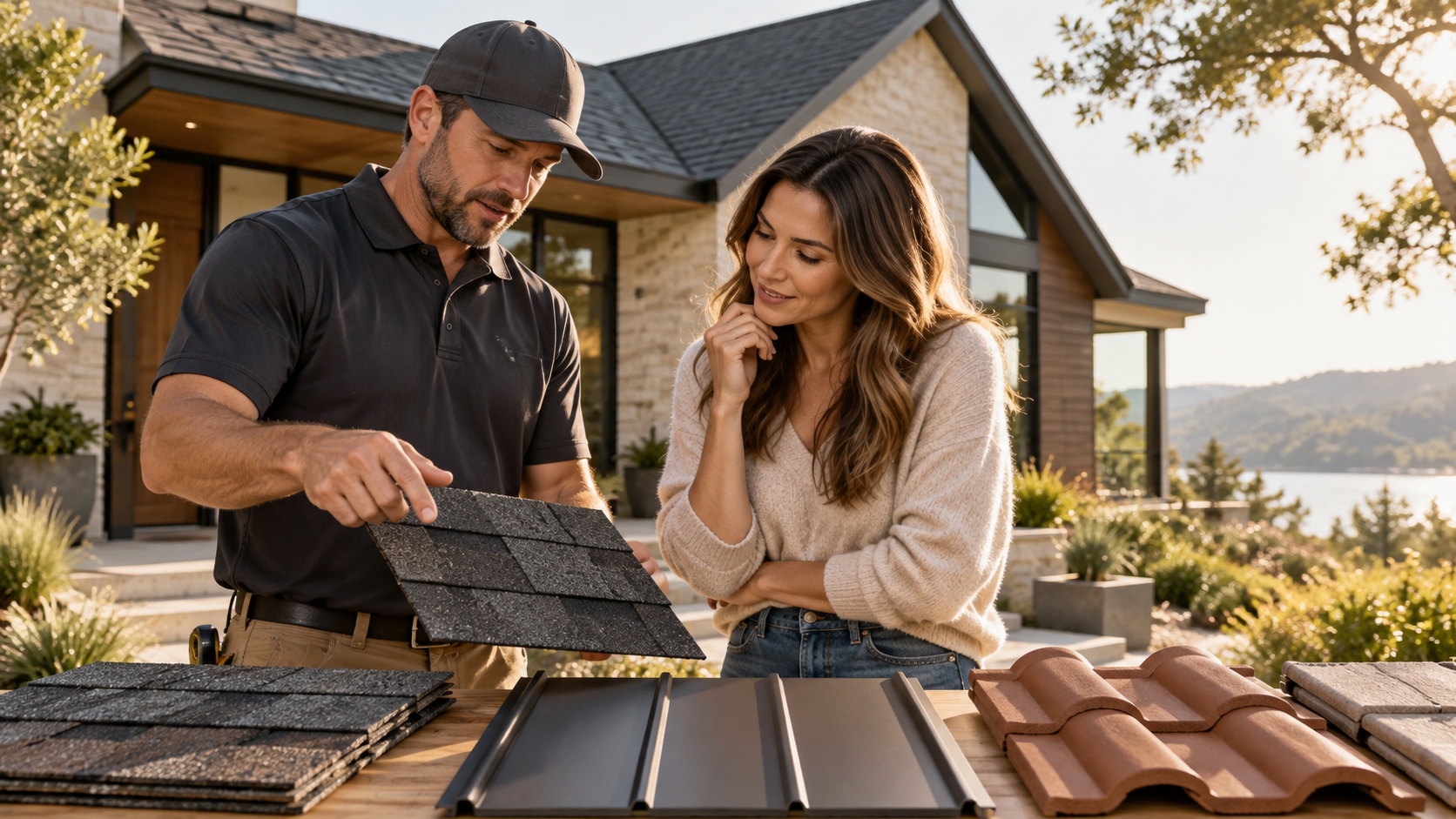
A roof is one of those parts of a house you can ignore for years. Then a shingle disappears after a storm, a ceiling stain shows up, or a contractor says the roof is nearing the end of its life. Suddenly, roofing materials become a very interesting subject.
And there are more options than most homeowners expect.
Asphalt shingles still cover a huge number of American homes, but they are far from the only choice. Metal, clay tile, concrete tile, slate, wood shakes, synthetic products, and several low-slope roofing systems all have their place.
The tricky part is that there is no single “best roof.”
A material that makes perfect sense on a ranch house in Ohio may be a poor match for a coastal home in Florida. A heavy tile roof can look fantastic in Arizona, yet the structure must be able to carry the weight. A dark roof may seem fine aesthetically, but solar heat can become a bigger concern in hot climates.
Price matters, obviously. But it is only one part of the decision.
Roof slope, local weather, wildfire exposure, wind, hail, maintenance, expected lifespan, neighborhood style, structural capacity, insurance requirements, and even how long you plan to stay in the house can all change the answer.
So here is the useful way to think about roofing materials: not as a beauty contest, but as a match between the roof, the house, the climate, and your budget.
What are the main roofing materials used in the USA?
Residential roofing in the United States covers a broad range of products, but a handful of categories appear again and again.
- Asphalt shingles
- Standing-seam and exposed-fastener metal roofing
- Clay and concrete tile
- Natural slate
- Wood shingles and shakes
- Synthetic or composite roofing products
- Single-ply membranes for low-slope roofs
- Modified bitumen and built-up roofing systems
Some systems are meant mainly for steep-slope roofs. Others are designed for nearly flat sections where ordinary shingles would not drain water properly.
That distinction matters more than appearance.
Asphalt shingles: still the familiar choice
Asphalt shingles are popular because they sit in a comfortable middle ground. They are widely available, familiar to contractors, relatively quick to install, and offered in a huge range of colors and styles.
There are two broad categories homeowners hear about most often: three-tab shingles and architectural shingles.
Three-tab shingles have a flatter, more uniform appearance. Architectural shingles, also called dimensional or laminated shingles, are thicker and designed to create more visual depth.
Architectural products now dominate many residential projects because homeowners often prefer the appearance and manufacturers offer many performance levels within that category.
But the words “architectural shingle” do not tell you everything.
One product may have a different wind rating, warranty, impact classification, algae resistance, or installation requirement from another. Compare the actual product specifications rather than assuming all laminated shingles perform the same.
Why homeowners like asphalt shingles
They work with a wide range of home styles. Repairs are usually straightforward. Materials are easy to source in most parts of the country.
And if a storm damages a section years later, finding a roofing contractor familiar with asphalt shingles is rarely difficult.
The trade-off is lifespan.
Asphalt is generally not the longest-lasting roofing option, especially when compared with quality metal, slate, or tile systems.
Heat, UV exposure, ventilation, storm damage, installation quality, and roof geometry all affect how long the roof actually lasts.
Metal roofing has moved far beyond the barn look
Metal roofs used to make many homeowners picture agricultural buildings.
That image is outdated.
Modern residential metal roofing can look clean, minimal, traditional, industrial, or surprisingly classic depending on the profile.
Standing-seam metal is especially popular on contemporary homes and higher-end renovation projects. The fasteners are concealed beneath the panels, creating a smooth surface with distinct vertical seams.
Exposed-fastener metal is another option. It usually costs less, but the visible fasteners and washers become part of the weathering system and may require more attention over time.
What metals are used for roofing?
Steel is common. Aluminum is also used, particularly where corrosion resistance is important. Copper and zinc appear on premium projects, historic buildings, architectural accents, and specialty roofs.
Coatings matter too.
A metal roof is not simply “metal.” The base material, protective coating, paint system, panel thickness, seam design, fastening method, and flashing details all affect performance.
| Roofing material | Typical character | Main advantage | Main consideration |
|---|---|---|---|
| Asphalt shingles | Traditional and versatile | Accessible cost and wide availability | Shorter service life than many premium systems |
| Standing-seam metal | Modern or clean traditional look | Long life and strong weather performance when properly installed | Higher initial price |
| Clay tile | Mediterranean, Spanish, Southwestern | Durable and visually distinctive | Heavy and breakable under foot traffic |
| Concrete tile | Available in many profiles | Durable with broad style options | High structural weight |
| Slate | Historic and premium | Very long service potential | Cost, weight, and specialist installation |
| Wood shakes | Natural and rustic | Unique texture and character | Maintenance and fire concerns in some regions |
| Synthetic roofing | Designed to imitate slate, shake, or tile | Often lighter than the natural material | Performance varies by manufacturer |
Does metal roofing make a house hotter?
Not automatically.
Roof temperature depends on several things, including color, surface reflectivity, insulation, ventilation, roof assembly, and climate.
Some metal roofing finishes are designed to reflect more solar energy than darker conventional materials.
The roof covering is only the outside layer. What happens inside the attic or conditioned roof assembly also depends heavily on insulation and ventilation design.
So no, a metal roof does not simply turn the home into an oven because it is made of metal.
Is a metal roof noisy in the rain?
A bare metal sheet over an open structure can be noisy.
A residential roof is different.
Decking, underlayment, insulation, ceilings, and attic space all reduce sound transmission. A properly built metal roof on a typical house usually does not sound like rain pounding directly on a tin shed.
That said, acoustic performance depends on the exact assembly.
Clay tile: beautiful, durable, and definitely not light
Clay tile has a look that is hard to fake.
It fits especially well with Spanish, Mediterranean, Mission, and Southwestern architecture, though modern flat clay profiles can work on contemporary buildings too.
Clay does not rot and can offer excellent service life when the complete roofing system is properly designed and maintained.
But tile roofs are heavy.
Before switching from a lighter roof covering to clay, the structure may need evaluation. You cannot simply remove lightweight asphalt shingles and assume the framing is ready for a much heavier assembly.
Tiles can also crack from impact or careless foot traffic.
The tiles are only one part of the roof. Underlayment, flashings, fasteners, battens where used, ventilation, and drainage details remain crucial.
Concrete tile looks similar but behaves a little differently
Concrete roofing tile can imitate traditional barrel tile, flat tile, slate-like profiles, and other styles.
It is generally heavy, durable, and widely seen in warmer parts of the United States.
Concrete tile can weather and change appearance over time, especially as surface coatings age.
Like clay, it depends on a well-designed roof assembly beneath the visible pieces.
This is an important point with almost every premium roofing material: the part you see is not the whole roof.
Slate can last a very long time
Natural slate belongs in a different category from most everyday roofing materials.
It is stone, not a manufactured sheet or shingle.
Quality slate roofs are associated with historic homes, churches, institutional buildings, and high-end residences. With suitable slate, good installation, and proper maintenance, their service life can be extremely long.
The downside is obvious once you start pricing the project.
Natural slate is expensive.
It is also heavy, and installation requires specialized knowledge. Repairs should ideally be handled by people familiar with slate rather than a general crew that happens to own ladders.
A poorly installed slate roof is an expensive way to learn that lesson.
Wood shingles and shakes bring natural texture
Few materials create the same warmth as wood.
Wood shingles are generally sawn and more uniform. Wood shakes have a rougher, thicker, more textured appearance.
Cedar is commonly associated with residential wood roofing.
Wood roofs need appropriate installation and maintenance, and they are not suitable everywhere.
Local fire rules can limit their use, particularly in wildfire-prone regions. Moisture, moss, shade, ventilation, and debris accumulation also affect how a wood roof ages.
If you love the look but live somewhere with strong fire restrictions or intense maintenance concerns, synthetic shake-style roofing may be worth considering.
Synthetic roofing is improving quickly
Synthetic and composite roofs are designed to reproduce the appearance of slate, wood shake, or tile while reducing some of the drawbacks of natural materials.
A synthetic slate product, for example, may be much lighter than natural stone.
But this category is broad.
Different manufacturers use different materials and formulations. Impact ratings, fire classifications, warranties, UV stability, expansion characteristics, and installation systems vary.
Do not evaluate “synthetic roofing” as one single material.
Evaluate the exact product.
Low-slope roofs need different roofing materials
This is where homeowners sometimes make an expensive mistake.
Ordinary shingles rely on sufficient roof slope to shed water. When a roof section is nearly flat, water drains more slowly and can sit on the surface longer.
Low-slope roofing therefore requires systems designed for that condition.
Common materials include TPO, PVC, EPDM, modified bitumen, and built-up roofing systems.
TPO roofing
TPO is a single-ply membrane commonly used on commercial and low-slope roofs.
It is often white or light-colored, which can help reflect solar energy.
Seams are typically heat-welded.
Residential homeowners may encounter TPO on modern homes, additions, garages, porch roofs, or flat sections connected to a larger steep-slope roof.
PVC roofing
PVC is another single-ply membrane system with heat-welded seams.
It is used on many low-slope roofs and is known for resistance to certain chemicals and grease.
For a normal house, the deciding factors are more likely to be contractor experience, roof design, local climate, and project specifications than commercial chemical resistance.
EPDM roofing
EPDM is a rubber-like membrane commonly associated with low-slope roofs.
It has a long history in roofing and is frequently black, though systems and accessories vary.
Like any membrane roof, seam detailing, flashing, penetrations, substrate preparation, drainage, and installation quality matter enormously.
Modified bitumen and built-up roofs
Modified bitumen roofing uses asphalt-based materials reinforced and manufactured for low-slope applications.
Built-up roofing, often called BUR, uses multiple layers that create a robust roof membrane.
These systems have long histories, though newer single-ply membranes have become common in many markets.
Again, roof slope and drainage should drive the material decision.
How climate changes the roofing decision
A roofing material never operates in a vacuum.
It deals with whatever your region throws at it for decades.
That may mean hail in Colorado, hurricanes along the Gulf and Atlantic coasts, intense sun in Arizona, heavy snow in northern states, salt air near the ocean, or wildfire exposure in the West.
The best material on paper is not necessarily the best material for your ZIP code.
- High-wind regions need roofing systems rated and installed for local wind conditions.
- Hail-prone regions may benefit from impact-resistant products.
- Hot climates can place greater value on reflective roofing and attic heat management.
- Snowy areas need attention to load, ice, flashing, ventilation, and freeze-thaw cycles.
- Coastal homes need corrosion-resistant materials and fasteners suited to salt exposure.
- Wildfire-prone locations should pay close attention to roof fire classification and local building rules.
What is an impact-resistant roof?
Some roofing products are tested for resistance to impact, including hail-like impacts.
Impact-resistant shingles and certain other materials may make sense in areas with frequent hailstorms.
They are not indestructible.
A severe storm can damage almost any roofing product.
Still, a higher-rated material can provide added protection and may be viewed favorably by some insurers depending on the state, insurer, and policy.
Never assume a specific insurance discount. Ask your carrier before making the purchase.
Cool roofing is not only about white roofs
A cool roof is designed to reflect more sunlight and absorb less heat than a conventional roof surface.
Light colors often help, but specialized reflective pigments mean some darker-looking products can also perform better than expected.
Cool-roof considerations can be valuable in hot climates, particularly on buildings with large roof areas or significant cooling loads.
But roofing color should not be treated as a substitute for proper insulation, air sealing, and ventilation.
Roof color can change the whole house
A roof covers a large visual area.
Yet homeowners sometimes pick the color from a tiny sample while standing under fluorescent showroom lighting.
Not ideal.
Look at full-size installations when possible.
Compare samples outdoors.
Think about brick, siding, stone, trim, gutters, and neighboring homes.
And remember that a dark charcoal shingle can look almost black on a cloudy afternoon while showing much more variation in direct sun.
How roofing materials compare on cost and lifespan
Exact installed prices change significantly by region, roof complexity, labor market, tear-off requirements, material grade, and structural work.
So it is safer to compare broad cost levels than pretend there is one national price per square foot that applies to every house.
| Material | Relative upfront cost | Potential service life | Maintenance level |
|---|---|---|---|
| Asphalt shingles | Low to medium | Moderate | Low to moderate |
| Metal roofing | Medium to high | Long | Low to moderate |
| Clay tile | High | Long | Moderate |
| Concrete tile | Medium to high | Long | Moderate |
| Natural slate | Very high | Very long | Specialized maintenance |
| Wood shake | Medium to high | Variable | Moderate to high |
| Synthetic slate or shake | Medium to high | Product-dependent | Usually moderate |
| Single-ply membrane | Project-dependent | Moderate to long | Periodic inspection |
Those lifespan descriptions assume the roof is suited to the structure and climate and installed correctly.
A premium material installed badly is still a bad roof.
The shape of your roof can change the price dramatically
Two houses can have the same floor area and completely different roofing costs.
A simple gable roof is fast to lay out and has relatively few transitions.
Now add valleys, dormers, skylights, chimneys, multiple levels, steep sections, turrets, walls intersecting the roof, and dozens of penetrations.
The material quantity goes up.
So does labor.
And flashing becomes far more complicated.
Roof complexity can sometimes affect the project cost almost as much as the roofing material itself.
What is under the roofing material?
The visible roof gets all the attention, but several other layers do important work.
Roof decking creates the structural surface beneath the covering.
Underlayment provides an additional weather-resistant layer.
Flashing manages water around valleys, walls, chimneys, skylights, roof edges, and penetrations.
Drip edge helps direct water at the roof perimeter.
Ventilation components may help control attic heat and moisture depending on the roof design.
Ice-and-water membranes may be installed in vulnerable areas or where required.
So when comparing roofing quotes, do not ask only which shingle or panel you are getting.
Ask about the complete assembly.
Roof decking problems can appear during tear-off
You cannot always see the condition of every sheet of decking while the old roof is still installed.
Once materials are removed, contractors may find rotted wood, delamination, old water damage, or weak sections that need replacement.
This is one reason final roof costs can change after tear-off.
Ask in advance how decking replacement will be priced if damaged areas are discovered.
That conversation is much easier before half the roof is open.
Ventilation deserves more attention
Roofing materials often get blamed for problems that actually involve attic ventilation, insulation, moisture, or air leakage from the living space.
A balanced attic ventilation design can help manage heat and moisture in vented roof assemblies.
But more vents are not automatically better.
Intake and exhaust need to work together.
And some modern homes have unvented conditioned roof assemblies, which follow a different approach.
If the roof has persistent condensation, mold, frost, or unusual heat problems, replacing shingles alone may not address the cause.
Fire resistance matters in parts of the country
Wildfire risk has changed the way many homeowners think about roofs.
Roof coverings are classified for fire performance, and local building codes may restrict certain materials in high-risk areas.
Metal, tile, slate, and many asphalt systems can offer strong fire resistance when installed as part of an appropriate roof assembly.
Wood roofs require much more careful evaluation.
Check local rules before falling in love with a cedar-shake photo online.
What about solar panels?
If solar is part of your future plans, think about it before installing the new roof.
Putting solar panels on an old roof and then replacing that roof a few years later means paying to remove and reinstall the array.
Roof age, remaining service life, orientation, shade, roof geometry, structural condition, and roofing type can all affect solar planning.
Metal standing-seam roofs are particularly interesting because certain solar mounting systems can attach to the seams without penetrating the roof panels.
Other roofing materials require different mounting approaches.
Should you install a new roof over the old one?
Roof-over installations are sometimes allowed, depending on the existing roof, material, local code, manufacturer requirements, and number of existing layers.
But installing new material over old roofing hides the deck beneath it.
That means damaged decking may remain unseen.
It also adds weight and can complicate future replacement.
A full tear-off costs more in labor and disposal, but it gives the contractor direct access to the deck and flashing details.
The right answer depends on the actual roof.
Roofing warranties are not all the same
A “30-year” or “50-year” label sounds wonderfully simple.
Warranty documents are not simple.
Coverage may change over time. Labor and material coverage can differ. Wind coverage may depend on installation details. Registration may be required. Certain accessories may need to be used as part of a manufacturer system.
There is also a difference between a manufacturer’s material warranty and a contractor’s workmanship warranty.
Read both.
Yes, warranty paperwork is boring.
It becomes much more interesting after a leak.
How should you compare roofing contractors?
The material brand matters, but the installer matters just as much.
Look for contractors familiar with the exact roofing system you are considering.
A crew that installs asphalt shingles every day may not be the crew you want experimenting with natural slate for the first time.
The same principle applies to standing-seam metal and specialized low-slope membranes.
- Ask for a detailed written scope.
- Confirm the exact manufacturer and product.
- Ask what underlayment and flashing systems are included.
- Find out how damaged decking will be handled.
- Confirm cleanup and old-roof disposal.
- Ask about permits and inspections.
- Verify appropriate insurance and local licensing requirements.
- Ask who provides the workmanship warranty.
- Confirm how landscaping, siding, windows, and driveways will be protected during tear-off.
Why the cheapest roofing quote can be misleading
A lower price is not automatically bad.
But make sure you are comparing the same project.
One contractor may include upgraded underlayment, new flashing, disposal, permits, ventilation work, and full cleanup.
Another quote may include only the visible roof covering and basic labor.
The second proposal looks cheaper because it is smaller.
Compare scope line by line.
Can insurance determine which roofing material you buy?
Sometimes insurance becomes part of the conversation.
Insurers may consider roof age, condition, material, location, wind risk, wildfire exposure, hail history, and local claims patterns when pricing or offering coverage.
Rules vary significantly between states and companies.
If you are considering an unusual or premium roofing material, talking with your insurer before installation can prevent surprises.
The same applies to impact-resistant upgrades. Some policies may offer incentives, while others may not.
Do homeowners associations restrict roofing materials?
They can.
An HOA may regulate color, appearance, profile, or approved materials.
Historic districts may have additional restrictions.
Do not order thousands of dollars of roofing before checking the rules that apply to your property.
That is the kind of mistake nobody wants to explain twice.
What roofing material is easiest to repair?
Asphalt shingles are often straightforward to repair because individual damaged shingles can sometimes be replaced and compatible materials are widely available.
Tile can also be repaired piece by piece, though matching older colors and profiles may be difficult.
Slate repair requires specialist skill.
Metal repair depends heavily on panel design, coating, seam configuration, and the location of the damage.
Membrane roofs can often be repaired locally when the problem is identified correctly.
Every system has repair methods. The question is how easy it will be to find matching material and qualified labor ten or twenty years from now.
Dark roof or light roof?
There is no universal answer.
Dark roofs can create strong contrast against light siding and look great on many architectural styles.
Lighter roofs may absorb less solar heat depending on the material and reflective properties.
In very hot climates, solar reflectance deserves more attention.
In colder climates, appearance, snow behavior, ventilation, and the total roof assembly may matter more than trying to capture small winter heating benefits from a dark surface.
Choose color with both design and climate in mind.
FAQ about roofing materials
What is the most common roofing material in the United States?
Asphalt shingles remain one of the most common residential roofing materials because they are widely available, relatively affordable, familiar to contractors, and offered in many styles.
What roofing material lasts the longest?
Natural slate can have an exceptionally long service life when the material, structure, and installation are suitable. Quality clay tile and metal roofs can also last much longer than many conventional asphalt systems.
Is metal roofing better than asphalt shingles?
Not automatically. Metal often offers longer service life and strong weather performance, but it usually costs more upfront. Asphalt shingles are less expensive, widely available, and simpler for many homes. The better choice depends on budget, climate, roof design, and long-term plans.
What is the best roofing material for hot climates?
Reflective metal roofing, certain tile systems, and cool-roof products can perform well in hot regions. Color, reflectivity, insulation, ventilation, and the full roof assembly matter as much as the material name alone.
What roofing is best for hail?
Impact-resistant shingles, some metal systems, and other tested impact-rated products can offer better resistance to hail. No roof is completely hail-proof, and performance depends on storm severity and installation.
Can I replace asphalt shingles with tile or slate?
Possibly, but tile and slate are much heavier. A structural evaluation may be necessary before installing them on a home originally designed for a lighter roof covering.
How do I know which roofing material is right for my house?
Start with roof slope, climate, structural capacity, budget, neighborhood or HOA rules, maintenance expectations, insurance considerations, and how long you plan to own the home. Then compare products that fit those conditions.
Conclusion: The Best Roof Is the One That Fits the House
Roofing materials are easy to compare when you look only at a brochure.
One lasts longer.
Another costs less.
Another has better hail resistance.
Another looks fantastic in a photograph.
Real houses make the decision more interesting.
A roof is tied to structure, drainage, climate, insulation, ventilation, flashing, local codes, insurance, architecture, and budget.
That means the roofing material cannot be considered by itself.
Asphalt shingles remain a sensible option for a huge number of American homes. They are familiar, practical, and available at several quality levels.
Metal can make sense for homeowners who value long service life, low weight, clean design, and strong weather performance.
Tile brings durability and character but requires a structure capable of supporting it.
Slate can last for generations, yet the price and specialist labor put it in a different category.
Wood offers natural warmth but carries maintenance and fire considerations.
Synthetic products can reproduce premium looks while reducing weight, though product quality varies.
And low-slope roofs need systems built specifically for slow drainage rather than whatever looks nicest in the shingle aisle.
If there is one mistake worth avoiding, it is choosing a roof only by initial price.
The cheapest material may need replacement sooner.
The most expensive material may be unnecessary for your plans.
A roof expected to last decades does not make much financial sense if you plan to sell next year unless it improves marketability or solves another problem.
On the other hand, if this is your long-term home, spending more on a durable system may become easier to justify.
Think about maintenance too.
Some people genuinely enjoy maintaining a historic home.
They are comfortable hiring specialists and keeping up with small repairs.
Others want the roof to disappear from their life for as long as possible.
Neither approach is wrong.
The material should fit the homeowner as much as the building.
Climate deserves equal attention.
A beautiful product that struggles with local weather is not a bargain.
If hurricanes are part of life, wind performance matters.
If hailstorms arrive every spring, impact resistance becomes relevant.
If summers are brutally hot, reflectivity and attic heat management deserve attention.
If wildfire risk is significant, fire performance moves much higher on the list.
If the home sits near saltwater, corrosion resistance matters in the roofing and the fasteners holding it together.
Then there is installation.
This may be the most important part of the whole conversation.
A premium roof can fail because of poor flashing.
Water can enter around a chimney while every field shingle looks perfect.
A membrane can leak at a badly handled penetration.
A metal roof can have problems when expansion, fasteners, seams, or trim details are wrong.
Tile can look beautiful while the underlayment beneath it quietly ages.
The visible material is only one layer in the system.
So when comparing contractors, ask about the boring parts.
Underlayment.
Flashing.
Decking.
Valleys.
Roof edges.
Pipe penetrations.
Ventilation.
Cleanup.
Those details do not make dramatic before-and-after photos, but they are where good roofs are made.
Also think about what might happen to the house later.
Planning solar panels?
Tell the roofer.
Thinking about adding a skylight?
This is a convenient time to discuss it.
Have an attic moisture problem?
Investigate it before covering everything with a new roof.
Planning an addition in two years?
That may affect roof layout and material quantities.
A roof replacement is expensive enough that coordination pays off.
And keep your paperwork.
Record the manufacturer.
Exact product.
Color.
Installation date.
Contractor.
Warranty information.
Permit documentation.
Photographs taken before and during installation can be useful too.
Years later, you may need matching material or warranty information, and “gray shingles from around 2026” will not be a particularly helpful description.
If you are still uncertain between two materials, stop looking only at the material.
Look at your house.
What is the roof slope?
How complicated is the geometry?
How much weight can the structure support?
What kind of storms happen locally?
How long do you expect to stay?
What maintenance are you comfortable with?
What does your insurer think?
What do local rules allow?
Those answers usually narrow the field quickly.
A roof does not need to be trendy.
It needs to keep water out, handle the local climate, work with the structure, and remain serviceable for years.
If it looks great at the same time, even better.
That is the real goal when comparing roofing materials: not finding the fanciest option, but finding the material that makes sense on your particular house.

Leave a Reply