

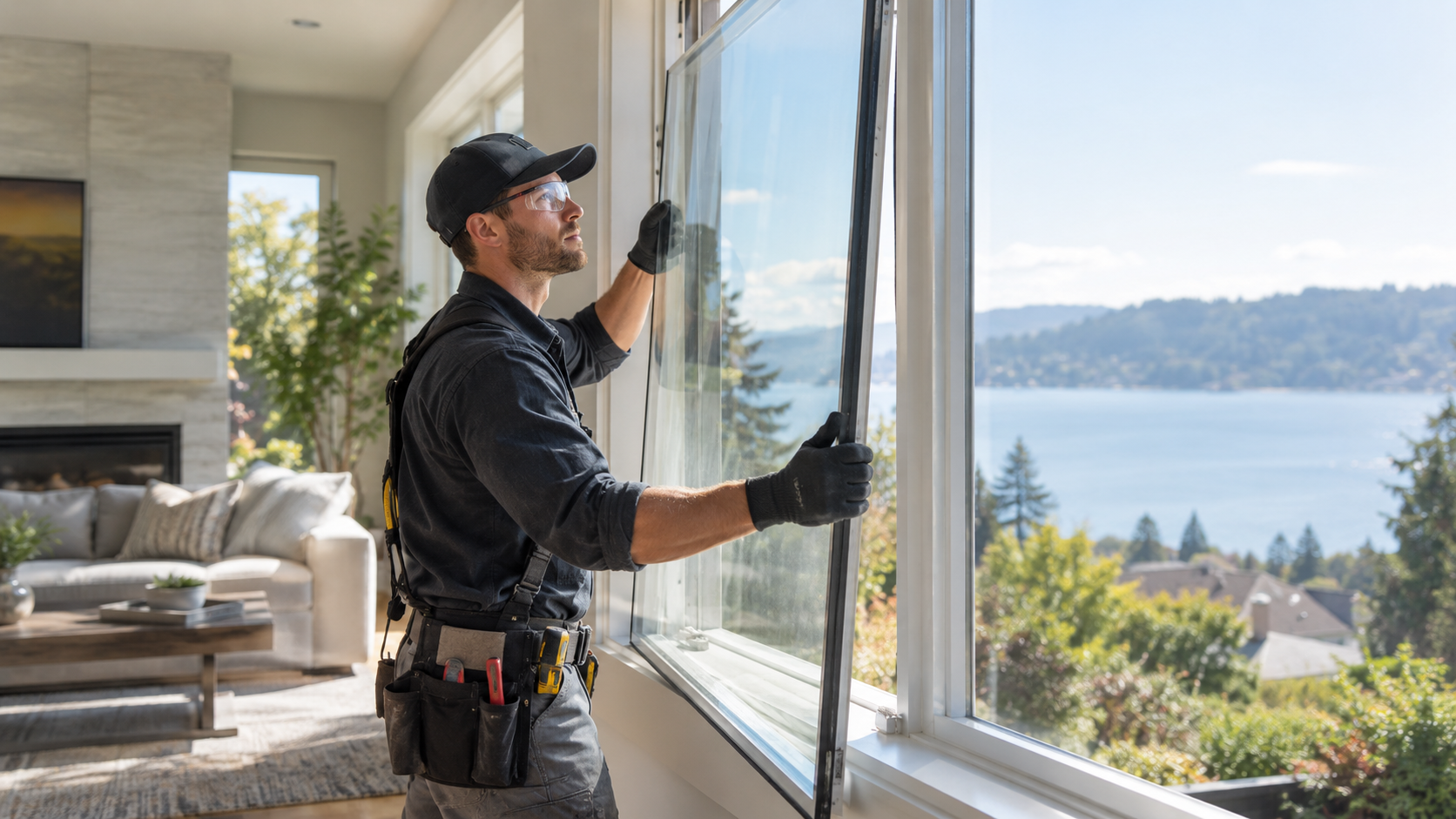
A cracked window has a funny way of demanding attention. One day it is a tiny line near the corner. A few weeks later, that line has traveled halfway across the pane, the room feels draftier, and you are wondering whether the whole window needs to come out.
Usually, it does not.
Window glass replacement can often restore a damaged, foggy, or inefficient window without replacing the frame, trim, and entire window unit. That can save money and avoid turning a fairly contained repair into a larger remodeling project.
But there is a catch. “Replacing the glass” can mean several different things.
A single sheet of glass in an older wood window is one job. Replacing a sealed double-pane insulated glass unit is another. Tempered glass near a door follows different safety rules. Laminated glass behaves differently again. And if the frame itself is rotten, warped, or leaking, new glass may only solve half the problem.
So the useful question is not simply, “Can the glass be replaced?”
The better question is: what exactly failed, and is the rest of the window worth keeping?
What does window glass replacement actually mean?
Window glass replacement means removing damaged or failed glazing and installing new glass while keeping some or all of the existing window frame.
Depending on the window, the replacement may involve:
- A single pane of glass
- A sealed double-pane insulated glass unit
- A triple-pane insulated glass unit
- Tempered safety glass
- Laminated safety glass
- Low-E coated glass
- Decorative or patterned glass
- Specialty privacy or obscure glass
The frame may remain completely in place, or the sash may be removed so a glass shop can work on it more easily.
This distinction matters because a homeowner saying, “I need a new window,” may actually need only a new insulated glass unit.
When replacing only the glass makes sense
Glass-only replacement is often a good option when the frame and sash are still in decent condition.
Maybe a lawn mower sent a stone through the pane. Maybe a seal failed inside a double-pane window and now there is permanent fog between the layers. Maybe thermal stress created a crack even though the frame itself is solid.
If the window opens properly, locks securely, drains correctly, and has no serious rot or structural damage, replacing the glass can be the sensible fix.
You are fixing the failed part instead of throwing away everything around it.
When replacing the entire window may be better
There are cases where new glass is technically possible but financially questionable.
If the frame is rotting, deeply corroded, badly warped, or pulling away from the wall, glass replacement will not correct those issues.
The same applies if the sash no longer closes properly, hardware is failing, or air and water are entering around the window assembly rather than through the glass.
Full window replacement deserves consideration when:
- The frame has significant rot or structural damage
- The sash is warped or no longer closes correctly
- Water leaks around the perimeter of the window
- Multiple parts of the window have failed
- The existing window is extremely inefficient
- Replacement hardware is no longer available
- The homeowner wants a major change in style or operation
- The surrounding wall or opening needs repair anyway
Glass replacement works best when the glass is the problem.
It sounds obvious, but that simple distinction prevents a lot of wasted money.
Single-pane window glass replacement
Single-pane windows contain one layer of glass.
You still find them in older houses, garages, sheds, historic buildings, storm windows, and some specialty applications.
Replacing a broken single pane can be relatively straightforward. The old glass is removed, the opening is cleaned, new glass is cut to size, and the glazing system is restored.
Older wood windows may use glazing points and glazing putty. Other frames use removable stops, clips, or gaskets.
Single-pane glass itself is simple. The surrounding frame can be the tricky part.
Old glazing compound may be hard and brittle. Wood stops can split. Paint may overlap the glass. Historic windows sometimes require much more patience than the size of the repair suggests.
Double-pane window glass replacement
Most modern residential windows use insulated glass rather than one loose pane.
A double-pane insulated glass unit, often shortened to IGU, has two pieces of glass separated by a spacer around the perimeter. The edge is sealed, creating an enclosed space between the panes.
The cavity may contain air or an insulating gas depending on the window design.
If one pane breaks, contractors generally do not peel the unit apart and replace only that sheet of glass on-site.
Instead, the damaged IGU is measured and a new sealed unit is manufactured to match the required dimensions and specifications.
Then the old IGU is removed from the sash and the replacement unit is installed.
What causes fog between double-pane windows?
This is one of the most common reasons homeowners look into window glass replacement.
You clean the inside.
You clean the outside.
The haze is still there.
That is because the moisture is between the panes.
When the perimeter seal of an insulated glass unit loses its ability to keep moisture out, condensation can develop inside the sealed space.
The amount of fogging may change with weather conditions. It can appear worse in the morning and less obvious later in the day.
Over time, mineral deposits or staining can remain on the inner glass surfaces.
If the seal has genuinely failed, cleaning the exposed sides of the window will not fix it.
Can a foggy double-pane window be repaired?
There are services that attempt to improve the appearance of fogged windows without replacing the full insulated unit.
But removing visible moisture is not the same thing as restoring the original sealed IGU construction.
For a failed insulated glass unit, replacement of the sealed glass assembly is generally the more complete repair because the failed unit is removed and a new sealed unit takes its place.
If energy performance matters, ask what replacement glass package will be installed rather than focusing only on whether the fog disappears.
What is Low-E window glass?
Low-E stands for low emissivity.
Low-E glass has a very thin coating designed to manage radiant heat transfer while still allowing visible light through the window.
The exact performance varies by coating type, glass configuration, climate target, and manufacturer.
If you are replacing one insulated glass unit in a group of windows, matching the existing Low-E characteristics can matter.
Otherwise, the replacement pane may look slightly different from neighboring windows under certain lighting conditions.
It may also perform differently.
So if the original glass had Low-E coating, mention that when requesting the replacement.
Tempered glass and why location matters
Not all window glass can be replaced with ordinary annealed glass.
Building codes require safety glazing in certain hazardous locations. The exact rules depend on the jurisdiction and window location.
Tempered glass is commonly used where broken glass could create a higher injury risk.
It is heat-treated so that when it breaks, it tends to fracture into many relatively small pieces rather than large sharp shards.
Common locations that may trigger safety-glazing requirements include certain glass near doors, bathrooms, showers, tubs, stairs, landings, and areas close to walking surfaces.
The details matter. Distance, pane size, height, and the exact installation can affect whether safety glass is required.
This is one reason you should not automatically replace broken glass with “whatever fits.”
Laminated glass works differently
Laminated glass consists of glass layers bonded to an interlayer.
If the glass breaks, the interlayer helps hold fragments together.
You see this concept in automotive windshields, though residential laminated products have their own specifications and applications.
Laminated glass may be used for security, sound control, storm-resistant assemblies, safety applications, or other specialty purposes.
It can also be part of impact-resistant window systems in hurricane-prone areas.
If your home has impact-rated windows, replacing a broken pane is not the moment to casually substitute ordinary glass.
The complete tested window assembly matters.
Common window glass types compared
| Glass type | Common use | Main benefit | Important consideration |
|---|---|---|---|
| Annealed glass | Standard applications where safety glazing is not required | Simple and widely available | Breaks into larger sharp pieces |
| Tempered glass | Safety-glazing locations | Designed to break into smaller pieces | Must be manufactured to final size before tempering |
| Laminated glass | Safety, security, sound control, impact applications | Interlayer helps hold broken glass together | Usually costs more than standard glass |
| Low-E glass | Energy-efficient windows | Helps manage radiant heat transfer | Coating should be matched to the desired performance |
| Insulated glass unit | Modern double- or triple-pane windows | Improved thermal performance compared with single glazing | Seal failure can cause fogging between panes |
| Obscure glass | Bathrooms and privacy areas | Allows light while reducing visibility | Pattern should match existing glass when replacing one pane |
How much does window glass replacement cost?
There is no single national price that fits every project.
A small single-pane repair in an accessible first-floor window can cost far less than a large custom insulated unit installed high above the ground.
Glass type matters too.
Tempered, laminated, Low-E, oversized, curved, decorative, and impact-resistant glass usually changes the price compared with basic clear glass.
Labor also varies by region.
A contractor working in Manhattan does not have the same operating costs as a small glass shop in rural Indiana.
So instead of chasing one magic price, look at what actually drives the quote.
Main factors that affect window glass replacement cost
- Glass dimensions
- Single-pane versus insulated glass
- Double-pane versus triple-pane construction
- Tempered or laminated safety requirements
- Low-E coating
- Decorative or privacy patterns
- Impact-resistant specifications
- Window location and access
- Second- or third-story work
- Sash condition
- Frame material
- Emergency or after-hours service
- Custom shapes
- Removal and disposal of broken glass
Large glass does not just mean more material.
It can also mean more people, special lifting equipment, larger vehicles, and additional safety planning.
Glass-only replacement vs. full window replacement
| Factor | Glass replacement | Full window replacement |
|---|---|---|
| Existing frame | Usually kept | Window unit is removed and replaced |
| Project disruption | Usually lower | Usually greater |
| Cost | Often lower when frame is sound | Usually higher |
| Fixes broken glass | Yes | Yes |
| Fixes rotten frame | No | Usually, depending on installation scope |
| Changes window style | No | Yes |
| Best when | Glass or seal is the main problem | Whole window is worn, damaged, or inefficient |
How long does window glass replacement take?
The physical installation can sometimes be quick.
The waiting period often comes before installation.
Basic single-pane glass may be cut relatively quickly if the size and material are readily available.
A custom insulated glass unit usually has to be manufactured after measurements are taken.
Tempered glass also requires factory processing because it cannot simply be cut to size after tempering.
Custom laminated, decorative, oversized, or specialty glass can take longer.
Ask whether the contractor will temporarily secure the opening if the existing pane is badly broken.
Can window glass be replaced from inside the house?
Sometimes.
It depends on how the window was built.
Some glazing beads or stops are accessible from the interior. Others are located outside. Certain sashes can be removed and worked on separately.
Large fixed windows may require exterior access and lifting equipment.
Do not assume a second-story glass replacement can be handled from inside simply because the window opens inward.
What happens during window glass replacement?
The process begins with identifying the exact type of glass and measuring the opening or existing insulated unit.
If the project involves an IGU, the technician may need several measurements beyond simple width and height.
Thickness matters.
Spacer dimensions matter.
Glass configuration matters.
Coatings can matter.
Safety requirements can matter.
Once the replacement is ready, the damaged glass or insulated unit is removed. The glazing pocket is cleaned and prepared. New glass is installed with the appropriate setting blocks, seals, tapes, gaskets, glazing compounds, or retainers used by that particular window system.
Then the stops or glazing beads are reinstalled.
Simple on paper. Very detail-dependent in practice.
Why accurate measurements matter so much
Glass does not have much patience for “close enough.”
An insulated glass unit that is slightly too large may not fit into the sash.
A unit that is too small may not be properly supported or sealed.
Thickness is especially important because the existing glazing pocket is designed for a certain assembly.
This is also why homeowners ordering custom glass themselves should measure carefully and understand exactly which dimensions the supplier wants.
Some suppliers ask for visible glass dimensions.
Others want the full glass unit size.
Those are not the same thing.
Can you replace just one pane of a double-pane window?
In practical residential repair, the sealed insulated glass unit is normally treated as one assembly.
If one pane cracks, replacing the complete IGU usually preserves the intended sealed construction.
Trying to disassemble the existing sealed unit and rebuild it in the field is not equivalent to installing a newly manufactured IGU.
This is one of those areas where the phrase “only one pane is broken” can be misleading.
Physically, yes.
Functionally, both panes belong to one sealed unit.
What if the glass cracked for no obvious reason?
Not every crack comes from a baseball.
Glass can crack because of thermal stress, edge damage, frame movement, installation pressure, or defects.
Temperature differences across the pane can create stress, particularly when part of the glass is heavily shaded while another part heats in direct sunlight.
It is worth looking at where the crack begins.
A crack starting from an edge may tell a different story from a clear impact point in the center of the pane.
If several replacement panes crack in the same window, stop replacing glass and investigate the frame and installation.
Can a cracked window be left alone?
Sometimes a crack remains stable for a while.
Sometimes it spreads surprisingly fast.
Temperature changes, vibration, wind pressure, opening and closing the sash, or minor movement can extend an existing crack.
Broken glass also creates an injury risk.
If the pane is badly fractured, loose, or located where people can contact it, secure the area and arrange repair promptly.
Tape may help keep some fragments together temporarily, but it is not a structural repair.
What should you do immediately after a window breaks?
Keep people and pets away from the area first.
Wear appropriate gloves and footwear before approaching broken glass.
Do not grab loose shards with bare hands.
Large pieces can be heavier and sharper than they appear.
If the window is exposed to weather, the opening may need temporary protection until replacement glass is available.
A contractor can board or secure the opening when necessary.
Be careful with plastic sheeting in windy conditions. A temporary cover needs to be attached securely enough that it does not become another problem.
Can window glass replacement improve energy efficiency?
If you are replacing a failed insulated glass unit with a new unit that matches or improves the original glass package, thermal performance can improve compared with the failed unit.
But replacing glass alone does not automatically make an old window equivalent to a completely new high-performance window.
The frame, spacers, weatherstripping, installation, air leakage, and overall design still matter.
If the existing window has severe drafts around the sash or frame, better glass will not stop all of them.
This is where a little diagnostic honesty helps.
If air is coming around the glass, glazing work may help.
If air is coming around the sash, look at seals and weatherstripping.
If air is coming between the window frame and wall, the installation itself may be the problem.
What is argon gas in windows?
Some insulated glass units are manufactured with argon or another gas inside the cavity between panes.
Argon has lower thermal conductivity than ordinary air, so it can improve the insulating performance of an IGU when used as part of an appropriate glass system.
You cannot see argon.
And no, a homeowner cannot realistically look at a window and tell whether the gas is still present.
If an IGU seal fails significantly, the original gas fill may no longer remain as designed.
Can Low-E coating look different after replacement?
Yes, occasionally.
Low-E coatings can create subtle differences in color or reflectivity depending on coating type, glass manufacturer, viewing angle, lighting, and which glass surface carries the coating.
If you replace one window in a wall of otherwise identical glass, an imperfect match may be noticeable in certain conditions.
This is especially relevant in homes with large groups of matching windows.
Tell the glass company if appearance matching is important.
What about grids between the glass?
Many double-pane windows have decorative grids sealed inside the insulated glass unit.
If that IGU needs replacement, the replacement unit may need matching grids.
Grid pattern, width, color, and placement can all matter.
A six-lite pattern that is half an inch off does not sound dramatic until you view it next to five matching windows.
Then you will see it every single day.
Privacy glass in bathrooms
Bathroom windows often use obscure or patterned glass to allow daylight while reducing visibility.
If that glass breaks, matching the pattern can be trickier than ordering clear glass.
Older patterns may be discontinued.
A close substitute may be available, but it may not look identical beside an existing pane.
Safety-glazing requirements may also apply depending on the window’s location relative to tubs, showers, floors, and other features.
Window glass in hurricane-prone regions
Coastal and hurricane-prone areas deserve extra care.
Impact-resistant windows are tested as complete systems, not simply as a random sheet of strong glass placed into any frame.
If a damaged window is part of an impact-rated assembly, the replacement should maintain the required system performance and comply with local requirements.
That can involve specific laminated glass, sealants, glazing methods, hardware, and frame components.
Do not downgrade an impact-rated unit to ordinary residential glass just because the opening dimensions match.
Window film and replacement glass
Some homeowners add aftermarket film for privacy, heat control, UV reduction, decoration, or security.
Film can change how solar energy is absorbed by the glass.
Not every film is suitable for every insulated glass configuration.
If you plan to apply film to replacement glass, check compatibility with the window and glass manufacturer where applicable.
This is especially worth considering with Low-E glass and insulated units.
Can scratched window glass be repaired?
Very light surface imperfections can sometimes be polished professionally.
Deep scratches are another story.
Aggressive polishing can distort the glass optically, leaving a wavy area that becomes more noticeable than the original scratch.
For deep scratches, glass replacement may produce the cleaner result.
Before replacing anything, confirm whether what looks like a scratch is actually on the glass. Construction debris, paint, hard-water deposits, and residue can imitate damage.
What about chips in window glass?
Small chips do not always require immediate replacement, but their location matters.
Edge damage deserves particular attention because the edges of glass are vulnerable stress points.
A chip can also be unpleasant or dangerous if it creates a sharp exposed edge.
If the glass is tempered, laminated, or part of a structural or impact-rated assembly, ask a professional rather than treating it like a windshield chip.
Does homeowners insurance cover broken window glass?
Coverage depends on the policy and cause of damage.
A window broken by a covered storm event or vandalism may be treated differently from glass that cracked because of age, seal failure, or maintenance issues.
The deductible matters too.
A repair could cost less than the deductible, making an insurance claim impractical even when the type of damage is technically covered.
Check your policy before assuming either way.
How to compare window glass replacement quotes
A quote should tell you more than the total price.
You need to know what glass you are actually getting.
Ask for the glass configuration, thickness, safety treatment where applicable, Low-E specification if relevant, and whether the unit includes grids or special coatings.
Also ask whether removal, disposal, installation materials, cleanup, and temporary securing are included.
If the job requires ladders, lifts, or difficult exterior access, confirm whether those costs are already part of the estimate.
Should you replace several foggy windows at once?
If one IGU has failed, replacing just that unit is completely reasonable.
But if several windows from the same installation are showing similar seal failure, it may be worth pricing them together.
There can be logistical savings when a contractor measures and installs multiple units during the same visits.
You also get a more consistent appearance if several adjacent panes need replacement.
That does not mean replacing every window in the house just because one looks foggy.
Repair what actually needs repair.
How do you know whether the frame is still good?
Start by operating the window.
Does it open smoothly?
Does it lock?
Does the sash sit squarely in the frame?
Look for soft wood, corrosion, cracks, loose joints, distorted vinyl, water staining, and failed seals.
Check the area around the frame too.
A perfectly good piece of glass will not solve water entering through failed flashing or damaged siding above the window.
FAQ about window glass replacement
Can you replace glass without replacing the whole window?
Yes. If the frame and sash are still in good condition, broken or failed glass can often be replaced while keeping the existing window. Double-pane windows typically receive a new sealed insulated glass unit rather than a single loose pane.
Is it cheaper to replace window glass or the whole window?
Glass-only replacement is often less expensive when the frame and hardware are still sound. Full replacement costs more but may make sense when the frame, sash, seals, or installation are also failing.
Can foggy double-pane glass be replaced?
Yes. A failed insulated glass unit can usually be removed from the sash and replaced with a newly manufactured sealed unit of the correct dimensions and specifications.
How long does window glass replacement take?
The installation itself may be relatively quick, but custom insulated, tempered, laminated, or decorative glass usually needs to be manufactured first. Total timing depends on the glass type and availability.
Can I replace one broken pane in a double-pane window?
The two panes normally form one sealed insulated glass unit. When one pane breaks, the complete IGU is generally replaced so the sealed construction and insulating space are restored.
When is tempered glass required?
Safety glazing is required in certain hazardous locations, such as some glass near doors, tubs, showers, stairs, landings, and walking surfaces. Exact requirements depend on local building codes and the window’s dimensions and position.
Does replacing window glass improve energy efficiency?
Replacing a failed insulated unit can restore much of the performance lost when its seal failed. However, overall window efficiency also depends on the frame, weatherstripping, installation, air leakage, spacer system, and glass configuration.
Conclusion: Replace the Part That Actually Failed
Window glass replacement is one of those home repairs that looks simple until you start asking what kind of glass is actually in the window.
Single pane?
Double pane?
Tempered?
Laminated?
Low-E?
Impact-rated?
Obscure?
Suddenly the piece of glass in front of you has a résumé.
Still, the basic decision is straightforward.
If the frame, sash, hardware, and installation are in good shape, replacing damaged glass can be a smart way to extend the life of the window.
You keep what still works and replace what failed.
A cracked pane can be changed.
A fogged insulated glass unit can be changed.
A damaged safety-glass unit can be replaced with the correct type.
You do not automatically need a new frame, new trim, drywall work, and a full window installation every time glass fails.
But there is a point where glass-only repair stops making sense.
If the frame is rotten, the sash is warped, the locks barely work, and water is entering around the opening, a sparkling new pane will not turn that old window into a good one.
That is why inspection matters before ordering glass.
Look beyond the crack.
Operate the window.
Check the frame.
Look for water staining.
Check the exterior.
Think about where the draft actually comes from.
If several problems exist at once, compare the cost of repairing them with the cost of full replacement.
Glass specifications deserve attention too.
Do not replace tempered safety glass with ordinary annealed glass just because it is cheaper.
Do not replace an impact-rated window assembly with random glass because the dimensions happen to match.
And if the rest of a wall has Low-E insulated glass, tell the glass shop you want the replacement to match as closely as practical.
Appearance matters more than people expect.
A slightly different tint or reflectivity may be barely noticeable on one isolated bedroom window.
Put that pane in the middle of a five-window wall and the difference can suddenly feel enormous.
The same goes for decorative grids.
Measure carefully.
Match the layout.
Check the color.
These details take minutes before ordering and can save years of looking at the one window that seems just a little off.
And remember that a failed insulated glass unit is not always proof that the entire window is bad.
Sealed units can fail while frames remain perfectly usable.
Replacing the IGU can remove fog, restore clear views, and return the window closer to its intended thermal performance without disturbing the opening in the wall.
That is one of the strongest reasons glass-only replacement remains useful.
It is targeted.
There is less demolition.
Less disruption.
And often a smaller bill.
On the other hand, do not let a lower initial price convince you to keep a window that has reached the end of its practical life.
If you are replacing glass today, hardware next month, weatherstripping in winter, and rotten frame sections next spring, the cheaper repair path starts becoming expensive.
Sometimes replacement is the repair.
The quote should make the decision clearer.
Ask exactly what glass is being installed.
Ask whether it is double pane.
Ask about Low-E coating.
Ask whether safety glazing is required.
Ask whether disposal is included.
Ask how the opening will be protected if the new glass needs to be manufactured.
And if access is difficult, ask how the contractor plans to reach it safely.
Those questions are much more useful than asking only, “How much per window?”
A tiny bathroom pane, a large living-room picture window, and a third-floor custom IGU are all windows, but they are not remotely the same job.
One last thing: keep records after the repair.
Save the invoice.
Note the glass type.
Keep the manufacturer’s information if you receive it.
If the window contains a special grid, coating, spacer, tint, or safety glass, record that too.
Years later, another pane may need replacement.
Being able to say, “This is the exact glass package installed in 2026,” is far more useful than saying, “It was kind of clear and maybe double pane.”
Window glass replacement does not need to become a full remodeling project.
Start with the problem you actually have.
If the glass failed and everything around it still works, replace the glass.
If the whole window is failing, treat the whole window.
That simple approach usually leads to the most sensible repair – and lets you see clearly through the window again without replacing more of the house than necessary.

Leave a Reply