

Firestone alignment: what the service actually covers
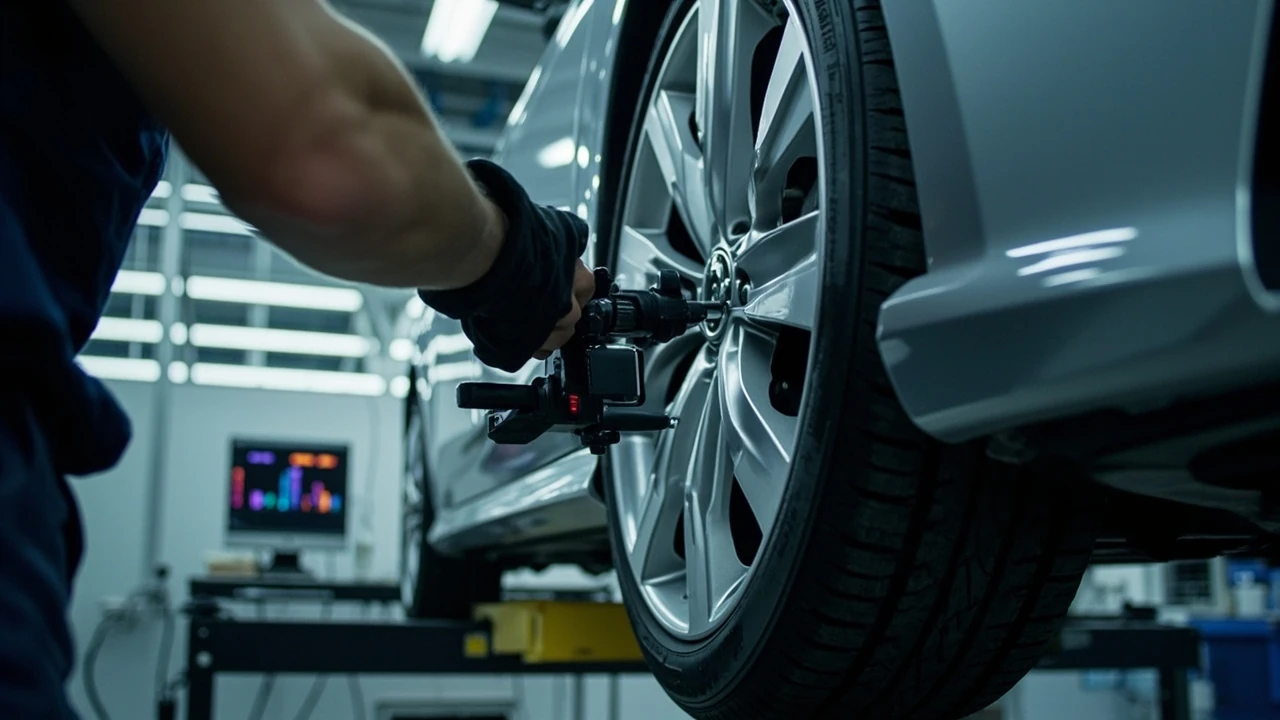
A car that drifts toward the shoulder, a steering wheel that sits crooked at highway speed, or a set of tires that wore out 8,000 miles early usually points to the same place: the wheel alignment. A Firestone alignment is the company’s branded version of that service, performed at Firestone Complete Auto Care locations and carried out with computer-calibrated sensors that measure where each wheel actually points relative to the vehicle centerline and the manufacturer’s specifications.
Unlike a tire rotation or an oil change, an alignment is a measurement-and-adjustment job, not a parts replacement. The technician starts by hanging optical or laser sensors on each wheel, then compares the live angles to the factory specs stored in the shop’s alignment database. If anything is out of range, the technician makes mechanical adjustments to the camber, caster, and toe at the front and, on most modern vehicles, the rear.
Understanding what the service does and what it does not do is the first step toward deciding whether the package a shop offers is the right one for your car.
What an alignment actually fixes
An alignment is essentially geometry work. The technician checks three core angles per wheel, plus a few related measurements, and brings them back inside the manufacturer’s tolerance band.
- Camber is the inward or outward tilt of the wheel when viewed from the front. Too much positive or negative camber wears the inside or outside shoulder of the tire and changes cornering grip.
- Caster is the forward or rearward tilt of the steering axis when viewed from the side. Caster affects straight-line stability, steering return, and the feel of the wheel after a turn.
- Toe is the direction each wheel points relative to the vehicle centerline, viewed from above. Toe is the single biggest contributor to premature tire wear, which is why it gets the most attention during the adjustment.
- Thrust angle is the direction the rear axle points relative to the vehicle centerline. On vehicles with an adjustable rear axle, the alignment machine will square the rear to the body before the front is set.
- Steering wheel position is reset last, so the wheel sits centered when the car drives straight on a level surface.
None of these adjustments replace worn ball joints, tie rods, bushings, or struts. If a component is bent, clapped out, or has play in it, the alignment will not hold, and the shop will usually tell you that before starting the job.
What a Firestone alignment is not
Because the term is used loosely in everyday conversation, it helps to separate the service from the things people often assume it includes.
- It is not a wheel balance. Balancing corrects weight distribution across the tire and wheel assembly; alignment corrects the direction the wheel points.
- It is not a tire rotation. Rotating tires moves them between positions to even out wear; alignment prevents uneven wear from happening in the first place.
- It is not a suspension repair. If a control arm is bent or a tie rod is loose, the alignment shop will typically refer you back to a repair shop first.
- It is not a steering-angle sensor calibration in the ADAS sense. On cars with lane-keep or adaptive cruise systems, a separate camera or sensor calibration may be needed after the alignment, and that is usually a different line item.
How a Firestone alignment is performed
The shop’s process is fairly standardized across most franchised locations, which is one reason Firestone’s packages are easy to compare across cities.
- Pre-check. The technician inspects the tires for uneven wear, checks air pressure, and looks at visible suspension components. If a tire is badly cupped or a ball joint is clearly worn, the shop will flag it before starting.
- Sensor mounting. Reflective targets or clamp-on sensors are attached to each wheel. The vehicle is then positioned on a level alignment rack and the sensors are zeroed.
- Live measurement. The technician turns the steering wheel to prescribed angles, runs the car on a slip plate, or both, depending on the equipment. The alignment console displays the current values next to the target values for the specific vehicle.
- Adjustment. The technician makes mechanical corrections to camber, caster, and toe using the factory adjustment points. On many modern cars, toe is the only front angle that is easily adjustable; camber and caster shims or bolts may be needed for the others.
- Final printout and steering wheel centering. A before-and-after report is generated. The steering wheel is centered, and the car is test-driven to confirm straight-line tracking.
The whole process usually takes 45 minutes to an hour and a half for a standard two-wheel alignment on a passenger car, and longer if the vehicle needs four-wheel adjustment or has rust-seized adjusters.
Standard, warranty, and lifetime packages compared
Firestone, like most national chains, sells the service as a tiered menu rather than a single flat-rate job. The tiers differ in how long the coverage lasts and what is included if the alignment drifts out of spec.
| Package | Typical use case | Coverage length | What you get on a re-visit |
|---|---|---|---|
| Standard alignment | One-time correction after a pothole, curb hit, or suspension part replacement | Single service, no follow-up coverage | None; you pay again if the angles drift later |
| Warranty alignment | Drivers who want a safety net for a defined period | Usually 12 months or a set mileage window | Re-adjustment within the coverage window if the alignment drifts out of spec under normal driving |
| Lifetime alignment | Long-term owners and high-mileage drivers | As long as you own the car and stay within the service interval | Re-alignments at the stated interval, often every 6,000 miles, tied to the same store or chain |
For pricing, the published guidance from Firestone’s own service descriptions places a one-time standard alignment in the $80 to $120 range for most passenger vehicles, with the warranty and lifetime packages sitting higher. The specific cost of a Firestone alignment will vary by region, vehicle, and store, but the way the tiers are structured is consistent nationwide.
Typical price drivers for a Firestone alignment
Two cars can sit on the same alignment rack at the same store and walk out with noticeably different bills. The variables below are usually why.
| Factor | Why it moves the price |
|---|---|
| Two-wheel vs. four-wheel alignment | Four-wheel alignments take longer and require more adjustments; rear toe and camber add labor |
| Vehicle make and adjustment range | Performance cars, European models, and trucks with solid rear axles often have more limited factory adjustment, requiring shims or specialty bolts |
| Package chosen | Standard, warranty, and lifetime tiers are priced as escalating products, not escalating labor |
| Regional labor rates | Urban stores and high-cost-of-living areas price higher than rural locations |
| Add-on services | Road-force balancing, new valve stems, or tire dismounts for inspection are billed separately |
| ADAS recalibration | Vehicles with lane-keep assist or adaptive cruise may need a camera calibration after the alignment, which is a separate line item |
For a current snapshot of the standard, warranty, and lifetime pricing, a Firestone wheel alignment cost guide lays out the typical ranges and explains how the packages differ for one-time versus long-term drivers.
When a Firestone alignment is worth booking
An alignment is preventive maintenance for the steering and suspension geometry, and it pays for itself when the symptoms below show up.
- The car pulls noticeably to one side on a flat, straight road.
- The steering wheel sits off-center when the car is driving straight.
- The tires show uneven shoulder wear, feathering, or cupping that matches an alignment issue rather than a balance or inflation problem.
- You have just replaced suspension parts such as tie rods, control arms, or struts, and the geometry needs to be re-set.
- You have hit a significant pothole, curb, or been in a minor collision and want the angles verified before the tires wear out.
- You are mounting new tires and want to start their life on correctly aimed wheels.
If your car drives straight, the steering wheel is centered, and the tires are wearing evenly across the tread, you do not need an alignment for alignment’s sake. Paying for service you do not need is one of the more common ways drivers overspend on routine maintenance.
When an alignment is not the fix
Several issues look like alignment problems but actually live elsewhere. Bringing the car in for an alignment will not solve them, and a good shop will redirect you.
- Brake pull. A sticking caliper, warped rotor, or uneven brake pressure can pull the car during braking. An alignment will not change brake feel.
- Tire problems. A separated belt, out-of-round tire, or bad wheel bearing can mimic alignment symptoms. The shop should rule these out first.
- Worn steering or suspension parts. If a tie rod end or ball joint has too much play, the alignment will not hold. The shop will usually write up the worn part before doing the geometry work.
- Frame damage. A vehicle that has been in a significant collision may need frame straightening before the alignment can be brought into spec.
What to do before you book the appointment
A small amount of preparation makes the visit smoother and the result more durable.
- Check that the tires are inflated to the door-jamb pressure. An alignment done on soft tires will read incorrectly and can drift out of spec within days.
- Note the symptoms. Pulling, a crooked wheel, and a vibration each suggest different underlying issues, and a clear description helps the technician prioritize.
- Decide on the package ahead of time. If you plan to keep the car more than three years, the lifetime package usually pays for itself after the second visit.
- Ask whether your vehicle has ADAS features that may need camera or radar calibration after the alignment. If it does, confirm whether the shop handles that in-house.
- Bring any recent repair receipts. Suspension work changes the baseline, and the technician needs to know what has been replaced.
How to read the alignment printout
Most alignment machines produce a color-coded before-and-after sheet. Knowing how to read it helps you judge whether the job was done well.
| Color on the printout | What it means |
|---|---|
| Green | Measurement is inside the manufacturer’s specified tolerance |
| Yellow | Measurement is at the edge of tolerance; acceptable but not ideal |
| Red | Measurement is outside the spec and needs correction |
For a finished job, every angle you care about should be green, the steering wheel should be centered, and the thrust angle should be near zero. Yellow readings on non-adjustable angles are common on production vehicles and are usually acceptable as long as the toe is solid green.
Firestone alignment vs. independent shops vs. dealerships
The service is largely the same regardless of who does it. The differences come down to pricing, equipment, and follow-up coverage.
| Provider type | Typical strengths | Typical trade-offs |
|---|---|---|
| Firestone (chain) | Standardized packages, lifetime coverage options, broad national footprint | Pricing varies by store, and the lifetime package is tied to the chain rather than a single mechanic |
| Independent alignment shop | Specialized equipment, often competitive pricing, flexible scheduling | Coverage terms vary widely; some shops offer a 30-day guarantee but not a lifetime plan |
| Dealership service center | Factory specs and tooling for that specific brand, plus brand-specific knowledge | Usually the most expensive option, especially for warranty or lifetime pricing |
| General mechanic | Convenient if you already use the shop for other work | Quality depends entirely on whether the shop runs alignments regularly and keeps its equipment calibrated |
If you want a standardized package and the option of lifetime coverage, a Firestone alignment is a reasonable default. If your vehicle is a brand-specific model with unusual geometry, a dealer or a specialist may be a better fit.
How often an alignment should be checked
There is no universal interval, but a few common rules of thumb hold up well across most driving conditions.
- Once a year for a typical commuter, ideally when the tires come off for seasonal changeover.
- Every 6,000 miles if your vehicle is a long-term member of the lifetime alignment plan, since the coverage is structured around that interval.
- Immediately after any pothole strike, curb hit, or minor collision that affects a wheel or the steering.
- Whenever you mount a new set of tires, so they start life on correctly aimed wheels.
How an alignment interacts with tire life
The single largest cause of premature tire wear that an alignment can prevent is incorrect toe. Even a small amount of toe that is out of spec can shave thousands of miles off a tire.
- Toe-in wear shows as a feathered edge across the tread blocks, typically with sharp edges on one side and smooth on the other.
- Toe-out wear looks similar but with the feathering direction reversed.
- Camber wear shows as heavy shoulder wear on one side of the tire, either inside or outside.
- Caster wear usually shows as a lead or pull that does not match a toe reading and is less common in everyday driving.
For a driver who buys a new set of tires every 40,000 to 60,000 miles, keeping the alignment in spec is usually cheaper than replacing a single tire early because of an alignment-related wear pattern.
Common myths about Firestone alignment service
Misconceptions about the service come up often enough to be worth clearing up directly.
- Misconception: any alignment is fine as long as the car drives straight. A wheel can be straight on the road and still have toe that is technically out of spec, which means tire wear is happening even if you do not feel it.
- Misconception: lifetime alignment means unlimited visits. The plan is typically tied to a service interval, often every 6,000 miles, and to the original vehicle owner.
- Misconception: alignment prevents all tire wear. Alignment addresses geometry-related wear. Inflation, balance, rotation, and driving style all matter independently.
- Misconception: a new set of tires includes an alignment. Tires and alignment are usually billed separately, and it is worth asking whether the shop will align the new tires at the time of mounting.
Frequently asked questions
How long does a Firestone alignment take?
A standard two-wheel alignment usually takes 45 minutes to an hour and a half. A four-wheel alignment, or one that requires extra time for seized adjusters or ADAS recalibration, can take closer to two hours. The shop will usually give you a time window when you book.
Do I need an alignment if my tires are wearing evenly?
If the steering wheel is centered, the car tracks straight, and the tread is wearing evenly across all four tires, an alignment is not urgent. It is still reasonable to check the alignment once a year as preventive maintenance, especially before mounting a new set of tires.
Is a Firestone alignment worth the cost compared with an independent shop?
The labor is comparable. Firestone’s main advantage is the standardized package menu and the lifetime coverage option, which an independent shop may or may not match. If you keep your car for several years, the lifetime plan often pays for itself after the second visit.
Will a Firestone alignment fix a crooked steering wheel?
Yes, in most cases. The steering wheel position is one of the final checks during the alignment, and the technician will recenter it as part of the procedure. If the wheel goes crooked again shortly after, that points to a suspension or steering component that needs to be replaced.
Does an alignment include a tire rotation?
No. An alignment and a rotation are two separate services. Many shops will rotate the tires at the same visit if you ask, but they are billed independently.
Can I drive my car before an alignment if it is pulling?
You can, but you will wear the tires faster the longer you drive with bad toe. A mild pull is not an emergency, but it is worth booking the service within a few days rather than waiting for the next scheduled maintenance.
How do I know if my car needs two-wheel or four-wheel alignment?
Most modern vehicles with independent rear suspension benefit from a four-wheel alignment so the rear thrust angle is set correctly. Older vehicles with a solid rear axle usually only need a front-end alignment. The shop will confirm which applies to your car before starting.
Will the lifetime alignment package transfer if I sell the car?
Typically, the lifetime plan is tied to the original purchaser and the original vehicle. Transferability varies by store and by region, so it is worth asking the manager at the location where you purchased the plan if you think you may sell the car.
Do I need a wheel alignment after replacing struts or tie rods?
Yes. Any time steering or suspension components that affect wheel angles are replaced, the alignment should be set after the parts are installed. The geometry will usually be off after the repair, even if the parts were installed to factory position.
Is a Firestone alignment the same as a front-end alignment?
A front-end alignment is one type of alignment that only adjusts the front wheels. Firestone offers both two-wheel and four-wheel alignments, and the package you need depends on the vehicle. The two terms are sometimes used interchangeably in conversation, but they are not technically identical.
Related home and property topics
While an alignment is a car maintenance job, keeping a household running smoothly involves a similar mix of preventive maintenance, scheduled service, and quick response to small problems before they become large ones. If you are working through a homeowner maintenance list, these guides cover comparable territory on the property side.

Leave a Reply