

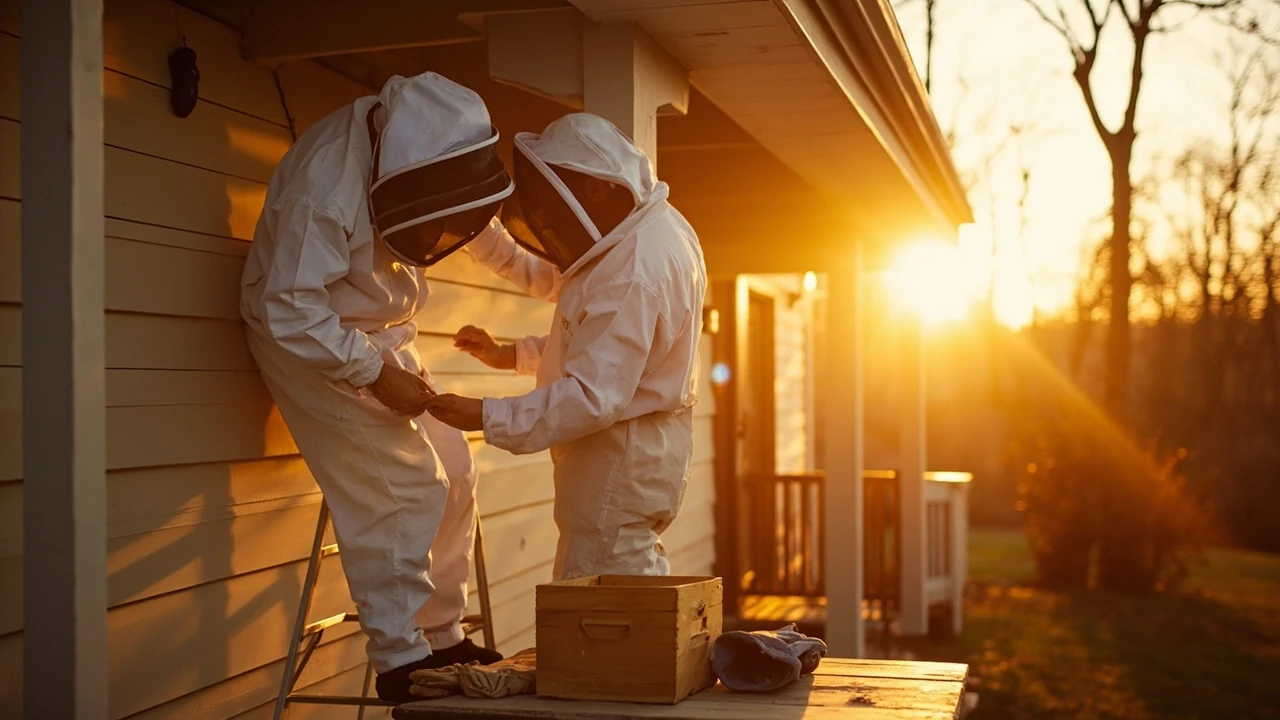
How to get rid of a bee hive in or around your home
A bee colony has taken up residence in the corner of a house, and the homeowner is weighing whether to spray it, ignore it, or call someone in. That is the decision most readers are actually trying to make, and it sits at the heart of any honest guide to how to get rid of a bee hive. The right answer depends on the species, the season, the size of the colony, where the hive is located, and how much risk the family is willing to absorb.
This guide walks through the practical decisions a U.S. homeowner faces when bees move in: how to tell honey bees from wasps and hornets, why a live removal usually beats an extermination, when do-it-yourself methods are reasonable, when a licensed remover is the safer call, and what a realistic timeline looks like. It is written for general household situations, not for commercial apiaries or large structural infestations that require structural contractors.
Start with identification, not action
Most of the bad outcomes people have with bee removal start before they know what they are dealing with. Spraying a colony of docile honey bees is wasteful. Spraying a yellowjacket nest under a deck is dangerous. The first job is to slow down and identify the insects correctly.
Honey bees, wasps, hornets, and solitary bees
Honey bees are fuzzy, roughly half an inch long, and brown and gold banded. They form waxy, multi-comb nests inside cavities such as wall voids, attics, chimneys, and hollow trees. A honey bee colony is perennial: the same queen and her daughters reuse the same cavity for years, building comb and storing honey.
Yellowjackets and hornets are sleeker, mostly hairless, and brighter yellow. They build papery nests, often underground, in shrubs, under eaves, or in sheds. Their colonies die off in late fall in most of the U.S., and only the new queens overwinter.
Solitary bees, including mason bees and carpenter bees, behave very differently. Mason bees nest in hollow stems and small cavities. Carpenter bees bore round holes into bare or weathered wood. Neither forms a large social colony, and both are usually best left alone or deterred with simple exclusion work.
If identification is uncertain, a state apiarist, local beekeeping club, or county extension office can often confirm a species from a photo. A wrong identification is the most common cause of unnecessary panic and unnecessary pesticide use.
Why it matters for removal
Identification changes the legal status, the urgency, and the legal tools available. In many U.S. states, honey bees are classified as livestock and cannot legally be killed with general-use pesticides. Yellowjackets, by contrast, are treated as stinging pests and are routinely controlled. Treating a honey bee colony like a yellowjacket nest is the single most common error in amateur bee work.
Safety and legal considerations before any work begins
Bee removal is one of those tasks where shortcuts cause ER visits. A reasonable plan accounts for allergic reactions, structural hazards, and local rules before any tool is picked up.
Allergy and bystander risk
Even calm honey bees will defend a nest. Roughly 1 to 3 percent of U.S. adults carry severe stinging-insect allergy risk factors, and reactions can escalate on later stings. Anyone in the household with a known allergy should not be within range during removal, and an epinephrine auto-injector should be on hand. If the home includes elderly residents, infants, or anyone with limited mobility to escape, the calculus shifts toward professional help.
Move pets indoors, close nearby windows, and warn neighbors a day in advance if the hive is near a property line. A colony that has been disturbed for several hours will send guard bees far from the nest site, which is a frequent cause of bystander stings.
Local rules and pesticide restrictions
Many U.S. municipalities restrict the use of general-use insecticides on pollinator nests, and some states require permits for structural pesticide applications. Check the state department of agriculture and the local code enforcement office before spraying. A licensed pest control operator (PCO) will already know the rules in their service area; a homeowner often does not.
Insurance and structural access
Cutting into a wall to remove a colony can affect fire blocking, electrical runs, and insulation. If the hive is inside a wall, attic, or chimney, a homeowner should know whether their homeowner’s policy covers any resulting damage. Professional removers often carry their own general liability insurance for the work itself, which is another reason to compare a beekeeper’s price against a PCO’s price rather than only against a DIY estimate.
Comparison of the three main removal paths
For most U.S. households, the decision collapses into three approaches. Each has clear strengths, clear failure modes, and a different cost band. The table below summarizes how they typically stack up.
| Method | Best for | Cost band (U.S., 2026) | Colony survival | Typical risks |
|---|---|---|---|---|
| Live removal by a beekeeper (cut-out) | Honey bees in walls, eaves, sheds, or accessible cavities | $300 to $1,000+ depending on access and size | High, if done carefully | Structural opening, possible cosmetic repair, several-hour job |
| Live trap-out | Hives that cannot be cut out without major damage | $200 to $600+ plus weeks of monitoring | Moderate, takes 4 to 8 weeks | Stragglers left behind, occasional re-entry, slower timeline |
| Extermination by a licensed PCO | Yellowjackets, hornets, or honey bees when no remover is available | $150 to $500 for typical residential jobs | Colony dies | Dead bees and brood inside walls, odor, possible secondary infestation, legal limits in some states |
The category that often gets overlooked is the trap-out. A trap-out uses a one-way cone at the hive entrance so foraging bees can leave but not return. Over several weeks, the field force relocates to a nuc box placed outside. This is the method that experienced beekeepers discuss in detail on community forums when a cut-out would mean tearing out a finished wall. The mechanics, including the use of a frame of open brood to anchor the relocated workers, are described in this hive removal discussion on the Honey Flow forum, where contributors walk through cone design, timing in early spring, and how to keep returning bees from finding alternate entry points.
Step-by-step plan for a live removal when it is realistic
Live removal is the right path for honey bees in most cases, both for the colony and for the local pollinator population. The plan below is for a reasonably accessible cavity in a wood-frame wall, shed, or eaves. It is not a license to skip professional help, and the steps assume at least one helper is present.
1. Confirm the species and the nest size
Watch the entrance for 10 to 15 minutes in warm midday weather. Honey bees will show a steady stream of foragers carrying pollen. Yellowjackets dart in and out quickly with no pollen. A large, loud hum and visible wax or honey at the entrance strongly suggest a mature honey bee colony. If the entrance is sealed with mud or paper, or the insects are clearly hairless, the identification has shifted toward wasps.
2. Choose the timing
Late winter through early spring, when the colony is small and the comb is at its lowest mass, is the safest window for a cut-out. Many experienced beekeepers explicitly recommend waiting for spring in cooler climates so the cluster is small and the equipment list is manageable. Summer cut-outs are doable but heavier, messier, and more defensive.
3. Stage equipment
A working kit for a small residential cut-out typically includes a full bee suit with veil and gloves, a smoker with fuel, a bee brush, a hive tool, a vacuum designed for bees (optional but very helpful), five to ten deep frames with foundation or rubber bands to secure comb, a nuc box or full hive, sugar syrup in a spray bottle, and a means of sealing the structural opening afterward. Most beginners underestimate the gear list, which is one reason the first cut-out usually takes four to six hours.
4. Smoke and open the cavity
Smoke the entrance for several minutes before any cutting. A cool, steady smoker output calms the colony far more than a hot, acrid blast. Cut from the inside out where possible, exposing the comb in sections. Honey comb with brood, pollen, and honey should be removed in the order that lets each piece be tied into a frame, so the colony can be rehoused in roughly the same orientation.
5. Transfer the comb and the bees
Each comb section is gently secured into an empty frame using rubber bands or fishing line. Place frames into the nuc box in the same vertical order they occupied in the wall. Once comb is in place, shake or brush the remaining adult bees into the nuc, or vacuum them with a bee vacuum set to low suction. The queen may or may not be in the transfer; experienced removers check the nuc after a few hours for eggs as confirmation.
6. Close and seal the structure
After the colony is relocated, every comb remnant, trace of honey, and any bee scent must be removed. Bees that find old comb and honey scent will try to recolonize the same cavity within days. The opening is then sealed with hardware cloth, plywood, or matching siding, and any entry points the colony may have used as alternate doors are also closed. If the structure is a load-bearing wall or contains wiring, the repair step is where a general contractor becomes a better fit than a beekeeper.
7. Feed and monitor the new hive
A relocated colony is stressed and often light on stores. A 1:1 sugar syrup in a boardman or top feeder for the first two to four weeks gives them a runway. Many relocating beekeepers also treat for varroa mites on a standard schedule, since the disruption is a good moment to reset.
When extermination is the right call
There are situations where live removal is not realistic, and a homeowner should not feel guilty about choosing a different path. A large, deeply embedded colony in a chimney with a working fireplace, a yellowjacket nest under a deck where children play, or a hornet nest above a doorway are legitimate cases for treatment. The point is to make the choice with eyes open, not by default.
When extermination is reasonable
- The insects are confirmed as yellowjackets, hornets, or other stinging pests rather than honey bees.
- The nest is in a location that cannot be reached without major demolition.
- No local beekeeper or removal service is available within a reasonable drive, and live removal is not feasible.
- There is a verified immediate health risk and no time to coordinate a live relocation.
What to expect from a professional extermination
A licensed PCO will usually treat the nest directly with a labeled insecticide, return in 24 to 48 hours to remove dead material, and seal the entry. With honey bees specifically, expect a follow-up within a few weeks to confirm no new swarm has moved into the same cavity, which honey bee scent traces often attract. Be aware that several pounds of dead brood and honey inside a wall can produce odor and secondary insect problems (flies, scavenger beetles) for several weeks.
Common mistakes homeowners make
Even careful homeowners tend to repeat the same errors. The list below is drawn from common patterns in residential bee complaints, not from any single source.
- Sealing the hive entrance with caulk or foam before removing the colony. This traps bees inside, and they often chew a new exit through drywall inside the home.
- Spraying a honey bee colony with a general-use insecticide at night, then leaving the comb. The comb and honey will continue to attract pests for months.
- Attempting a cut-out without a smoker, a proper suit, or a partner on site. Bee suits fail, smokers go out, and ladders fall.
- Assuming the job is done after the adult bees are gone. Queens, brood, and the queen cell structure mean the colony can rebound from what looks like total removal.
- Calling a general handyman instead of a beekeeper or PCO. Bee removal is a small specialty, and most general contractors will sub it out anyway.
Costs, timelines, and what to budget
Bee removal pricing varies widely across the U.S. because the work is labor-heavy, location-dependent, and rarely insured under standard home warranties. The table below gives a realistic spread for 2026; actual quotes can run higher in major metros and lower in rural counties.
| Scenario | Typical price range | Time on site | Notes |
|---|---|---|---|
| Accessible yellowjacket nest, ground level | $150 to $300 | 1 to 2 hours | Often same-day service |
| Hornet nest under eaves, single story | $200 to $400 | 1 to 3 hours | Often a one-visit job |
| Honey bee cut-out, single-story wall | $300 to $700 | 3 to 6 hours | Repairs often extra |
| Honey bee cut-out, two-story or chimney | $700 to $1,500+ | 5 to 10 hours | Often a two-person team |
| Honey bee trap-out, multi-week | $200 to $600+ | 4 to 8 weeks of visits | Lower per-visit, higher total time cost |
A few practical budget rules of thumb help frame a real conversation with a remover. A cut-out that is priced unusually low usually means the remover is not insured, will not repair the opening, or plans to kill the colony in place. A cut-out priced at the high end often includes structural repair, paint, and a follow-up visit, which can be a better value than the headline number suggests.
Prevention after the hive is gone
Once a colony has been removed, the same cavity is attractive to the next swarm. Prevention is mostly exclusion, and the list of high-leverage actions is short.
Seal entry points
Any gap larger than roughly a quarter inch is a candidate entry for a honey bee swarm scouting a home. Common offenders include where siding meets the foundation, gaps around hose bibs, rotted soffit corners, uncapped vents, and openings around utility penetrations. Stainless steel or copper mesh plus exterior-grade caulk closes most of these.
Reduce swarm-attracting cues
Old comb residue is one of the strongest attractants. After a removal, the cavity should be opened fully, scraped clean, and either wiped with a mild bleach solution or replaced with new insulation. The smell of fermenting honey on a hot day can pull a new swarm from a long distance.
Maintain the exterior
Paint and seal exposed wood, repair damaged trim, and keep gutters clear. Carpenter bees and mason bees are far less likely to occupy well-maintained wood, and yellowjackets are less likely to build in undisturbed wall cavities that are not already warm and sheltered.
Finding the right professional in your area
Bee removal is small enough that most regions have only a handful of qualified people, and they are usually easy to find with a focused search. Three reliable paths:
- Local beekeeping clubs. Clubs maintain referral lists and can often name a member who does cut-outs as a side business.
- State apiarist. Most state departments of agriculture keep a public list of registered bee removers, particularly for Africanized honey bee response.
- Licensed pest control operators with bee experience. Larger firms will subcontract to beekeepers; smaller regional operators often do the removal themselves.
When calling, ask whether the remover is insured, whether they perform live removal or extermination, what happens to the colony afterward, and whether they handle or subcontract the structural repair. The answers tell you more about the service than the price quote does.
A practical decision checklist
Before scheduling any work, a homeowner can usually answer the questions below in an afternoon. The answers map to a clear path.
- What species is in the wall, eaves, or yard? Honey bee, yellowjacket, hornet, or solitary bee?
- Where exactly is the nest, and what would it take to access it?
- Are there household members with severe stinging-insect allergy or limited mobility?
- Is live removal geographically available within a reasonable drive?
- What is the season, and how much time is there before the colony grows or swarms?
- Is the cavity already causing damage (honey leaking, drywall staining, audible activity in living spaces)?
- What is the homeowner’s budget, and does it cover both removal and the likely repair?
Frequently asked questions
How do I know if it is really a honey bee hive and not a wasp nest?
Honey bees are fuzzy, brown and gold banded, and move at a steady pace in and out of their entrance, often carrying visible yellow or orange pollen pellets on their hind legs. Yellowjackets and hornets are sleeker, brighter, and faster, and they do not carry pollen. Watching the entrance for several minutes in warm weather is usually enough to tell the difference. When in doubt, photograph a single insect and ask a local beekeeping club or county extension office before any treatment.
Is it legal to kill a honey bee colony in the United States?
Rules vary by state and sometimes by city. Many states treat honey bees as livestock and restrict the pesticides or methods that can be used against them, even on private property. Some states require that a beekeeper be given a chance to remove the colony before treatment. Before any extermination, confirm the rule with the state department of agriculture, the county extension office, or a licensed pest control operator who works in that jurisdiction.
How much does it cost to remove a bee hive from a house?
For most U.S. homes in 2026, a single-story honey bee cut-out runs roughly $300 to $700, two-story or chimney work often runs $700 to $1,500 or more, and a multi-week trap-out usually falls in the $200 to $600+ range plus return visits. Extermination of yellowjackets or hornets is typically $150 to $500. The spread is driven by access, height, structural repair scope, and whether the colony is rehoused.
Can I remove a bee hive myself?
It depends on the species, the season, and your tolerance for risk. A small honey bee colony in a shed wall during early spring is a reasonable DIY project for someone with a proper suit, a smoker, a helper, and a basic understanding of bee behavior. A large colony inside a finished wall, a nest in a chimney, or anything involving ladders over a story is a job for a professional. Yellowjacket and hornet work is rarely a good DIY project, especially for ground nests.
What time of year is best for bee removal?
Early spring, when the colony is at its smallest and the cluster is tight, is the safest and cleanest window for a honey bee cut-out. The comb has less honey, the adult population is lower, and the bees are less defensive than during a summer nectar flow. Late fall can work for trap-outs, but winter cut-outs carry the risk of chilling brood and losing the queen, and most beekeepers will not attempt them.
Will the bees come back after the hive is removed?
If the cavity is cleaned of comb and honey and then sealed, the same colony will not return. A new swarm, however, can move into the same cavity if it is left open and still smells of bees. That is why the final step of any removal is exclusion: closing the original entry, blocking alternate entries, and removing every trace of old comb from inside the wall.
What happens to a honey bee colony that is exterminated inside a wall?
The adult bees die, and the brood, comb, and honey remain inside the cavity. Over the following weeks, the honey can ferment and leak through drywall, the dead brood decays, and the smell draws flies, carpet beetles, and other scavengers. Most pest control operators recommend opening the wall to remove comb and honey after a treatment, which adds cost and is one reason live removal is often cheaper in total even when the upfront price is higher.
How long does a trap-out take?
A trap-out usually runs four to eight weeks, depending on the size of the colony, the weather, and whether any bees find alternate entries back into the cavity. A trap-out is the right choice when a cut-out would destroy finished surfaces, but it requires more visits and more monitoring than a single-day cut-out. Experienced beekeepers often recommend a trap-out over a cut-out for established colonies behind finished walls.
Do I need a permit to remove a bee hive from my own house?
Permit requirements vary by state and city. In some jurisdictions, no permit is required for a homeowner to remove a hive on their own property, particularly for a pest species. In others, structural pesticide use requires a licensed applicator regardless of who owns the home. A quick call to the local code enforcement office or a licensed pest control operator will confirm the rule before any work begins.
What should I do with the bees right after they have been removed?
If the colony is rehoused on-site, give them a quiet spot with the entrance reduced to a small opening, feed 1:1 sugar syrup for two to four weeks, and leave them alone except for brief checks. If the beekeeper relocates the colony to an apiary, ask whether they are willing to share an update on how the hive is doing, which is a small but useful signal of how serious the remover is about the work.

Leave a Reply