

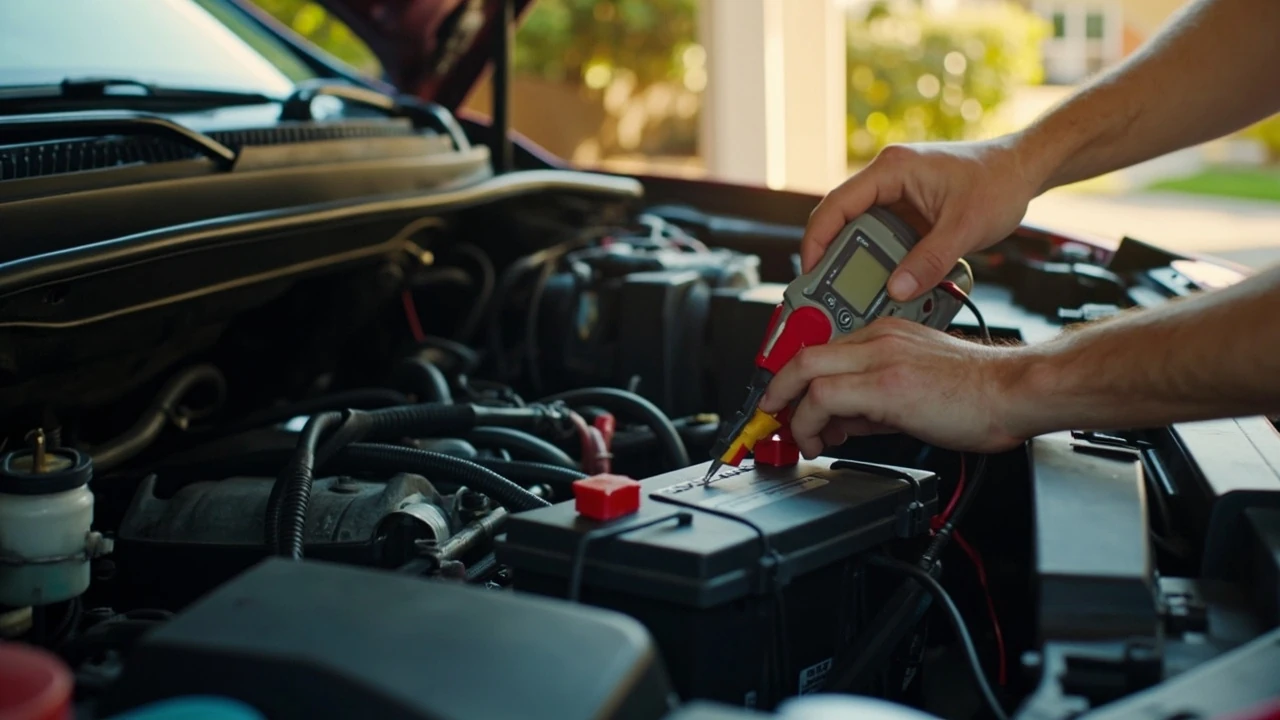
How to check car battery health at home before it strands you
A weak battery rarely gives a warning. One morning you turn the key, the dashboard lights flicker, the starter clicks lazily, and the engine refuses to turn over. Most drivers first think about the battery only when it fails, but a few minutes of testing once or twice a year will tell you whether the battery is still reliable or quietly approaching the end of its service life. Learning how to check car battery condition yourself saves a service appointment, helps you decide whether a no-start is a battery problem or something else, and prevents the surprise of being stuck in a parking lot.
This guide walks through the practical checks any driver can do at home with basic tools, the readings that actually matter, and the warning signs that mean the battery should be replaced rather than recharged. It also covers common battery problems that mimic a bad cell, so you can avoid buying a new battery when the real issue is a slow drain or a tired alternator.
What a car battery actually does
A standard 12-volt automotive battery is not a fuel source. It is a reservoir of chemical energy whose only job at the moment you start the car is to deliver a short, high-current burst to the starter motor. Once the engine is running, the alternator takes over and powers the vehicle’s electrical systems while also recharging the battery for the next start.
Inside the hard plastic case are six cells, each producing about 2.1 volts, connected in series to make roughly 12.6 volts when the battery is fully charged. The cells are filled with a dilute sulfuric acid solution and contain lead plates. When you turn the key, the acid reacts with the plates to release electrons, and the chemical reaction reverses as the alternator pushes current back in.
Three things follow from that chemistry, and they explain every check below:
- A healthy, fully charged battery holds a stable voltage between roughly 12.4 and 12.7 volts at rest.
- Each cell that fails or sulfates drags the whole pack down, so weak cells show up as low resting voltage or a fast voltage drop under load.
- Cold temperatures slow the chemical reaction, which is why a borderline battery often fails on the first cold morning of the season.
Tools you need to check a car battery
You do not need a mechanic’s shop to do a useful test. Most of what matters can be measured with a small digital multimeter, a basic hydrometer for flooded batteries, and a pair of safety glasses. Optional but useful items include a battery load tester, a memory saver for the car’s electronics, a wire brush for cleaning terminals, and a pair of mechanic’s gloves.
| Tool | What it measures | Approximate cost | When you need it |
|---|---|---|---|
| Digital multimeter | Resting voltage, charging voltage | Low, often under 30 dollars | Every check, the core tool |
| Battery load tester | Voltage under simulated load | Moderate, often 40 to 100 dollars | Suspicion of weak cells |
| Hydrometer | Specific gravity of cell electrolyte | Low | Only for serviceable flooded batteries |
| OBD-II code reader | Stored fault codes, battery voltage on some vehicles | Moderate | Useful after a no-start or jump start |
| Memory saver | Preserves radio presets and modules | Low | Only when disconnecting the battery |
A multimeter is the one tool worth owning. A 20-dollar unit is enough to spot a bad battery, a bad alternator, and a parasitic drain with reasonable accuracy.
Safety steps before you touch the battery
A lead-acid battery stores a serious amount of energy and contains corrosive acid. The list below is short because the risks are real, not because the steps are decorative.
- Park on a level surface, turn off the ignition, remove the key, and switch off all lights and accessories.
- Open the hood and let the engine cool if you have just driven. A hot engine bay raises the risk of burns and of igniting hydrogen gas that batteries can vent.
- Put on safety glasses and gloves. Even sealed batteries can leak a small amount of acid around the terminals.
- Remove metal jewelry, especially rings and bracelets, that could contact both terminals at once and short the battery.
- Identify the positive and negative terminals. The positive is marked with a plus sign and usually a red cover, the negative with a minus sign and a black cable.
- Work in a ventilated area. A small amount of hydrogen can build up around a battery, and a spark near the terminals can ignite it.
How to check car battery voltage with a multimeter
The first and most useful measurement is resting voltage. Set your multimeter to DC volts on the 20-volt scale, touch the red lead to the positive terminal, and touch the black lead to the negative terminal. Hold the probes steady, and read the display.
For the reading to be meaningful, the car needs to have been off for at least a few hours, ideally overnight. A surface charge from recent driving can mask a weak battery by inflating the voltage for a short time. If you have just driven, leave the hood open, turn the headlights on for about a minute to burn off the surface charge, then wait another ten minutes before measuring.
| Resting voltage (12V battery) | State of charge | What to do |
|---|---|---|
| 12.6 V or higher | Fully charged, about 100 percent | No action needed unless the car struggles to start |
| 12.4 to 12.6 V | Around 75 to 90 percent | Charge the battery and recheck in a day |
| 12.2 to 12.4 V | Around 50 to 75 percent | Charge the battery and look for a parasitic drain |
| 12.0 to 12.2 V | Around 25 to 50 percent | Battery is heavily discharged and may be sulfated |
| Below 12.0 V | Discharged, possibly damaged | Charge, then test under load before trusting the battery |
| Below 11.8 V after a full charge | Likely a bad cell | Replace the battery |
A reading below about 12.4 volts after the car has been sitting is the first sign something is wrong. A reading below 12.0 volts after a full overnight charge is a strong signal that the battery is no longer holding capacity.
How to do a load test on a car battery
Voltage alone does not tell the whole story. A battery can show 12.5 volts at rest and still collapse when the starter pulls hundreds of amps through it. A load test simulates that demand and reveals weak cells that pass a static check.
You have two practical options for a load test at home.
- Use a dedicated battery load tester. A good unit lets you apply a calibrated load, usually half the battery’s cold cranking amp rating, for about 10 to 15 seconds, then reads voltage under load. Most home testers are simple and forgiving.
- Use the car’s starter as a load. With the engine off, headlights on high beam and the heater fan on high, turn the key to crank for no more than 10 seconds. Watch the multimeter during the cranking. The battery should not drop below about 9.6 volts during the test.
For a true 10-second carbon pile load test, the battery should stay above roughly 9.6 volts at 70 degrees Fahrenheit. If it drops below that, especially on a warm day, the battery cannot deliver starter current reliably. Bridgestone’s overview of how to test and replace a dead car battery explains how a weak or aged battery tends to fail and why load behavior is a better signal than voltage alone.
Bring the battery to a full charge before any load test. Testing a discharged battery just confirms that it is discharged, not whether it is still good.
How to test charging system voltage with the engine running
Once the engine is running, the battery is no longer the only source of power, so the multimeter reading changes. A healthy charging system holds the battery between roughly 13.7 and 14.7 volts at idle with most accessories off. This is the easiest way to check whether the alternator is doing its job.
- Start the engine and let it idle with the headlights and blower off.
- Read the battery voltage at the terminals.
- Turn on the headlights, the rear defroster, the blower on high, and the heated seats if equipped.
- Read the voltage again. The reading should stay above about 13.5 volts even with the load.
Readings below 13.5 volts at idle usually mean the alternator is undercharging, the belt is slipping, or there is a voltage drop in the cables. Readings above about 15 volts point to a regulator problem and risk cooking the battery and the electronics. The For additional context, Wikipedia entry on automotive batteries describes the role of the alternator in recharging the battery and the way the charging voltage is regulated to extend battery life.
How to inspect the battery physically
Voltage numbers can look perfect on a battery that is mechanically compromised. A careful visual and tactile inspection takes only a few minutes and often finds the real problem.
- Look at the case. Bulges, cracks, or a wet film on top suggest the battery has overheated, frozen, or vented. Replace it immediately.
- Check the terminals. A white or bluish powdery crust around the posts means corrosion. Heavy corrosion adds resistance and can hide a healthy battery behind a bad connection.
- Test for movement. With the engine off, try to wiggle the battery in its tray. A battery that rocks can crack internally from vibration and should be secured or replaced.
- Inspect the hold-down. A loose clamp lets the battery shift, which shortens its life and can damage the case.
- Look at the vent tubes on flooded batteries. They should be connected and routed away from the cabin or the engine bay.
Clean any corrosion with a paste of baking soda and water, a wire brush, and a rag. Disconnect the negative cable first and reconnect it last so a dropped wrench cannot short the positive terminal to ground.
How to test a flooded battery with a hydrometer
Sealed AGM and gel batteries do not allow access to the electrolyte, so the following test applies only to older flooded batteries with removable cell caps. A hydrometer measures the specific gravity of the electrolyte, which is a direct read on the state of charge of each cell.
- Remove the cell caps and set them somewhere clean.
- Squeeze the bulb of the hydrometer, insert the tip into the first cell, and release to draw up enough liquid to float the internal float.
- Read the float level at eye level and record the value for that cell.
- Return the electrolyte to the same cell and move to the next one.
| Specific gravity reading | Cell state of charge | What it means |
|---|---|---|
| 1.265 or higher | Fully charged | Healthy cell |
| 1.225 to 1.265 | About 75 percent | Charge and recheck |
| 1.190 to 1.225 | About 50 percent | Charge and look for a drain |
| 1.155 to 1.190 | About 25 percent | Deeply discharged, may be sulfated |
| Below 1.155 | Discharged | Charge fully, then test again |
| Cell differs by more than 0.050 | Weak or shorted cell | Replace the battery |
If one cell reads dramatically lower than the rest, that cell is failing. Once a single cell goes, the rest of the battery will follow, usually within weeks.
Warning signs that point to a failing battery
Numbers from a multimeter or a hydrometer tell you the state of the battery at one moment. Day-to-day driving tells you whether it is still doing its job. The list below is what to pay attention to, especially as temperatures drop.
- Slow cranking, where the starter sounds labored or the engine turns over more slowly than it used to.
- Clicking when the key is held in the start position, with no crank.
- Dim headlights that brighten with engine speed, which can mean a weak battery or a weak alternator.
- Dashboard battery or charging system warning lights that come on while driving.
- Swollen battery case, strong sulfur or rotten egg smell, or visible leaks.
- Electrical accessories resetting or the clock losing time after the car sits for a few days.
- A battery older than about four to five years in a hot climate or five to six years in a temperate climate.
Common battery problems that look like a bad battery
Sometimes a battery reads weak because something else is pulling it down. Replacing the battery in those cases only delays the same no-start by a few days.
- Parasitic drain. A glove box light, a stuck relay, an aftermarket accessory, or a faulty control module can keep drawing current after the car is parked. A normal drain is around 20 to 50 milliamps, enough to flatten a battery in a couple of weeks.
- Loose or corroded ground straps. A poor ground at the engine block or chassis can mimic a weak battery by limiting the current that reaches the starter.
- Slipping serpentine belt. A belt that does not grip the alternator pulley will undercharge the battery and trigger the same symptoms as a failing alternator.
- Failed alternator diode. A bad diode can slowly drain the battery overnight even when the car is off, because current leaks back through the alternator.
- Frequent short trips. Starting the car uses a noticeable amount of energy, and short drives do not give the alternator enough time to put it back. Over weeks, the battery can drift into a chronically undercharged state and sulfate.
If a new battery goes flat within a couple of weeks, suspect a parasitic drain rather than a defective battery. A simple way to find one is to put a multimeter in series with the negative battery cable and start pulling fuses one at a time. The circuit that drops the current the most is the one with the drain.
How often to test a car battery
Most batteries give some warning before they fail, but the warning can be a single slow crank. A reasonable schedule catches problems before they leave you stranded.
- Check resting voltage once every three months on a battery that is more than two years old.
- Test before and after summer, since heat accelerates internal corrosion and shortens battery life.
- Test before a long road trip, especially if the car will sit in extreme cold or heat.
- Test any battery that has been deeply discharged, including one that needed a jump start, before trusting it again.
- Replace any battery older than about five years unless it has been recently load tested and holds its voltage.
Frequently asked questions
What is a healthy voltage for a car battery at rest?
A fully charged 12-volt automotive battery should read between about 12.4 and 12.7 volts after the car has been off for several hours. A reading consistently below 12.4 volts means the battery is undercharged, and a reading below about 12.0 volts after a full charge points to a failing cell.
How long should a car battery last?
Most modern batteries last between four and six years in temperate climates and three to five years in hot climates. Heat, vibration, frequent short trips, and chronic undercharging all shorten that range. Load testing once a year tells you where the battery sits inside that window.
Can a car battery be bad even if it reads 12.5 volts?
Yes. Resting voltage only shows the state of charge, not the battery’s ability to deliver current under load. A battery with a weak cell can show 12.5 volts at rest and collapse to 8 volts the moment the starter engages. That is why a load test is a more reliable indicator of a battery’s health than a static voltage check.
How do I tell whether the problem is the battery or the alternator?
Measure the voltage at the battery with the engine running. A healthy alternator holds the system between roughly 13.7 and 14.7 volts. A reading below about 13.5 volts usually means the alternator is undercharging, while a reading above about 15 volts points to a regulator problem. If the car starts fine but dies shortly after, the alternator is the more likely culprit.
Is it safe to test a car battery in the rain?
Light drizzle is not a problem on its own, but standing water on the battery or the terminals is. A wet surface can create a path for current and increase the chance of a short. If the engine bay is wet, dry the top of the battery and the terminal area before connecting a meter or load tester.
Do I need to disconnect the battery to test it?
For a voltage or load test, no. You can measure voltage across the terminals with the cables still attached. Disconnect the battery only if you are cleaning terminals, replacing the battery, or doing a parasitic drain test, where you want to put the multimeter in series with the negative cable.
What does the battery warning light on the dashboard actually mean?
The battery light is tied to the charging system, not just the battery. It usually means the alternator is not putting out enough voltage, the serpentine belt is slipping, or there is a significant voltage drop in the wiring. A working battery will still light the dashboard when the engine is running, so do not assume the battery itself is the problem.
Can a battery read 12 volts and still be good?
Possibly, but only if the surface charge has been removed and the battery was recently charged. A resting reading right at 12.0 volts means the battery is around 25 percent charged and needs a slow charge before it is reliable. A battery that reads exactly 12.0 volts after sitting overnight and a full charge has lost capacity and is a candidate for replacement.
How do I find a parasitic battery drain?
With the car fully asleep, including the doors closed and the key out of the ignition, connect a multimeter set to milliamps in series with the negative battery cable. A normal draw is roughly 20 to 50 milliamps. Pull the fuses one at a time and watch the meter. The circuit that drops the reading the most is the one feeding the drain, and the components on that circuit are the next things to inspect.
When should I replace the battery instead of charging it?
Replace the battery if it is more than about five years old, if it drops below roughly 9.6 volts during a load test, if the case is swollen or leaking, if one cell reads very different from the others, or if it goes flat again within a few days of a full charge with no obvious drain. A weak battery that will not hold a charge is a reliability risk, and a new battery is cheaper than a tow.

Leave a Reply