

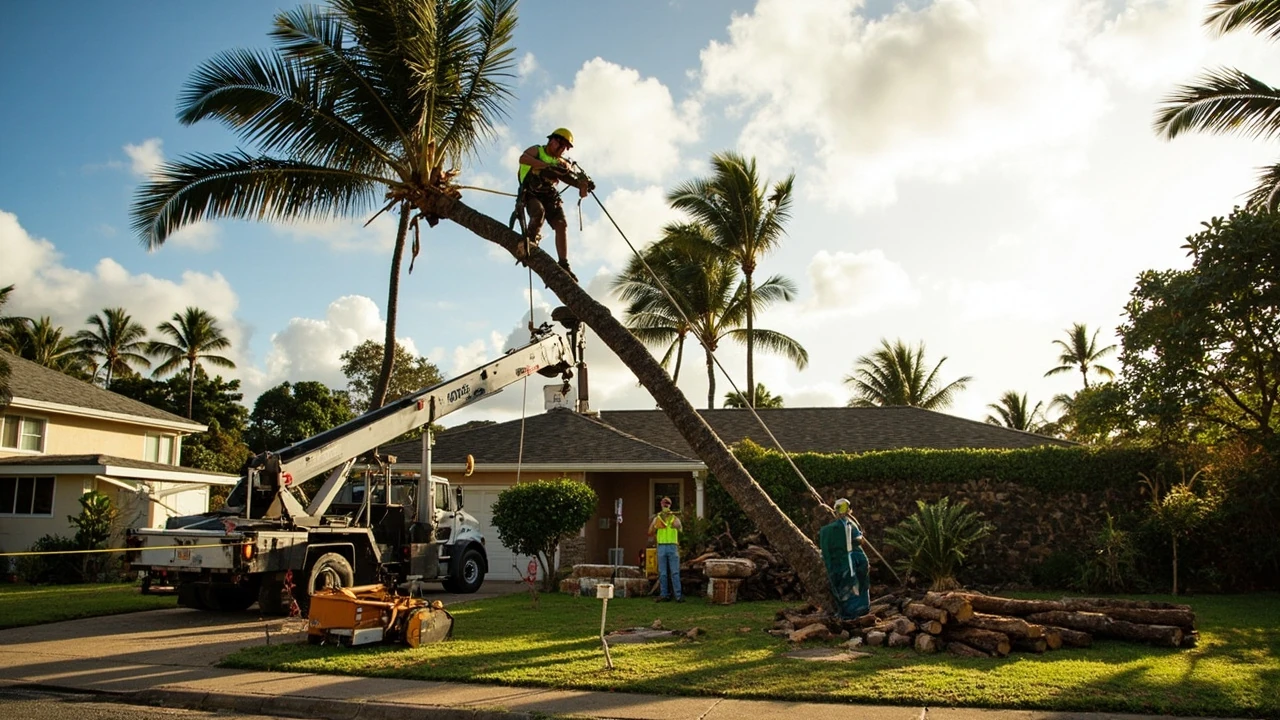
Large tree removal in Honolulu: what actually drives the job
A 60-foot monkeypod dropping limbs across a Hilo driveway. A leaning albizia threatening a neighbor’s roof in Kaimuki. A storm-split Norfolk pine hanging over a power line in Hawaii Kai. On Oahu, the trees that draw the most urgent calls are not the small ornamentals in a planter, but the large, mature specimens that have grown into the structures, utilities, and sidewalks around them. When homeowners search for help with large tree removal in Honolulu, they usually already know the tree has to come down. What they need is a realistic picture of what the job involves, what it costs, and how to avoid a dangerous or overpriced outcome.
This guide walks through how professional crews approach a large tree in an island urban setting, what drives the final bill, the permits and utility coordination that Honolulu jobs require, and the safety and property decisions that change a quote from “cut and haul” to a multi-day engineered lift. It is written for a homeowner or property manager evaluating options, not for a climber choosing rigging hardware. The goal is to help you ask the right questions before you sign anything.
What counts as a “large” tree on Oahu
Tree service companies on Oahu generally classify jobs by canopy size, trunk diameter, and the equipment required. A small job is a hand-pruned plumeria or a coconut haul at the front of a lot. A large job is anything that needs a bucket truck, a crane, sectional dismantling, or coordinated utility shutoffs. Common species that fall into the large category include:
- Albizia (Falcataria moluccana), the fast-growing nitrogen-fixer that frequently reaches 80 to 100 feet and tends to self-prune in trade winds.
- Monkeypod (Samanea saman), with a broad, heavy canopy that can spread 100 feet across mature specimens.
- Norfolk Island pine, planted as a windbreak but capable of topping 100 feet and shedding large limbs without warning.
- Ficus (often Ficus benjamina or Ficus microcarpa), whose aggressive surface roots and dense wood make removal a structural problem as much as a tree problem.
- Rainbow shower tree, mango, lychee, and other large fruitwoods that are common in older Honolulu neighborhoods.
If your tree is over about 40 feet tall, has a trunk diameter larger than 18 inches, or sits within striking distance of a structure, utility, or right-of-way, you are firmly in the large-removal category. That distinction matters because it changes the crew size, the equipment on site, the time on site, and the insurance exposure for the company you hire.
How Honolulu crews price a large removal
Most Oahu tree services price large removals on a per-foot-of-height basis, then adjust for complexity. A widely used local benchmark, as published in the standardized rate sheet for tree removal on the island, is an average of $150 per foot of tree height, with the final figure depending on the tree’s condition, accessibility, and the scope of work. That figure covers the standard removal itself; stump work, hauling, and crane fees are typically itemized separately.
For a clearer picture, the table below shows how a typical island crew breaks down the components of a quote, using a 60-foot hypothetical tree as the baseline.
| Component | What it covers | Typical pricing model on Oahu | What changes the number |
|---|---|---|---|
| Removal itself | Sectional dismantling, rigging, ground crew, debris handling | Per foot of tree height (around $150/ft for large trees as a starting reference) | Canopy width, wood density, dead or hollow sections, leaning bias |
| Stump removal or grinding | Excavation or grinding below grade, backfill, haul-out | Per square foot of stump surface (around $180/sq ft in standardized local pricing) | Root spread, presence of utilities, access for the grinder |
| Crane or bucket truck | Boom lift to lift heavy sections clear of structures | Flat mobilization fee, often $1,000 to several thousand depending on reach | Overhead clearance, street closure needs, lift height |
| Permit and utility coordination | City permit fees, 811-style utility locates, traffic plan if needed | Pass-through cost plus coordination time | Right-of-way, protected tree status, arterial road frontage |
| Hauling and disposal | Chipping, log hauling, green-waste drop | Per load or bundled into the removal price | Volume, distance to green-waste site, mixed debris |
Stump work deserves special attention. A large albizia stump in a front yard is rarely a one-pass grinder job. Crews typically hand-dig or air-spade around the surface roots to expose utilities, then either grind to 12 to 18 inches below grade or excavate the full stump. If you are replanting the same spot with a smaller species, ask the estimator to price full stump removal rather than grinding; the cost difference is usually less than people expect, and the replanting results are better.
Permits, utilities, and Honolulu-specific rules
Honolulu removed its general tree-cutting permit in 2022 for most private property work, but the city still regulates trees in several situations. Before any crew sets up, the following issues need to be checked:
- Protected or exceptional trees. Some species, including exceptional monkeypod and exceptional banyan trees on private property, retain special protections. A protected tree can be removed only with a permit that requires documented reason and sometimes a replacement tree.
- Street trees and right-of-way trees. If the trunk is on the property line, if branches extend over the sidewalk, or if the tree sits in a City right-of-way, a separate permit and a traffic control plan are usually required.
- Utility proximity. Large removals near HECO lines or telecom lines require coordination with the utility. Many local companies will contact locators as part of their own workflow, and the local utility has published guidance on safe distances when working near energized lines.
- Shoreline, SMA, and conservation districts. Properties near the shoreline or within the Special Management Area may face additional review.
- Historic district overlays. Some older neighborhoods in Honolulu have design and landscape rules that affect even routine tree work.
Reputable Honolulu tree services will not start cutting until they have cleared these issues. If a contractor offers to “just take care of the permit” for a protected tree without a documented hardship, that is a red flag. Similarly, any job that requires a bucket truck within ten feet of an energized HECO line should involve the utility in the planning conversation, not just on the morning of the work.
Safety: what a real large-tree job looks like
Large tree removal is one of the most dangerous jobs in the U.S. private sector. Arborist fatalities are dominated by struck-by and electrocution incidents, and Honolulu adds trade winds, soft volcanic soils, and tight urban lots to the standard list of hazards. A professional crew on a large Oahu job will typically:
- Set a drop zone with cones, tape, or rope, and station a ground person whose only job is to keep people out of it.
- Pre-cut tie-in points and plan the order of section removal so that the tree’s center of gravity shifts in a controlled way.
- Use a ropesaw or hand saw for the final cuts, never a chainsaw alone, when the climber is in the canopy.
- Coordinate a crane operator and a rigger when sections are too heavy or too close to structures to lower by rope.
- Chip on site where possible, and haul logs in covered loads to prevent debris on the street.
From a homeowner’s perspective, the visible difference between a safe crew and a risky one is planning. A safe crew walks the site with you, points out what is going to happen to the fence, the lawn, and the parked car, and is willing to stop the work if wind picks up. A risky crew shows up with a chainsaw and a chip truck and starts cutting. If anything on site feels improvised, ask questions.
Questions to ask before you sign an estimate
A good Honolulu tree service will answer all of these without hesitation. If a contractor is vague, keep shopping.
- Are you licensed and insured for tree work in Hawaii, and can I see a certificate of insurance that names me as additional insured for this job?
- Who is the certified arborist on the crew, and what is their ISA certification number?
- How will you protect my roof, my neighbor’s fence, and the lawn during the lift?
- What is your plan if the trunk is hollow, or if the tree leans toward the house once top weight is removed?
- Who is responsible for the permit, and is that cost in the written quote?
- What happens to the wood? Can I keep logs for a mill, or is everything hauled?
- How long will the crew be on site, and what hours will the work happen?
- What is the warranty on the stump removal if it resprouts?
Two of those questions deserve a second look. First, insurance: a tree falling on a house is the kind of claim that ends small companies. The contractor’s general liability should specifically cover arborist operations, and workers’ comp is non-negotiable on a crew. Second, the resprouting warranty: albizia, Ficus, and several other large Honolulu species will regrow from cut stumps. A responsible company will either guarantee a treatment, price the stump removal to a depth that prevents regrowth, or both.
How to read a Honolulu estimate line by line
Most island estimates for large removals follow the same structure, but the wording varies. The table below shows how a typical line item reads versus what to ask about it.
| Line item on the estimate | What it should specify | What to ask if it is vague |
|---|---|---|
| Tree removal | Species, height, and diameter class | “Is this price based on a 60-foot tree with a 24-inch trunk, or is it open-ended?” |
| Sectional dismantle | Crane or rope-only, and section size limit | “What is the heaviest section you plan to lift over my roof?” |
| Stump grinding or removal | Grinding depth, or full excavation, and backfill | “Does this include grinding to 18 inches below grade, or only surface?” |
| Haul and disposal | Volume included, wood kept on site, green-waste destination | “Can I keep the trunk rounds for a neighbor’s project?” |
| Permit fees | Pass-through of city fee plus coordination time | “Is this a city fee you are passing through, or your time to file?” |
| Mobilization | Crane, bucket truck, chip truck | “If the crane is not used, is this refundable?” |
For a real cross-check, a published Oahu pricing reference describes how the standardized rate per foot of height is set, how stump work is calculated by square footage, and how bulk work is treated differently from single-tree jobs. Reading that kind of published rate sheet in advance gives you a way to test whether an estimate is in the right ballpark for your specific tree.
What Honolulu homeowners most often get wrong
Three mistakes come up again and again on Oahu removals.
1. Waiting for the storm. Albizia and Norfolk pine do not give much warning before a failure. If a neighbor’s tree has been dropping limbs in light wind, that is the time to act, not the day the gusts hit 35 mph.
2. Pricing the stump as an afterthought. A grinder-only job at a low price is often a grinder-only job at a low price, with a 12-inch grind and a resprouting Ficus three years later. Either price full removal, or price treatment.
3. Hiring a handyman for a large tree. This is the single most expensive mistake. A handyman crew that climbed a 70-foot albizia with a 24-inch bar and no rigging created exactly the kind of claim that makes insurance rates climb for everyone. Large tree removal belongs to companies that carry arborist-specific insurance and have a real training pipeline.
Special cases: protected species, big Ficus, and power lines
Some large-removal jobs in Honolulu have unusual complications that change both the price and the timeline.
- Protected exceptional trees. An exceptional tree, defined by the city based on species, size, and condition, requires a permit even on private property. The application is public, and the replacement requirement is part of the deal. Expect a longer lead time and a clear written plan from the contractor.
- Mature Ficus. Ficus roots travel under foundations, driveways, and retaining walls. The temptation is to leave the stump, but a Ficus left in the ground can damage masonry within a few years. Plan for full stump removal, and ask the contractor to map visible roots before cutting.
- Trees near HECO lines. The local electric utility publishes minimum approach distances, and any line work requires coordination. In practice, the safest path is a planned outage or a fully insulated lift plan agreed in writing with the utility before the day of the work.
- Shoreline lots. A tree on a beachfront property may need a separate county review under Special Management Area rules, especially if access for a crane crosses environmentally sensitive areas.
A simple timeline for a typical large removal
Most Honolulu homeowners underestimate how long a large tree job takes from first call to finished stump. A realistic schedule for a 60-foot tree on a standard lot looks like this:
- Day 1 to 5: Initial call, site walk, and written estimate from one or more companies.
- Day 5 to 15: Permit filing, utility coordination, crane scheduling, and a final go-date.
- Day of removal: Crew on site by 7 a.m., crane if needed, sectional dismantle over 4 to 8 hours, chip and haul the same day.
- Within a week: Stump grinding or removal, backfill, and final walkthrough.
- Two to four weeks later: Replanting, irrigation, and lawn repair, if included in the scope.
If a contractor offers to start tomorrow on a large job that needs a crane and a permit, that is not efficiency. That is corner-cutting. Build in a two- to three-week lead time and you will get a safer, more organized job.
How to compare two Honolulu estimates fairly
When the prices on two estimates are very different, the difference is almost always in scope. To compare them properly, put both quotes side by side using the same line items.
- Confirm both quotes name the same tree, by species, height, and trunk size.
- Confirm both include sectional dismantle, not just “top the tree.”
- Confirm both list stump work to the same depth.
- Confirm both include haul and disposal of all debris.
- Confirm both name the same permit responsibility.
- Confirm both carry the same level of insurance.
Once the scopes match, the price difference usually comes down to crew experience, equipment, and how busy the company is. A higher price from a company that has done your specific species in your specific neighborhood is often the better long-term value, because they will not be guessing on the lift plan.
What to do on the day of the work
On the morning of the job, plan to be off-site or in a designated safe area with children and pets. Move vehicles out of the driveway and away from the street in front of the house. Roll up any exterior shades, and let the crew know about anything fragile inside the house near the wall closest to the tree; vibration from a crane or a heavy drop can shift pictures and shelves. Make sure the crew has a working outdoor outlet if they need one, and that any gate codes are shared in advance.
Most important, do not direct the crew. A large tree removal is a choreographed sequence, and even a small change in the order of cuts can change the lift plan. If something looks wrong, raise it with the lead climber or the project manager, not with the ground person running the chipper.
After the tree is down
The work is not over when the last log is hauled. A few practical follow-ups protect your property:
- Walk the lawn with the crew lead and look for ruts, torn irrigation lines, and damaged plant material. Photograph anything that needs repair.
- Confirm the stump depth in writing if the stump was ground or removed, so you know what you can plant on top.
- Ask for a copy of the final invoice that matches the estimate. If the scope changed on site, the change order should be written, not verbal.
- Watch the stump area for regrowth. A Ficus or albizia resprout within a season means the original job did not go deep enough; call the company back under the warranty.
- Replant within a year. A bare lot in Honolulu quickly becomes a weed lot, and invasive species move in fast.
Choosing the right Honolulu company for your job
The best contractor for a large Oahu tree is rarely the cheapest bid, and rarely the largest national brand. The right match is a company that:
- Is based on Oahu and works Honolulu-specific trees regularly.
- Employs at least one ISA-certified arborist and carries arborist-specific insurance.
- Owns or has reliable access to a crane and a bucket truck of the right size for your tree.
- Has handled protected-tree permits, utility coordination, and shoreline reviews before.
- Writes a clear scope and stands behind the stump work with a written guarantee.
Ask for references from jobs of similar size and species in your neighborhood. A crew that did a 70-foot albizia in Kaimuki will handle your situation with fewer surprises than a crew whose last big job was a 30-foot mango in Mililani.
Frequently asked questions
How much does large tree removal in Honolulu usually cost?
Most local companies price large removals on a per-foot basis, with a commonly cited starting reference around $150 per foot of tree height for the removal itself. Stump work is typically itemized separately, often by square foot of stump surface. The final price depends on species, height, canopy spread, access, and whether a crane is required.
Do I need a permit to remove a large tree from my yard in Honolulu?
For most private lots, a general tree-cutting permit is no longer required. However, protected or exceptional trees, trees in the City right-of-way, and trees in shoreline or historic districts still require permits. Your tree service should confirm the rules for your specific property before work begins.
Can a large tree be removed without a crane?
Sometimes. Rope-only sectional dismantle is possible when the tree has open space to fall into, no structures in the line of drop, and sections light enough to control with rigging. Trees over about 50 feet, with heavy limbs close to a house, or with dense wood like mature mango almost always need a crane for safety reasons.
How long does a large tree removal take?
Plan for one full day on site for the dismantle and chip work, and a separate visit within a week for stump grinding or removal. The total lead time from first call to finished job is usually two to four weeks, longer if a permit or crane is required.
Who is responsible for utility coordination?
Your contractor is. A reputable Honolulu tree service contacts underground utility locators, and coordinates with HECO for any work near overhead power lines, before the day of the work. This should be part of the written estimate, not an extra charge that appears on the morning of the job.
Will my homeowners insurance cover the removal if the tree fell on the house?
That depends on your policy and the cause. Storm damage from a named event is often covered, while removal of a healthy or declining tree as preventive maintenance typically is not. Check with your insurance carrier, and save any photos of prior damage before the work begins.
What happens to the wood after the tree is cut down?
Most Honolulu crews chip the branches on site and haul the chips and logs to a green-waste facility. If you want to keep rounds for a neighbor’s milling project, or firewood for a luau pit, ask before the work begins. It is easier to set aside logs on day one than to retrieve them from a green-waste site later.
How do I know whether the stump should be ground or fully removed?
Grinding to 12 to 18 inches below grade is enough for most replanting situations, but species that resprout from the stump, including Ficus, albizia, and several others, need deeper removal or chemical treatment. If the spot will host a new tree, ask the estimator to price full stump removal rather than grinding.
Is it safe to keep part of the tree as a habitat feature?
Leaving a tall snag can be valuable for native birds, but in an urban Honolulu yard it is usually a liability. If you want a habitat element, talk to your arborist about leaving a short, secured trunk section with a flat top rather than a tall standing snag.
What is the best time of year to schedule large tree removal in Honolulu?
Honolulu’s climate is mild year-round, so the work is not seasonal. The busier periods for island tree services are right after major windstorms and during the late-summer months. If your schedule is flexible, ask for a midweek slot in spring or early winter for the most availability and the most attention from the lead crew.

Leave a Reply