Smoke remediation: what it is and when a home needs it
When a kitchen grease fire, a forgotten candle, or years of indoor cigarette use leaves a house smelling stale and looking gray, the problem is rarely solved by opening a window and lighting a candle. The residue from combustion settles into soft surfaces, clings to paint, and migrates into the ductwork of the heating and cooling system, where it keeps releasing odor long after the original event. Smoke remediation is the professional process of identifying that residue, physically removing what can be cleaned, sealing what cannot, and restoring indoor air to a livable condition.
Homeowners usually reach this point after one of three events: a contained fire that produced visible soot, long-term indoor smoking that yellowed walls and left a pervasive smell, or a wildfire smoke intrusion that pushed outdoor particulates indoors for days. In each case, the goal is the same: remove the source of the odor, not just mask it. The work typically combines deep cleaning, surface sealing, air filtration, and, in severe cases, replacement of porous materials like carpet, padding, and drywall.
This article walks through what a typical smoke remediation project includes, how specialists decide what to clean versus what to replace, what affects the total price, and which questions are worth asking before signing a contract. It is written for homeowners weighing whether to attempt parts of the job themselves and for anyone comparing estimates from restoration companies.
How smoke damage actually behaves in a home
Smoke is not a single substance. It is a mixture of fine particles, gases, and vaporized compounds that change character depending on what burned. A grease fire in a kitchen produces oily, smearable soot that travels short distances and sticks aggressively to cold surfaces like windows and metal trim. A structural fire burning wood, plastics, and synthetic fabrics produces a finer, more acidic soot that penetrates paint, corrodes metals, and embeds deep into soft goods. Cigarette smoke deposits a sticky, yellow-brown residue that builds up slowly on ceilings, light fixtures, and upper walls because warm air rises.
Two physical behaviors make smoke hard to remove. The first is penetration: particles are small enough to work their way into fabric weave, carpet backing, and the paper facing of drywall, where household cleaners cannot reach. The second is recirculation: once residue reaches the return side of a forced-air system, every time the fan runs, the smell and the particles are pushed back out through the supply ducts. Cleaning walls without treating the HVAC system usually leaves the smell in place, which is why homeowners often think a job failed when the ductwork was simply skipped.
The three categories specialists use on site
Restoration professionals classify the residue by appearance, because the appearance tells them what burned and how aggressive the cleaning has to be.
- Dry smoke: Light, powdery residue from fast-burning, high-oxygen fires such as paper or wood. It wipes away more easily but spreads farther because the particles are so fine.
- Wet smoke: Smudgy, sticky residue from slow, smoldering fires with low oxygen, often involving plastics or rubber. It is harder to clean and tends to smear if the wrong solvent is used.
- Protein smoke: Nearly invisible residue from burned food, often the result of an overheated pan. It is the most common cause of a persistent, unpleasant odor in a kitchen after a fire that produced almost no visible damage.
Knowing which type is present determines the cleaning chemistry. Dry smoke responds to dry sponges and HEPA vacuuming. Wet smoke needs degreasers and sometimes wet wiping. Protein smoke is the reason a kitchen can smell burnt for weeks: the residue is essentially cooked onto every nearby surface, and only enzymatic or alkaline cleaners break it down reliably.
What a professional smoke remediation project includes
A complete job is staged, not a single visit with a spray bottle. The sequence exists because each step depends on the previous one being finished, and because skipping ahead tends to lock odor into surfaces that are then sealed in.
1. Assessment and scope
The crew walks the property, photographs affected rooms, checks the HVAC system, and tests porous materials for odor retention. The output is a written scope that lists what will be cleaned, what will be sealed, and what will be removed and replaced. Without a written scope, the cost discussion is hard to evaluate against another company’s bid.
2. Source control and ventilation setup
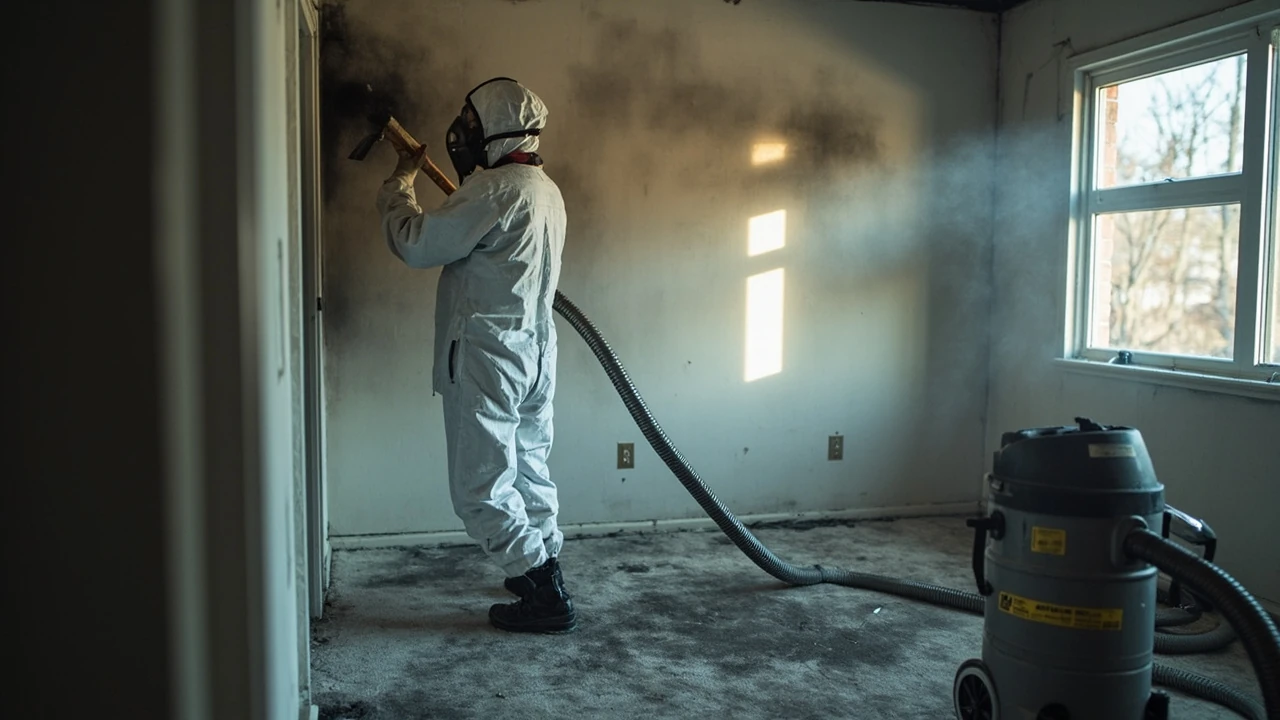
If the original cause is still active, such as a smoldering fire risk or ongoing occupant smoking, it has to be resolved before cleaning starts. Negative-pressure air scrubbers with HEPA filtration and activated carbon stages are positioned to capture airborne particles during the work. This is the difference between a real remediation and a cosmetic wipe-down.
3. Dry removal of loose soot
Before any liquid touches a soot-covered surface, the loose layer has to come off. Crews use dry cleaning sponges, HEPA vacuums with sealed hoses, and gentle brushing from top to bottom so particles do not fall onto already-cleaned areas. Attempting to wipe wet soot almost always smears it and embeds it deeper into the surface.
4. Wet cleaning of hard surfaces
Walls, ceilings, trim, and hard floors are cleaned with chemistry matched to the residue type. Degreasers handle wet smoke, alkaline detergents handle protein residue, and sealing primers are used on surfaces where odor remains after cleaning. Specialty sealants, often called odor-locking primers, are designed to trap residual smell and prevent it from bleeding through new paint.
5. Treatment of soft materials
Upholstery, curtains, and area rugs are evaluated piece by piece. Some can be cleaned in place with hot water extraction and deodorizing agents. Others, especially items exposed to wet or protein smoke, are usually removed for off-site cleaning or discarded. Carpet padding is rarely salvageable after significant smoke exposure because the foam absorbs and holds odor permanently.
6. HVAC cleaning
This step is often the most underestimated. A technician inspects the return and supply sides of the system, removes and replaces filters, and cleans accessible ductwork. In heavier contamination, the blower fan, evaporator coil, and interior of the air handler may need to be cleaned as well. Skipping this step is the most common reason a remediation fails the sniff test.
7. Air purification and deodorization
After cleaning, the space is treated with air scrubbers, hydroxyl generators, or ozone machines, depending on the company’s equipment and the situation. Each tool has trade-offs, which are discussed below. The goal at this stage is to oxidize the airborne odor molecules that no amount of surface cleaning can catch.
8. Sealing and re-finishing
If odor remains in walls after cleaning, a stain-blocking primer is applied before repainting. This is standard after a serious fire and is the difference between a room that smells clean a month later and one that does not.
What can be cleaned versus what should be replaced
A common question from homeowners is whether something is salvageable. The honest answer depends on the material, the smoke type, and how long the exposure lasted. The table below summarizes the typical decisions a restoration contractor makes on site.
| Material | Often cleaned successfully | Often replaced | Why |
|---|---|---|---|
| Painted drywall | Light, dry smoke | Heavy wet or protein smoke | Smoke penetrates the paper facing and the paint layer; if odor remains after cleaning, sealing primer alone may not be enough. |
| Hardwood floors | Dry smoke on sealed surfaces | Heavy residue, especially in grain | Soot settles into the grain and into gaps between boards; refinishing may be required. |
| Carpet | Light dry smoke within 48 hours | Wet smoke, protein smoke, or smoke older than a few days | Padding under the carpet almost always holds odor after serious exposure. |
| Upholstery | Synthetic fabrics, light exposure | Natural fibers, heavy exposure | Cellulose fibers absorb odor much more readily than synthetics. |
| HVAC ductwork | Sheet metal ducts, accessible runs | Old flexible ducting, heavily lined ducts | Porous internal liners trap residue; flexible ducting is often replaced rather than cleaned. |
| Electronics | Items professionally disassembled and cleaned | Devices with soot inside housings | Residue is acidic and can corrode boards over time if not removed. |
| Window glass and frames | Almost always cleanable | Rarely replaced | Glass is non-porous, but frames and seals may need detailed attention. |
The decision to replace is usually a cost-versus-result call. Cleaning a heavily damaged sofa is often possible, but the labor and chemistry can exceed the cost of reupholstering or replacing it. A good contractor will quote both options and let the homeowner choose.
How long the work takes
Most single-room jobs where the smoke source was small and contained take one to three working days. Whole-house remediation after a structural fire can run one to two weeks, especially if material replacement and repainting are involved. The variables are predictable:
- How many rooms are affected
- Whether the HVAC system needs cleaning
- How much material will be replaced
- Whether repainting is included
- Drying and ventilation time between cleaning stages
Homeowners should plan to be out of the work area during active treatment, especially if ozone or hydroxyl generators are used. Pets and children are typically kept away until the space is cleared and ventilated.
What affects the total cost
Costs for professional smoke remediation depend heavily on the size of the affected area, the type of residue, and how far the smoke traveled. According to HomeGuide’s smoke remediation cost guide, a full-home project commonly runs from a few thousand dollars for a contained, light-smoke situation to significantly more for severe fire damage. The breakdown below reflects the factors that move a quote up or down.
| Cost factor | Effect on price | Why it matters |
|---|---|---|
| Severity of residue | Higher | Heavy contamination needs more labor, chemistry, and often material replacement. |
| Square footage | Higher | Larger areas require more crew time, equipment, and product. |
| Type of smoke | Higher for fire and protein smoke | Wet and protein residues are chemically harder to remove than dry smoke. |
| Materials affected | Higher | Carpet, drywall, and soft goods often need special treatment or replacement. |
| HVAC contamination | Higher | Cleaning ductwork and replacing filters adds a measurable line item. |
| Urgency of service | Higher for emergency calls | After-hours or rapid-response work usually carries a premium. |
| Repair and repainting | Higher | Priming and painting walls is a separate scope from cleaning. |
Homeowners who receive an unusually low bid should ask what is excluded. A quote that does not mention the HVAC system, sealing primer, or content manipulation often does not include them, which usually means the smell will return within weeks.
Cleanup chemistry, briefly explained
It is worth understanding what is being used in your home, especially if anyone in the household has respiratory sensitivities.
- Surfactant-based detergents lift soot particles from hard surfaces so they can be wiped or rinsed away.
- Alkaline cleaners break down protein residue from kitchen fires and are often paired with a neutralizer to bring pH back to safe levels before repainting.
- Degreasers handle the oily film left by grease or wet smoke.
- Sealing primers are not cleaners. They encapsulate remaining odor in the wall so it does not bleed through paint.
- Oxidizing deodorizers include ozone, hydroxyl generators, and hydrogen-peroxide-based fogs. Each works differently, and the choice depends on whether the space can be safely vacated during treatment.
Most professional products are non-toxic once the area is ventilated, but pets and children should be kept out during active treatment. The contractor’s material safety data sheets should be available on request.
Air treatment: ozone, hydroxyl, and HEPA
These three tools are often confused, and companies sometimes use them interchangeably in marketing, but they do different things.
- HEPA air scrubbers physically capture particles. They do not eliminate odor molecules; they only remove the airborne particulates that carry them.
- Hydroxyl generators produce hydroxyl radicals that break down odor molecules. They are safe for occupied spaces at low output and are often used in restaurants and hotels.
- Ozone generators produce ozone, a strong oxidizer that destroys odor molecules quickly. They require the space to be unoccupied during treatment and to be ventilated before re-entry. Ozone is not safe for people, pets, or plants at treatment levels.
A reputable contractor explains which device is being used, why, and what the re-entry time is. If the answer is vague, ask for the equipment make and model and look up the manufacturer’s guidance.
What homeowners can reasonably do themselves
There is a sensible boundary between DIY steps and professional work. Light smoke from a small kitchen incident, addressed within hours, can often be handled with good ventilation, dry sponges, and a careful wipe-down of hard surfaces. The list below covers what is reasonable to attempt without a contractor.
- Ventilate the area by opening windows and running bathroom and kitchen fans.
- Vacuum upholstery and carpets with a HEPA-filtered vacuum, using a clean bag or empty canister.
- Wipe hard surfaces with a dry cleaning sponge before any liquid is applied.
- Clean glass and metal with a non-ammonia glass cleaner.
- Replace HVAC filters after the area is cleaned and aired out.
Anything beyond this list, especially work that involves sealing primer, duct cleaning, or treatment of items with significant soot, is usually a job for a trained crew. Mistakes at this stage, like wiping wet soot into a porous surface, often make the eventual professional job more expensive because the residue is now driven deeper.
What to ask a remediation contractor before signing
The estimate is only useful if it covers the same scope as the next estimate. A short list of standard questions helps compare bids fairly.
- What equipment will be on site, and is it rated for the size of the affected area?
- Does the scope include HVAC inspection and duct cleaning, or is that billed separately?
- Which materials are you proposing to remove and replace, and which will be cleaned?
- Will sealing primer and repainting be included if odor remains after cleaning?
- What deodorization method will be used, and how long must the home be vacant?
- Can you provide references from similar jobs, and proof of insurance and any required certifications?
- What is the written warranty on the work if the odor returns within a stated period?
These questions are useful not because contractors are dishonest, but because scope definitions vary widely. Two bids that look similar in price can cover very different amounts of work.
How smoke remediation relates to broader restoration work
Smoke remediation is a subset of property restoration, and the line between it and adjacent services is not always obvious. A house that has had a structural fire usually needs both fire damage restoration and smoke remediation, with the first covering structural repair and the second focusing on residue and odor. If you are comparing service categories, it helps to know what each is meant to handle.
Homeowners thinking about whole-property concerns beyond smoke can also review practical guides on related systems, like a homeowner’s guide to water main repair when plumbing damage is part of a larger loss, or a practical look at window glass replacement when glass and seals were damaged by heat. Each of these topics is a separate scope, but they tend to come up together after a serious house-level event.
Preventing future smoke problems
Once a home is clean, a few small habits keep it that way. These steps are not substitutes for remediation, but they reduce the chance of needing it again.
- Test smoke detectors monthly and replace batteries annually.
- Keep a lid and a fire extinguisher rated for grease fires within reach of the cooking area.
- Avoid smoking indoors, and if smoking does occur indoors, run the HVAC fan and open windows for at least an hour afterward.
- Change HVAC filters every one to three months, and sooner after any smoke event.
- Schedule a duct inspection every two to three years, more often if anyone in the home smokes or if wildfires are common in the area.
Frequently asked questions
What is the difference between smoke remediation and fire damage restoration?
Fire damage restoration covers structural repair after flames, including rebuilding framing, replacing drywall, and addressing water damage from firefighting. Smoke remediation focuses specifically on residue, soot, and odor, including the cleaning and deodorizing steps that restore livable air quality. A serious fire usually requires both.
Can smoke smell be removed without replacing drywall?
Often, yes. If the smoke exposure was light and the drywall was cleaned within a reasonable window, sealing primer and repainting can lock in residual odor without removing the drywall. Heavy wet or protein smoke usually requires replacement, because the paper facing of the drywall absorbs and holds the smell.
How long does smoke remediation take in a typical home?
Most single-room jobs take one to three days. Whole-house work after a significant fire commonly takes one to two weeks, especially when materials are being replaced and walls are being repainted.
Is ozone treatment safe for a home with pets and children?
During active ozone treatment, the home must be unoccupied, including by pets. After the treatment cycle finishes and the space is ventilated, ozone levels return to background and the home is safe to re-enter. The contractor should specify the re-entry time based on the equipment used.
Will homeowners insurance cover smoke remediation?
Coverage depends on the cause of the smoke and the specific policy. Damage from a sudden, accidental fire is typically covered under the dwelling portion of a homeowners policy. Long-term cigarette smoke is usually considered a maintenance issue and is not covered. Wildfire smoke intrusion policies vary by carrier and region.
Can I stay in the home during smoke remediation?
Usually no. The work involves chemicals, air scrubbers, and possibly ozone or hydroxyl treatment. The contractor will set clear re-entry times based on the products and equipment in use.
What is the difference between dry smoke and wet smoke?
Dry smoke comes from fast, high-temperature fires such as burning paper or wood, leaves a powdery residue, and is easier to clean. Wet smoke comes from slow, low-oxygen fires such as burning plastics or rubber, leaves a sticky smudgy residue, and requires more aggressive cleaning methods.
Why does the smell come back after cleaning if the HVAC system is not treated?
Residue lodged in ductwork and on the blower fan keeps releasing odor every time the system runs. Cleaning the rest of the home without addressing the air distribution system is the most common reason a remediation fails to hold.
How do I tell if a contractor’s bid is complete?
Ask whether the scope includes HVAC cleaning, sealing primer where needed, content manipulation, deodorization method and equipment, and any required repainting. A complete bid addresses all five; a vague bid often addresses only the visible surfaces.
How do I keep wildfire smoke from lingering indoors?
Keep windows and doors closed during heavy outdoor smoke events, run the HVAC fan with a high-MERV or HEPA filter, avoid using range hoods that pull outdoor air, and consider a portable HEPA air cleaner in the rooms where the household spends the most time. After the event, change filters and vacuum soft surfaces with a HEPA-filtered vacuum.

Leave a Reply